Which Is the Cleanest Fuel? Hydrogen, CNG and What 'Clean' Means
Hydrogen is cleanest because it produces only water. Among fuels in general use, CNG is the least polluting. Here is the full ranking.
Key takeaways
- Hydrogen is cleanest: the only combustion product is water.
- CNG is the least polluting fuel in common use, and the usual answer for vehicles.
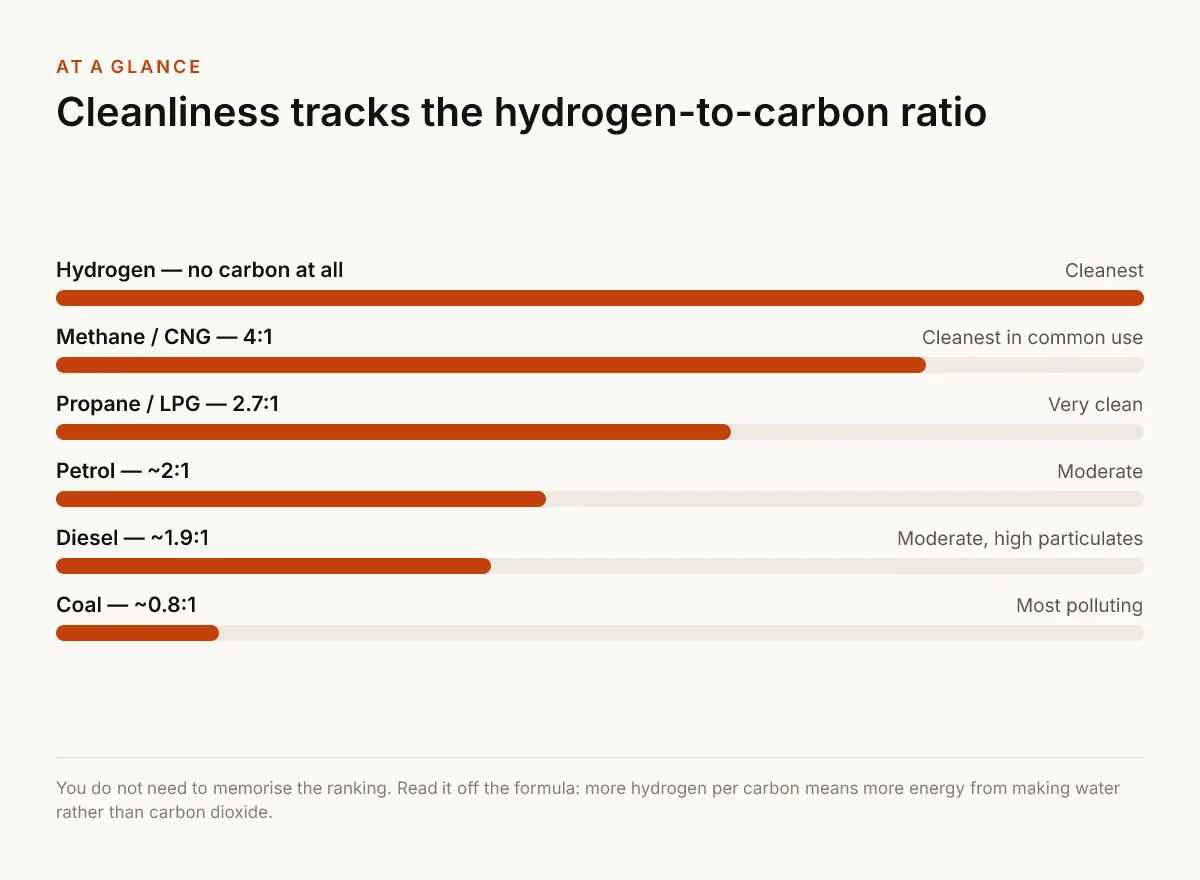
- The cleanliness ranking follows the hydrogen-to-carbon ratio of the fuel.
- Hydrogen's drawback is production and storage, not its emissions.
- Solid fuels — coal, wood, dung — are the most polluting.
This question has two correct answers depending on what is in the options, which sounds unfair until you see that both come from the same rule.
The rule is one ratio, and once you have it you can rank any fuel you are given, including ones nobody taught you.
#The ranking, and the rule behind it
| Fuel | CO₂ | CO | Particulates | SO₂ | Verdict |
|---|---|---|---|---|---|
| Hydrogen | None | None | None | None | Cleanest |
| CNG / natural gas | Low | Very low | Negligible | None | Cleanest in common use |
| LPG | Low | Very low | Negligible | None | Very clean |
| Biogas | Low net | Low | Negligible | Trace | Clean and renewable |
| Petrol | Moderate | Moderate | Low | Trace | Moderate |
| Diesel | Moderate | Low | High | Low | Moderate, high particulates |
| Kerosene | Moderate | Moderate | Moderate | Low | Moderate |
| Coal | High | High | Very high | High | Most polluting |
| Wood / dung | High | Very high | Very high | Low | Most polluting indoors |
The ordering is not arbitrary. It tracks the hydrogen-to-carbon ratio:
| Fuel | H:C ratio |
|---|---|
| Hydrogen | Infinite (no carbon) |
| Methane (CNG) | 4:1 |
| Propane (LPG) | 2.7:1 |
| Petrol | ~2:1 |
| Diesel | ~1.9:1 |
| Coal | ~0.8:1 |
| Wood | Low, plus high oxygen and moisture |
More hydrogen per carbon means more of the fuel's energy comes from forming water rather than carbon dioxide. That single ratio predicts the entire ranking.
#Why hydrogen is cleanest
2 H2 + O2 -> 2 H2O
That is the whole reaction. No carbon in, so no carbon out — no carbon dioxide, no carbon monoxide, no soot, no unburnt hydrocarbons. No sulphur, so no sulphur dioxide.
The one qualifier worth stating: burning hydrogen in air at high temperature still forms nitrogen oxides from atmospheric nitrogen, as any hot flame does. Hydrogen fuel cells avoid even this, because they generate electricity electrochemically without a flame, emitting only water.
#Why CNG is the practical answer
If a question lists petrol, diesel, kerosene and CNG, the answer is CNG. It is the cleanest fuel in general use because methane has the highest hydrogen-to-carbon ratio of any hydrocarbon, it is a gas that mixes thoroughly with air for complete combustion, and it contains no sulphur, lead or heavy aromatics.
The urban air quality benefit is dominated by particulates. Diesel vehicles are the major source of vehicle particulate matter; CNG vehicles emit almost none. That is why bus and taxi fleets in polluted cities were converted to CNG rather than to a different liquid fuel.
#The catch: clean where?
Any serious treatment has to separate two questions.
Clean at the point of use. Hydrogen wins outright. Nothing but water leaves the vehicle.
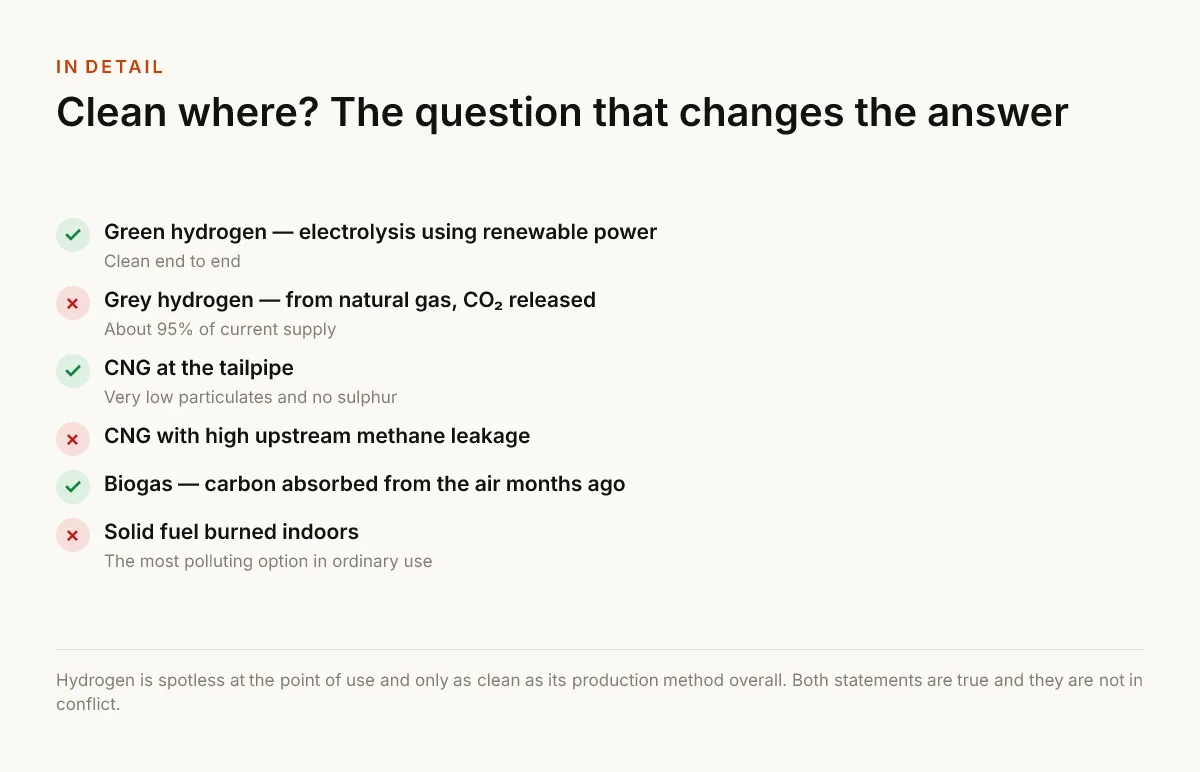
Clean over the whole life cycle. Hydrogen has to be made, and roughly 95% of commercial hydrogen today comes from steam reforming of natural gas, which emits carbon dioxide. Electrolysis using renewable electricity is genuinely clean but currently expensive and a small share of supply.
Hydrogen is therefore an energy carrier whose cleanliness depends entirely on how it was produced. The colour vocabulary that has grown up around this is useful:
- Grey hydrogen — from natural gas, CO₂ released
- Blue hydrogen — from natural gas with carbon capture
- Green hydrogen — from electrolysis using renewable electricity
Only green hydrogen is clean end to end.
The same life-cycle scrutiny applies to CNG, where the issue is methane leakage in the supply chain, and to biogas, which comes out well because its carbon was recently absorbed from the atmosphere.
#The most polluting end of the table
Worth stating because it is where the health burden actually falls: solid fuels burned indoors — wood, charcoal, crop residue and dung — are the most polluting fuels in ordinary use. They combine low calorific value with very incomplete combustion, releasing particulates, carbon monoxide and carcinogens directly into the space where people breathe.
The difference between the top and bottom of this table is not academic. It is the difference between a clean kitchen and one of the leading environmental causes of premature death worldwide.
The two ends of this ranking have their own guides: why hydrogen is not widely used despite being cleanest, and why natural gas is called a clean fuel despite not being green.
#The compact answer
Hydrogen is considered the cleanest fuel because it produces only water on combustion, with no carbon dioxide, carbon monoxide, smoke or sulphur dioxide. Among fuels in common use, CNG (compressed natural gas) is the least polluting, producing less carbon dioxide, carbon monoxide and particulate matter than petrol or diesel.
Frequently asked questions
Which among the following is considered the cleanest fuel?
Hydrogen, because its combustion produces only water vapour, with no carbon dioxide, carbon monoxide, soot, sulphur dioxide or particulate matter. If hydrogen is not among the options, the answer is CNG or natural gas, the cleanest of the fuels in common use.
The least polluting fuel for vehicles is?
CNG, among fuels in general use. It produces roughly 20–25% less carbon dioxide than petrol per unit of energy, much less carbon monoxide, almost no particulate matter and negligible sulphur. Hydrogen would be cleaner still, but hydrogen vehicles remain rare.
Why is hydrogen the cleanest fuel?
Because it contains no carbon at all. Burning it combines hydrogen with oxygen to form water and nothing else, so there is no carbon dioxide, no carbon monoxide, no soot, no unburnt hydrocarbons and no sulphur dioxide. The only significant combustion by-product is a small amount of nitrogen oxides formed from the air at high flame temperature.
If hydrogen is the cleanest fuel, why is it not widely used?
Because clean combustion is not the only requirement. Hydrogen must be manufactured, and most of it is currently made from natural gas with associated carbon dioxide emissions. It also has very low energy density by volume, requires 700 bar compression or cryogenic storage, embrittles many metals, and has almost no distribution infrastructure.
Sources
Every figure above traces back to one of these. If you find one that does not, tell us and we will fix it.
- [1]Natural gas basics — U.S. Department of Energy, Alternative Fuels Data Center
- [2]Hydrogen basics — U.S. Department of Energy, Alternative Fuels Data Center
- [3]Household air pollution and health — World Health Organization
Written by
Priya Raman — Energy science editor
Taught school science for eight years, then moved into writing about combustion and energy. Still explains things the way you would to a class.
- MSc Chemistry
- Eight years teaching physical science
- Science curriculum writer