Why Hydrogen Is Not Used as a Fuel Despite Being the Cleanest
It has the highest calorific value and produces only water, yet must be manufactured, stored at 700 bar or −253 °C, and it embrittles metals.
Key takeaways
- Hydrogen is an energy carrier, not an energy source — it must be manufactured.
- About 95% of commercial hydrogen comes from natural gas, releasing carbon dioxide.
- Highest calorific value by mass, but very poor energy density by volume.
- Storage needs 700 bar compression or cryogenic cooling to −253 °C.
- Hydrogen embrittles steels and leaks through seals that contain other gases.
Hydrogen has the best numbers of any fuel and almost none of the usage, and the gap between those two facts is one of the most instructive things in energy.
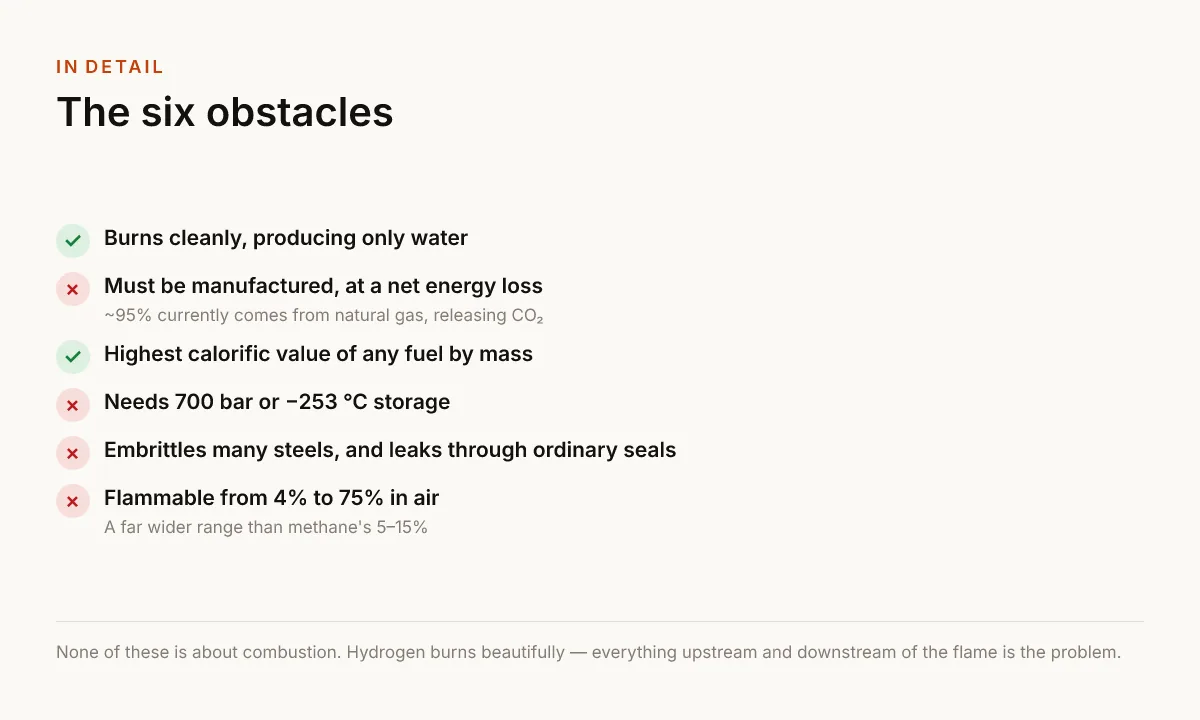
It is not that hydrogen burns badly. It burns better than anything. Every obstacle sits either before the fuel reaches the engine or in the tank holding it.
#What hydrogen has going for it
- Highest calorific value of any fuel — about 150,000 kJ/kg, roughly three times petrol
- Only combustion product is water — no carbon dioxide, carbon monoxide, soot or sulphur
- The most abundant element in the universe
- Usable in fuel cells, generating electricity directly at high efficiency with no flame
On paper it is the ideal fuel. In practice, five obstacles stand in the way.
#Obstacle 1: it has to be manufactured
There are no hydrogen wells. Free hydrogen gas is almost absent from the Earth's atmosphere because it is light enough to escape into space. All hydrogen on Earth is chemically bound — in water, in hydrocarbons, in biological matter.
Extracting it costs energy, and thermodynamics guarantees the cost exceeds the return:
Steam methane reforming (about 95% of world production):
CH4 + H2O -> CO + 3 H2
Cheap, mature — and it releases carbon dioxide, so the hydrogen is only as clean as its production allows.
Electrolysis of water:
2 H2O -> 2 H2 + O2
Clean if the electricity is clean, but round-trip efficiency is poor. Electrolysis, compression, storage and reconversion in a fuel cell typically return roughly 30% of the input electricity.
This is the central point: hydrogen is an energy carrier, not an energy source. It stores energy generated elsewhere, at a loss.
#Obstacle 2: terrible volumetric density
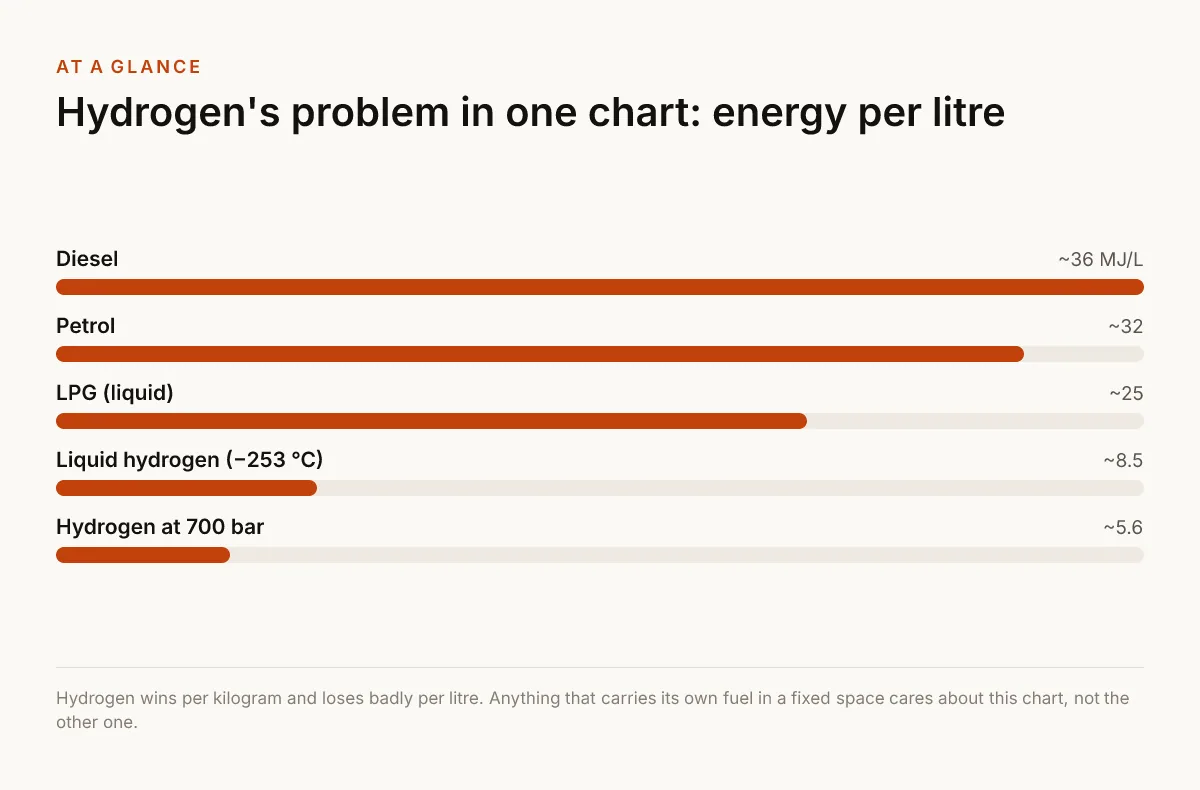
Hydrogen is the lightest gas, which gives it the best mass-based calorific value and the worst volume-based one.
| Storage form | Energy per litre (MJ) |
|---|---|
| Petrol | ~32 |
| Diesel | ~36 |
| LPG (liquid) | ~25 |
| Liquid hydrogen (−253 °C) | ~8.5 |
| Hydrogen at 700 bar | ~5.6 |
| Hydrogen at 1 bar | ~0.011 |
At ordinary pressure, a cubic metre of hydrogen contains almost no energy. Even compressed to 700 bar — requiring heavy carbon-fibre tanks and about 10–15% of the hydrogen's own energy to compress — it stores roughly a sixth of petrol's energy per litre.
For anything carrying its own fuel, this is decisive.
#Obstacle 3: storage is hard in every direction
- Compression to 700 bar — expensive tanks, energy cost, safety engineering
- Liquefaction at −253 °C — consumes 30–40% of the hydrogen's energy content, and stored liquid hydrogen boils off continuously
- Metal hydrides and chemical carriers — safer and denser but heavy, slow to charge and discharge, still developmental
#Obstacle 4: it attacks its own containers
Hydrogen embrittlement. Hydrogen atoms are small enough to diffuse into the crystal lattice of many steels, where they accumulate at grain boundaries and make the metal brittle and prone to cracking. Ordinary steel pipelines and vessels cannot simply be repurposed; special alloys or liners are required.
Leakage. The hydrogen molecule is the smallest there is, so it escapes through seals, joints and materials that comfortably contain methane. Leaked hydrogen is also an indirect greenhouse gas, since it extends the atmospheric lifetime of methane.
#Obstacle 5: the flammability envelope
Hydrogen burns in air across an unusually wide concentration range — roughly 4% to 75%, against about 5–15% for methane. That means far more leak scenarios produce an ignitable mixture. Its ignition energy is very low, and its flame is nearly invisible in daylight, which complicates detection.
In its favour, hydrogen disperses upward extremely fast in open air, so outdoor leaks dissipate quickly. The danger is concentrated in enclosed spaces.
#Obstacle 6: no infrastructure
A century of investment built refineries, pipelines, tankers, filling stations and engines around liquid hydrocarbons. Hydrogen has a few hundred public refuelling stations worldwide against hundreds of thousands of petrol stations, and existing gas pipelines mostly cannot carry pure hydrogen without modification.
#Where hydrogen does make sense
The obstacles are logistical, not fundamental, so hydrogen wins wherever those specific constraints do not bite:
- Rocketry. Liquid hydrogen and liquid oxygen give the highest specific impulse of any practical chemical propellant. Volume is available; mass is critical.
- Industrial feedstock. Ammonia for fertiliser, refinery hydrotreating, methanol production — already the largest current uses.
- Steel making. Hydrogen can replace coking coal as the reducing agent, eliminating a large industrial carbon source.
- Heavy transport and long-duration storage. Where batteries are too heavy or too slow to recharge.
For the number that makes hydrogen look so good on paper, see which fuel has the highest calorific value. For the technology that uses hydrogen best, fuel cells explained.
#The compact answer
Hydrogen is not widely used as a fuel because it does not occur freely in nature and must be manufactured, which consumes more energy than the hydrogen releases. It has a very low energy density by volume, so it must be stored at about 700 bar or cooled to −253 °C, both of which are expensive and energy-intensive. It also causes embrittlement of metals, leaks easily, has a very wide flammability range, and lacks distribution infrastructure.
Frequently asked questions
Why is hydrogen not used as a fuel?
Because it is difficult and expensive to produce, store and distribute. Hydrogen does not occur freely in nature and must be manufactured, which consumes more energy than the hydrogen later releases. Its very low density by volume requires extreme compression or cryogenic cooling, it embrittles many metals used in pipes and tanks, and there is almost no refuelling infrastructure.
Is hydrogen a good fuel?
Chemically, it is excellent: the highest calorific value of any fuel at about 150,000 kJ/kg, and the only combustion product is water. Practically, the difficulties of production, storage, transport and infrastructure have kept it out of general use. It is an outstanding fuel with poor logistics.
Where is hydrogen actually used as a fuel?
In rocketry, where liquid hydrogen with liquid oxygen gives the highest specific impulse of any practical chemical propellant and mass matters more than volume. It is also used in fuel cell buses, trucks and forklifts, and is being trialled for steel making and long-duration energy storage.
What is green hydrogen?
Hydrogen produced by electrolysis of water using renewable electricity, so no carbon dioxide is released in its manufacture. Grey hydrogen comes from natural gas with CO₂ released; blue hydrogen is the same with carbon capture. Only green hydrogen is genuinely clean across its whole life cycle.
Sources
Every figure above traces back to one of these. If you find one that does not, tell us and we will fix it.
- [1]Hydrogen basics — U.S. Department of Energy, Alternative Fuels Data Center
- [2]Hydrogen storage — U.S. Department of Energy, Office of Energy Efficiency and Renewable Energy
Written by
Priya Raman — Energy science editor
Taught school science for eight years, then moved into writing about combustion and energy. Still explains things the way you would to a class.
- MSc Chemistry
- Eight years teaching physical science
- Science curriculum writer