Disadvantages of Fossil Fuels: The Full List, Ranked by Consequence
Fossil fuels are finite, polluting and unevenly distributed. Here are the disadvantages in order of importance, with the mechanism behind each one.
Key takeaways
- If asked for two: non-renewable and exhaustible, and highly polluting.
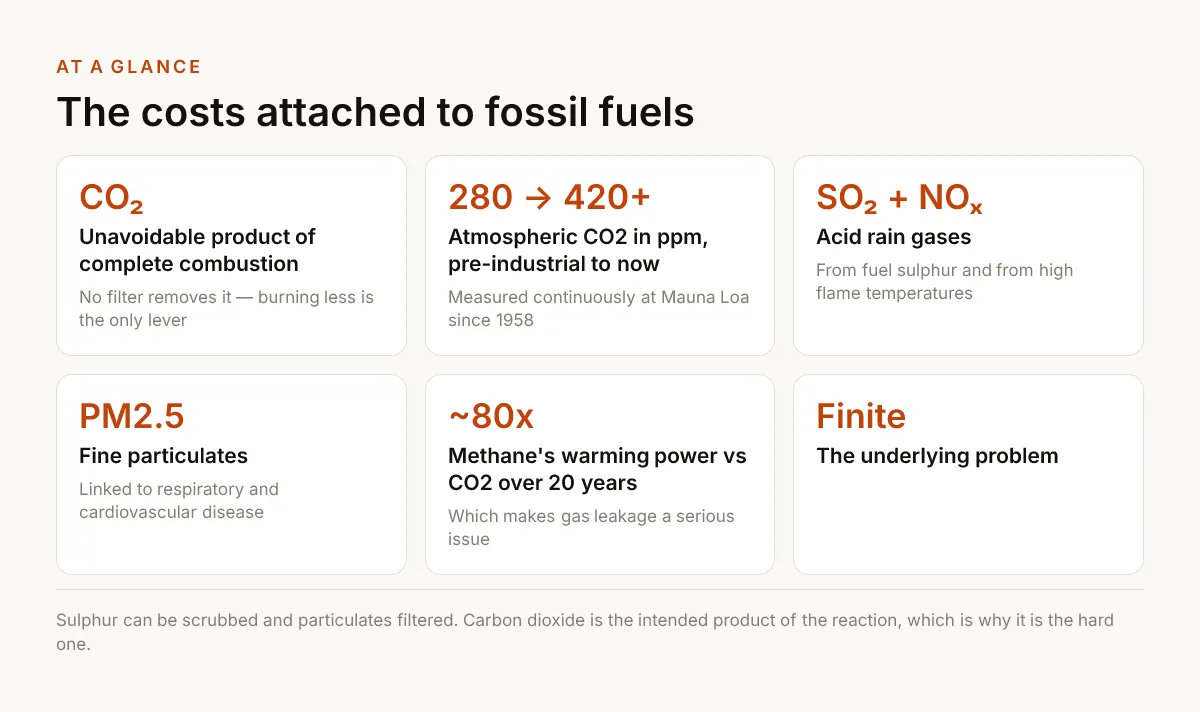
- Carbon dioxide is unavoidable — it is a product of complete combustion, not a fault.
- Sulphur dioxide and nitrogen oxides cause acid rain; particulates cause respiratory disease.
- Extraction damages land and water: mining subsidence, oil spills, methane leaks.
- Reserves are concentrated in a few regions, creating supply and price insecurity.
Lists of disadvantages usually fail in one of two ways. Either everything is presented as equally terrible, or the list quietly implies nobody should ever have used these fuels — which is hard to square with the fact that they still supply about four-fifths of the world's energy.
So here is the list ordered by how much each item actually matters, with the mechanism behind it, and an honest section at the end on the advantages. You cannot understand why the transition is difficult without both halves.
#1. They are non-renewable and will be exhausted
Coal, petroleum and natural gas formed over 10 to 400 million years from buried organic matter. The stock in the Earth's crust is fixed and is being drawn down at a rate millions of times faster than it forms.
Three consequences follow:
- Depletion. Reserves fall as consumption continues.
- Rising extraction difficulty. The easiest, richest deposits are used first. What remains is deeper, more remote, lower grade and more energy-intensive to extract.
- Intergenerational cost. Fuel burned now is unavailable to anyone later, and petroleum is also the feedstock for plastics, fertilisers and pharmaceuticals — arguably a poor thing to simply set fire to.
#2. Burning them pollutes the air
Even perfect combustion produces carbon dioxide. Imperfect combustion and impurities in the fuel produce everything else.
| Pollutant | Origin | Effect |
|---|---|---|
| Carbon dioxide | Complete combustion of any carbon fuel | Greenhouse gas; global warming |
| Sulphur dioxide | Sulphur in coal and heavy oil | Acid rain; airway irritation |
| Nitrogen oxides | Atmospheric nitrogen at high flame temperature | Acid rain; smog; ozone |
| Carbon monoxide | Incomplete combustion | Toxic; binds haemoglobin |
| Particulate matter | Unburnt carbon and ash | Respiratory and cardiovascular disease |
| Unburnt hydrocarbons | Incomplete combustion | Smog formation |
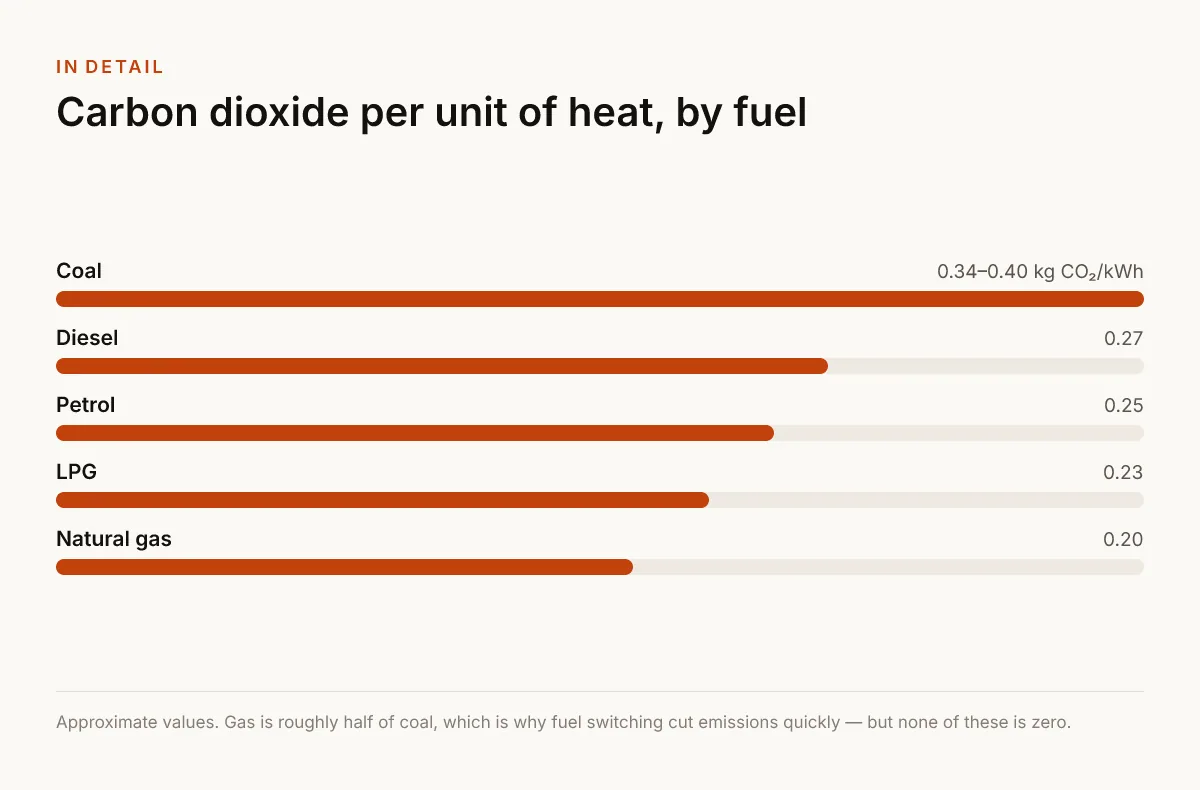
The carbon dioxide row is the difficult one. Sulphur can be removed by flue-gas desulphurisation; particulates can be caught by electrostatic precipitators; nitrogen oxides can be reduced catalytically. Carbon dioxide is the intended product of the reaction — unlike carbon monoxide and soot, which appear when combustion goes wrong. Capturing it is possible but expensive and energy-hungry, and it is not standard practice at scale.
#3. Climate change
Atmospheric carbon dioxide has risen from roughly 280 parts per million before industrialisation to over 420 ppm today, overwhelmingly from fossil fuel combustion and land use change. The consequences — rising global average temperature, sea level rise, ocean acidification, shifting rainfall patterns, more frequent extreme heat — are the reason energy policy worldwide is oriented around reducing fossil fuel use.
This is not a separate disadvantage from carbon dioxide emission; it is what that emission does.
#4. Extraction damages land and water
Before anything is burned, getting it out causes harm:
- Coal mining causes land subsidence, deforestation, acid mine drainage into rivers, and severe occupational disease including pneumoconiosis.
- Oil drilling and transport risks spills that devastate marine and coastal ecosystems and persist for decades.
- Gas extraction leaks methane, itself a greenhouse gas roughly 80 times more potent than carbon dioxide over a twenty-year horizon.
- Waste. Coal-fired plants produce large volumes of fly ash and bottom ash requiring disposal, sometimes containing heavy metals.
#5. Uneven distribution creates insecurity
Reserves are concentrated where the ancient geology happened to be right, not where demand is. A few regions hold most of the world's oil and gas, so most countries import.
That produces price volatility driven by events far outside a consumer's control, trade deficits for importing nations, and energy supply as an instrument of geopolitics. Renewable resources are far more evenly spread — most places have some combination of sun, wind or water.
#6. Health costs are large and immediate
Outdoor air pollution, much of it from fossil fuel combustion in power generation and transport, is associated with millions of premature deaths worldwide each year. Unlike climate change, this cost is not deferred — it accrues now, concentrated in cities and near power stations, and falls hardest on the people least able to move away from it.
#For balance: the advantages
An answer that lists only disadvantages misses why the transition is hard:
- Very high energy density — petrol carries about 12 kWh/kg, far above any production battery
- Indefinite storage with no self-discharge
- Easy transport by pipeline, tanker, rail and road
- Dispatchable — available on demand, independent of weather
- Mature infrastructure built over more than a century
- Chemical feedstock for plastics, fertilisers, dyes and medicines
#The compact answer
Two main disadvantages of fossil fuels: (1) they are non-renewable and exhaustible — formed over millions of years, they are being used far faster than they can be replaced and will eventually be exhausted; (2) they cause serious pollution — burning them releases carbon dioxide, which causes global warming, along with sulphur dioxide and nitrogen oxides, which cause acid rain, and carbon monoxide and particulate matter, which damage health.
Frequently asked questions
Mention any two disadvantages of fossil fuels.
First, they are non-renewable and exhaustible — formed over millions of years, they are being consumed far faster than they can form and will eventually run out. Second, burning them causes serious pollution: carbon dioxide leading to global warming, sulphur dioxide and nitrogen oxides leading to acid rain, and carbon monoxide and particulates that harm health.
What is the biggest disadvantage of fossil fuels?
Carbon dioxide emissions, because they are unavoidable. Sulphur can be scrubbed from flue gas and particulates can be filtered, but carbon dioxide is a direct product of complete combustion of any carbon-based fuel. Cutting it means burning less, not burning better.
How do fossil fuels cause acid rain?
Sulphur present in coal and heavy fuel oil oxidises to sulphur dioxide during combustion, and high flame temperatures convert atmospheric nitrogen into nitrogen oxides. Both dissolve in atmospheric moisture to form sulphuric and nitric acids, which fall as acid rain, acidifying soils and lakes and corroding buildings.
Do fossil fuels have any advantages?
Yes, which is why they dominate. They have very high energy density, store indefinitely without loss, can be transported easily, generate power on demand regardless of weather, and are supported by more than a century of existing infrastructure. The disadvantages are serious enough to drive a transition, but the advantages explain why the transition is difficult.
Sources
Every figure above traces back to one of these. If you find one that does not, tell us and we will fix it.
- [1]Carbon dioxide emissions coefficients by fuel — U.S. Energy Information AdministrationSource of the CO2 per unit energy figures.
- [2]Trends in atmospheric carbon dioxide — NOAA Global Monitoring Laboratory
- [3]Household air pollution and health — World Health Organization
- [4]Greenhouse gas equivalencies calculator — calculations and references — U.S. Environmental Protection Agency
Written by
Priya Raman — Energy science editor
Taught school science for eight years, then moved into writing about combustion and energy. Still explains things the way you would to a class.
- MSc Chemistry
- Eight years teaching physical science
- Science curriculum writer