Why Energy From Fossil Fuels Is Not Green Energy
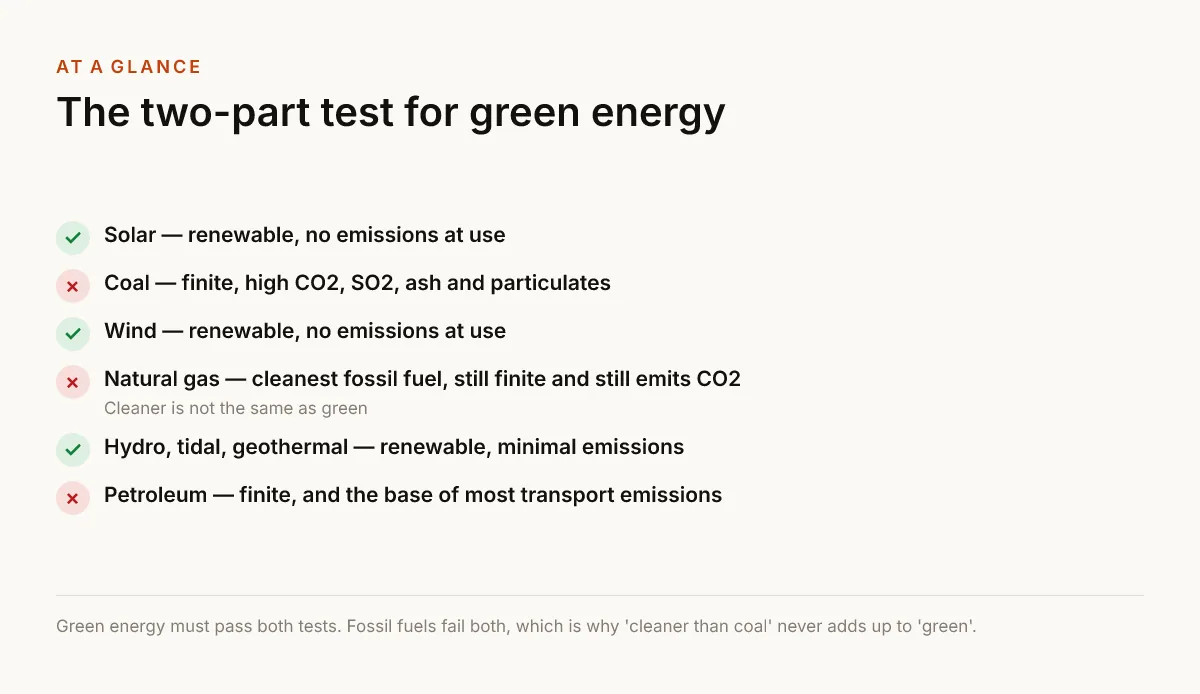
Fossil fuel energy fails both green tests: it is non-renewable, and burning it releases carbon dioxide, sulphur dioxide and particulates.
Key takeaways
- Green energy must be both renewable and low-polluting; fossil fuels fail on both counts.
- Complete combustion still releases carbon dioxide, the main greenhouse gas driving climate change.
- Sulphur in coal and oil becomes sulphur dioxide, which causes acid rain.
- Fossil fuels formed over millions of years and are consumed in a fraction of that time.
- Solar, wind, hydro, tidal, geothermal and biomass are the standard green alternatives.
A reader once sent me an electricity tariff advertised as a "green energy plan" and asked why their bill still mentioned gas generation. It is a good question, and the answer is that "green" gets used in two different ways: as a technical classification, and as a marketing adjective.
The technical version is a two-part test, and energy from fossil fuels fails both parts. Once you know the test, tariff pages and product claims get much easier to read.
#The two conditions for green energy
An energy source is called green when it satisfies both of the following:
- It is renewable. The source replenishes itself naturally on a human timescale — sunlight arrives daily, wind blows, rivers flow, heat rises from the Earth's interior.
- It is non-polluting, or nearly so. Converting it into useful energy releases little or no harmful material into the air, water or soil.
Coal, petroleum and natural gas fail the first test decisively and the second test comprehensively. That is the whole answer; the rest of this guide is why.
#Failure one: fossil fuels are not renewable
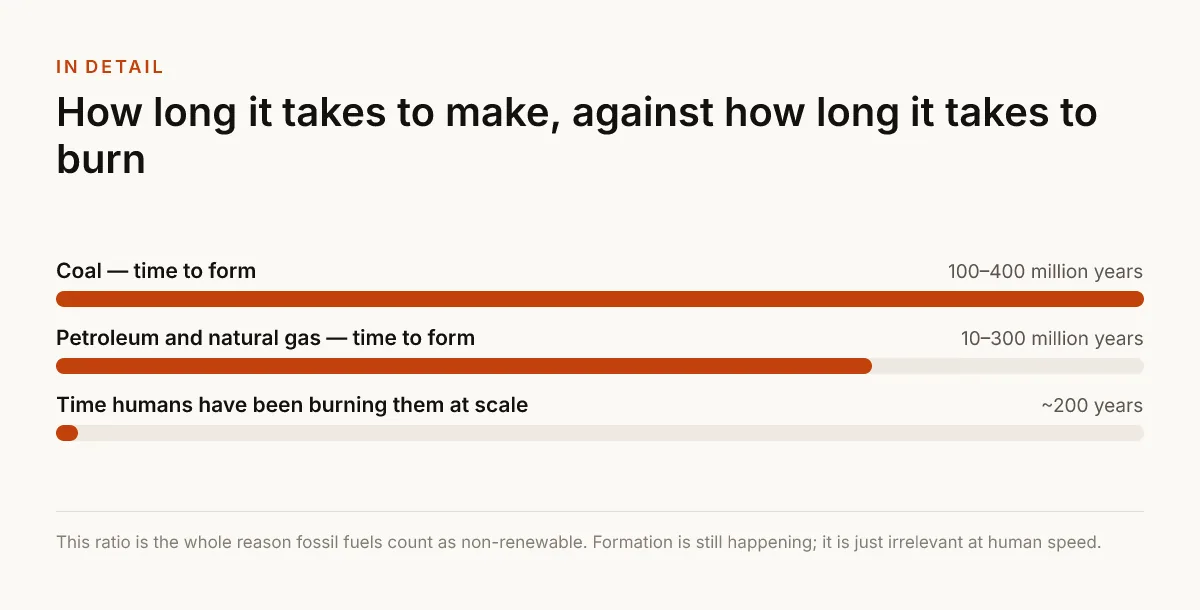
Fossil fuels are the compressed remains of organisms that lived hundreds of millions of years ago. Dead plants and marine organisms were buried under layers of sediment, and over immense spans of time, heat and pressure converted that buried organic matter into coal, petroleum and natural gas.
The timescale is the point:
| Fuel | Approximate formation time |
|---|---|
| Coal | 100–400 million years |
| Petroleum | 10–300 million years |
| Natural gas | 10–300 million years |
Humanity has consumed a large fraction of the accessible reserves in roughly two centuries. Deposits are technically still forming today, but at rates so slow that they are irrelevant to anyone alive. That is what makes fossil fuels exhaustible natural resources: consumption vastly outpaces formation, so the stock only shrinks.
Renewable sources behave in the opposite way. Using sunlight today does not reduce tomorrow's supply of it.
#Failure two: burning them pollutes
Even when combustion is complete and efficient, burning a hydrocarbon produces carbon dioxide and water:
CH4 + 2 O2 -> CO2 + 2 H2O
Carbon dioxide is not a pollutant in the irritant sense — it is not toxic at atmospheric concentrations — but it is the principal greenhouse gas. It traps outgoing infrared radiation and drives global warming and climate change. There is no way to burn a carbon-based fuel without producing it. This is chemistry, not engineering, and no filter fixes it.
Then there are the products that depend on how dirty the fuel and the flame are:
- Sulphur dioxide (SO₂). Coal and heavy fuel oils contain sulphur, which oxidises during combustion. SO₂ irritates airways and dissolves in atmospheric water to form sulphuric acid — acid rain.
- Oxides of nitrogen (NOₓ). Formed from atmospheric nitrogen at high flame temperatures. They contribute to acid rain, ground-level ozone and smog.
- Carbon monoxide (CO). Produced whenever combustion is incomplete — a poisonous gas that binds to haemoglobin far more strongly than oxygen does.
- Particulate matter and soot. Unburnt carbon particles that penetrate deep into the lungs and are associated with respiratory and cardiovascular disease.
- Fly ash and residue. Coal leaves large volumes of solid ash requiring disposal.
Green sources produce essentially none of this at the point of generation.
#Why "cleaner" is not "green"
Natural gas is often marketed as clean, and relative to coal that is fair: per unit of energy it releases roughly half the carbon dioxide, negligible sulphur and almost no ash. But "cleanest fossil fuel" is a ranking within a category that fails the test — like being the least expensive luxury car. It still emits CO₂ and it is still finite.
The same caution applies to the phrase "clean coal". Technologies such as flue-gas desulphurisation and carbon capture reduce specific emissions, sometimes substantially, but they do not make coal renewable and they do not eliminate carbon dioxide entirely.
#What counts as green energy instead
| Source | Renewable | Emissions at use |
|---|---|---|
| Solar | Yes | None |
| Wind | Yes | None |
| Hydroelectric | Yes | None |
| Tidal and wave | Yes | None |
| Geothermal | Yes | Minimal |
| Biogas and sustainable biomass | Yes | Low net CO₂ |
| Coal, petroleum, natural gas | No | High |
Biomass and biogas deserve a note. Burning them does release carbon dioxide, but the carbon came from plants that absorbed atmospheric CO₂ while growing, so the cycle is roughly closed if the resource is replanted. That is why they are counted as renewable while fossil fuels are not — fossil carbon has been locked underground for millions of years, and burning it adds carbon to the active atmosphere that was not previously part of the cycle.
If you want the underlying reason spelled out, it is worth reading why fossil fuels count as exhaustible resources and what the full list of disadvantages actually contains.
#The exam-style answer
If you need the compact version:
Energy obtained from fossil fuels is not green energy because fossil fuels are non-renewable, exhaustible resources formed over millions of years, and their combustion releases carbon dioxide, sulphur dioxide, oxides of nitrogen and particulate matter, causing global warming, acid rain and air pollution. Green energy sources such as solar, wind and hydro are renewable and cause little or no pollution.
#Why this distinction matters practically
Roughly 80% of the world's primary energy still comes from fossil fuels. Nothing about calling them non-green means they are useless — their energy density, storability and existing infrastructure are exactly why they are so hard to replace. But the labelling matters when policies, tariffs and "green" product claims are involved. A tariff that sells you electricity generated by burning gas is not selling you green energy, however the marketing is worded.
The honest framing is that fossil fuels are a powerful, finite, polluting energy source that the world is trying to use less of — not a green one.
Frequently asked questions
Why is energy obtained from fossil fuels not green energy?
Because green energy has to be both renewable and non-polluting. Fossil fuels are exhaustible natural resources that took millions of years to form, and burning them releases carbon dioxide, sulphur dioxide, nitrogen oxides and particulate matter, which cause global warming, acid rain and air pollution.
Is natural gas green energy?
No. Natural gas is the cleanest of the three fossil fuels — it produces roughly half the carbon dioxide of coal per unit of energy and almost no sulphur or ash — but it is still a non-renewable fossil fuel that emits carbon dioxide when burned. Cleaner is not the same as green.
Which energy sources are green energy?
Solar, wind, hydroelectric, tidal, wave, geothermal and sustainably produced biomass and biogas. They are replenished naturally on a human timescale and release little or no pollution at the point of use.
Do fossil fuels cause acid rain?
Yes. Coal and heavy fuel oils contain sulphur, which burns to sulphur dioxide. High combustion temperatures also form nitrogen oxides from the nitrogen in air. Both dissolve in atmospheric moisture to form sulphuric and nitric acids, which fall as acid rain and damage soil, forests, lakes and buildings.
Sources
Every figure above traces back to one of these. If you find one that does not, tell us and we will fix it.
- [1]
- [2]Trends in atmospheric carbon dioxide — NOAA Global Monitoring LaboratorySource of the atmospheric CO2 concentration figures.
- [3]Carbon dioxide emissions coefficients by fuel — U.S. Energy Information Administration
Written by
Priya Raman — Energy science editor
Taught school science for eight years, then moved into writing about combustion and energy. Still explains things the way you would to a class.
- MSc Chemistry
- Eight years teaching physical science
- Science curriculum writer