The Most Abundant Fossil Fuel in India Is Coal — Here's Why
India holds the world's fifth-largest coal reserves and produces most of its electricity from it, while importing the majority of its petroleum and natural gas.
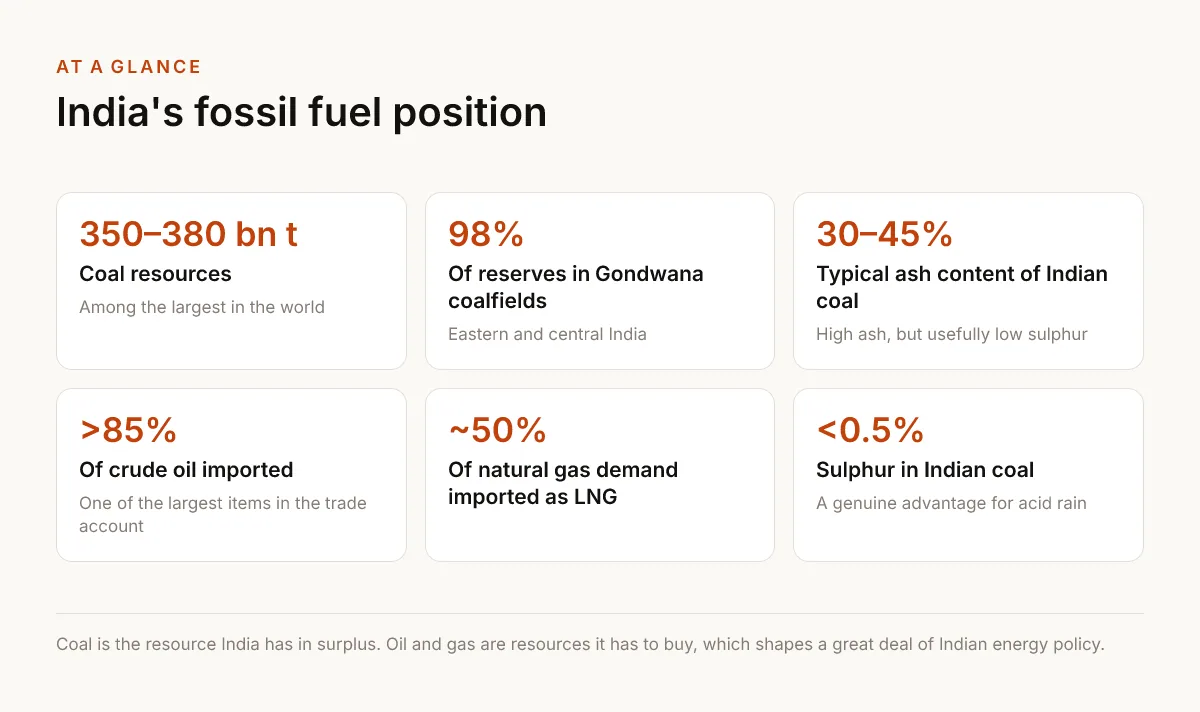
Key takeaways
- Coal is by far India's most abundant fossil fuel; petroleum is the scarcest relative to demand.
- The Gondwana coalfields hold about 98% of India's reserves.
- Jharkhand, Odisha and Chhattisgarh together dominate reserves and production.
- Most Indian coal is high-ash, low-sulphur, and mostly non-coking.
- India imports over 85% of its crude oil, making petroleum a strategic vulnerability.
If you have taken a long-distance train through Jharkhand or Odisha, you have seen the answer to this question without being told it: rake after rake of open wagons heaped with coal, moving west and south, all day.
Coal is the resource India has in genuine abundance. Oil is the one it has to buy. Almost everything interesting about Indian energy policy sits in the space between those two facts.
#The reserve picture
| Fossil fuel | Indian position |
|---|---|
| Coal | ~350–380 billion tonnes of resources; among the world's largest |
| Petroleum | ~4.5 billion barrels of proven reserves; small relative to demand |
| Natural gas | ~1,300 billion cubic metres; moderate, insufficient for demand |
Coal is not merely the largest of the three — it is the resource India has in genuine surplus, while oil and gas are resources India must buy.
#Where the coal is
About 98% of Indian coal reserves lie in the Gondwana formations, deposited roughly 250 million years ago across what is now eastern and central India. The remaining 2% is Tertiary coal in the north-east, generally higher in sulphur.
The principal coalfields:
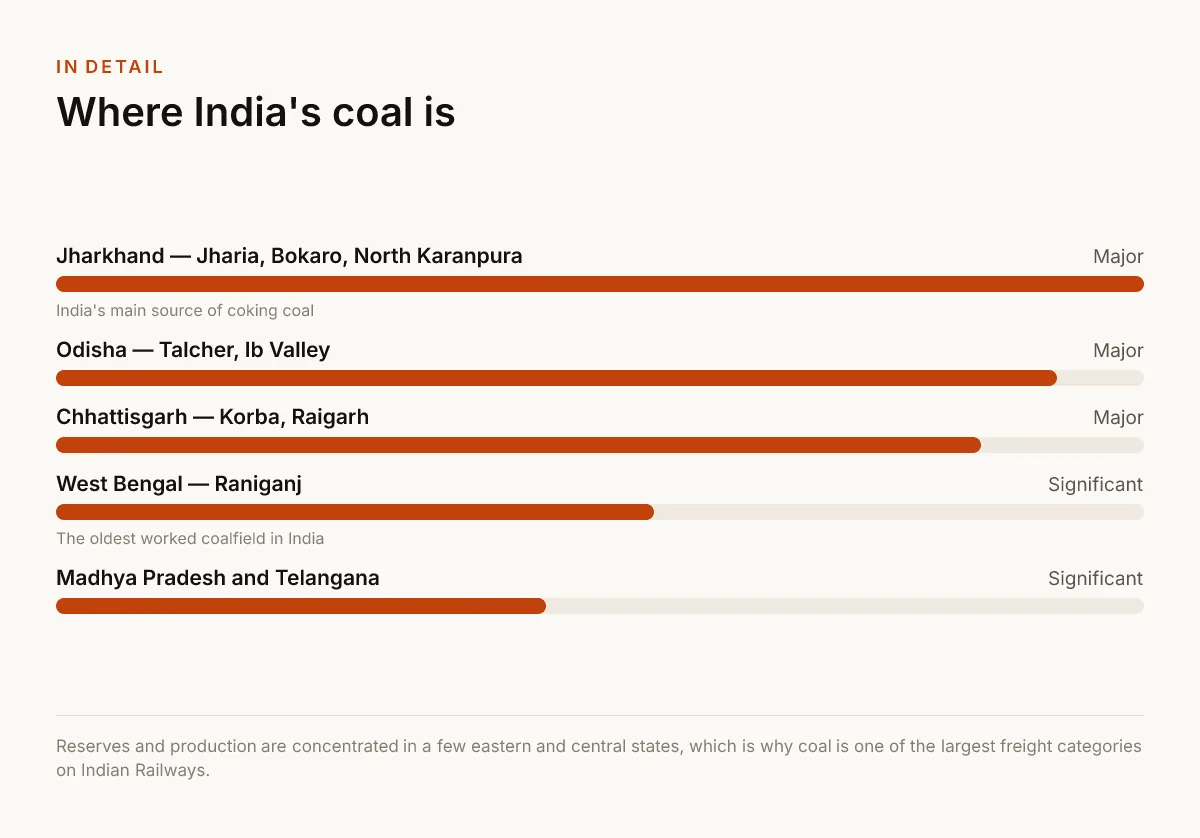
- Jharkhand — Jharia (India's main source of coking coal), Bokaro, North Karanpura
- Odisha — Talcher, Ib Valley
- Chhattisgarh — Korba, Raigarh
- West Bengal — Raniganj, the oldest worked field in India
- Madhya Pradesh — Singrauli, Sohagpur
- Telangana — Singareni
Together, Jharkhand, Odisha and Chhattisgarh account for a large majority of both reserves and output. That geographic concentration is why coal transport is one of the largest single categories of freight on Indian Railways: the coal is in the east, and much of the demand is elsewhere.
#The quality problem
Indian coal has two defining characteristics:
High ash content, frequently 30–45%. Ash is incombustible mineral matter, so a tonne of high-ash coal delivers less heat than a tonne of low-ash coal, and the difference has to be transported, handled and disposed of as fly ash and bottom ash. Many power stations are built at the pithead specifically to avoid hauling ash-heavy coal across the country.
Low sulphur, typically under 0.5%. This is a genuine advantage: sulphur dioxide emissions and acid rain risk are lower than for high-sulphur coals used elsewhere.
Most Indian coal is thermal (non-coking) grade, suitable for power generation. Coking coal, needed for steel making, is in short supply domestically, so India imports large volumes of it — an import dependence that exists despite the enormous total reserve.
#What coal does for India
Coal supplies the majority of India's electricity generation, and its role goes beyond power:
- Electricity — thermal power stations burning pulverised coal
- Steel — coking coal converted to coke for blast furnaces
- Cement, bricks, chemicals — process heat and feedstock
- Employment — coal mining and transport support very large workforces, concentrated in states with fewer alternative industries
That last point is why coal transition in India is a social and regional question as much as an environmental one.
#The petroleum contrast
India's oil position is the mirror image. Domestic production comes chiefly from:
- Mumbai High offshore, the largest single field
- Gujarat — Ankleshwar, Kalol
- Rajasthan — Barmer basin
- Assam — Digboi, Naharkatiya, among the oldest producing fields in the world
Together these meet under 15% of consumption. The rest is imported, mainly from West Asia. This makes the oil import bill one of the largest items in India's trade account, and it is the reason policy pushes so hard on CNG vehicles, ethanol blending in petrol, and electrification of transport — every unit of demand shifted away from imported crude improves the external balance directly.
Natural gas sits in between: domestic production from the Krishna-Godavari basin, Mumbai offshore and Assam covers roughly half of demand, with the remainder imported as LNG.
#Why the distribution is what it is
None of this is an accident of policy. Fossil fuel deposits form where ancient geology cooperated. India's landmass carried extensive Gondwana-era swamp forests, producing coal in abundance. It has comparatively fewer of the marine sedimentary basins with the right burial conditions and trapping structures for large oil accumulations.
The resource endowment is fixed. What is not fixed is what a country builds on top of it — which is why India's renewable capacity expansion, particularly solar, is framed domestically as an energy-security measure as much as a climate one.
#The compact answer
The most abundantly available fossil fuel in India is coal. India has one of the largest coal reserves in the world, roughly 350–380 billion tonnes, mainly in the Gondwana coalfields of Jharkhand, Odisha, Chhattisgarh, West Bengal, Madhya Pradesh and Telangana. Coal generates most of India's electricity, whereas over 85% of its petroleum is imported.
Frequently asked questions
Which is the most abundantly available fossil fuel in India?
Coal. India's coal resources are estimated at roughly 350–380 billion tonnes, among the largest in the world, and coal supplies the majority of the country's electricity generation. Petroleum and natural gas reserves are comparatively small relative to demand.
Where are India's main coalfields?
Chiefly in the Gondwana belt of eastern and central India: Jharia and Bokaro in Jharkhand, Talcher and Ib Valley in Odisha, Korba in Chhattisgarh, Raniganj in West Bengal, Singrauli in Madhya Pradesh, and Singareni in Telangana. Tertiary coalfields in the north-east hold a very small share.
Why does India import so much petroleum?
Because domestic crude reserves are modest — concentrated in Mumbai High, Gujarat, Rajasthan and Assam — while demand from transport and industry is very large and growing. India imports over 85% of the crude oil it consumes, which is why global oil price movements affect Indian inflation so directly.
Is Indian coal good quality?
It is generally high in ash, often 30–45%, with relatively low sulphur. High ash content lowers the calorific value and increases handling and disposal burdens at power stations. Most Indian coal is thermal (non-coking) grade, so coking coal for steel making is largely imported.
Sources
Every figure above traces back to one of these. If you find one that does not, tell us and we will fix it.
- [1]Coal explained — U.S. Energy Information Administration
- [2]Fossil fuels — International Energy Agency
- [3]Fossil fuels — Our World in Data
Written by
Priya Raman — Energy science editor
Taught school science for eight years, then moved into writing about combustion and energy. Still explains things the way you would to a class.
- MSc Chemistry
- Eight years teaching physical science
- Science curriculum writer