Why Fossil Fuels Are an Important Source of Energy
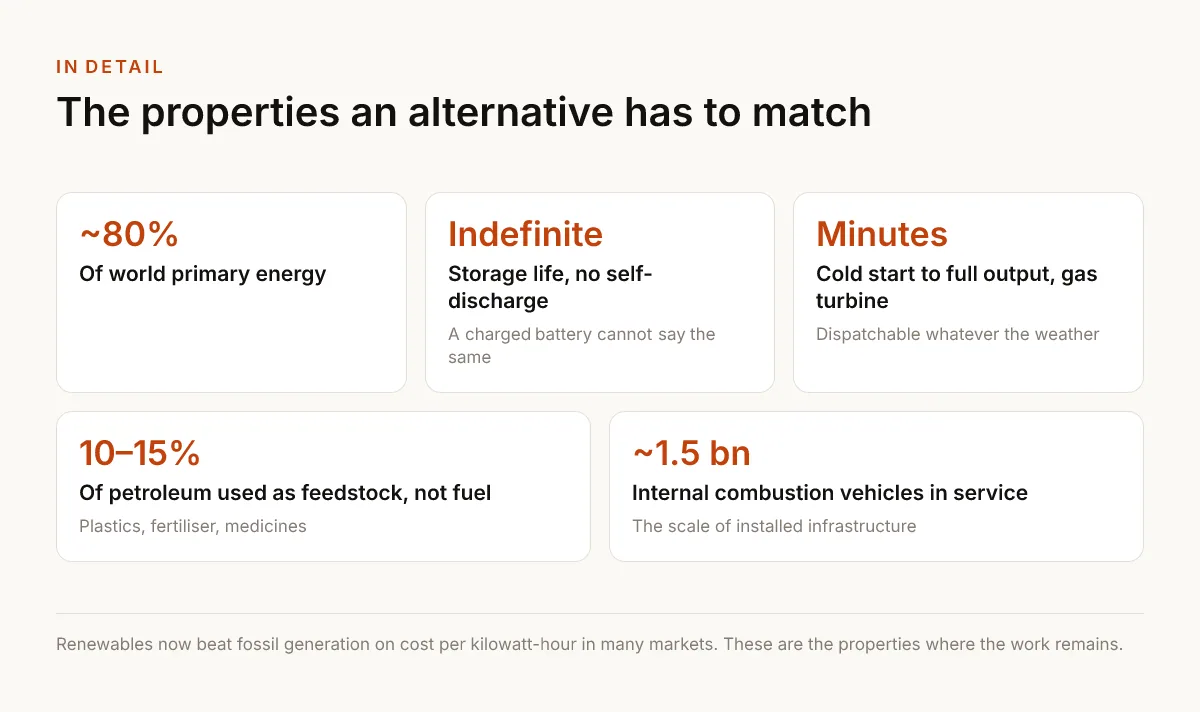
Fossil fuels supply about 80% of world energy through energy density, storability and dispatchability — the properties that make them hard to replace.
Key takeaways
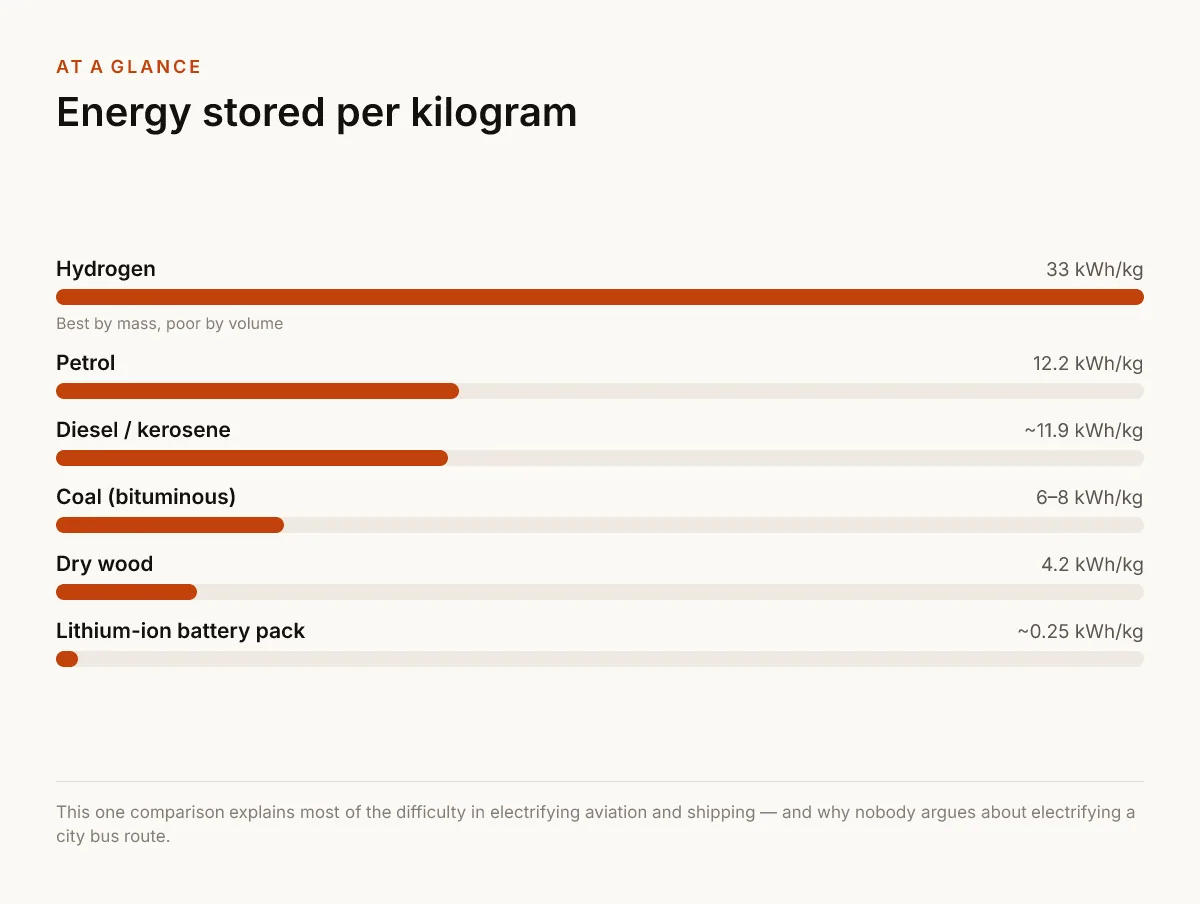
- Petrol carries about 12 kWh per kilogram — far above any production battery.
- Stored fuel loses no energy over time, unlike batteries which self-discharge.
- Fossil-fired plants are dispatchable: output on demand, independent of weather.
- Petroleum is a chemical feedstock, not just a fuel — plastics, fertilisers, pharmaceuticals.
- These strengths explain why replacing fossil fuels is technically hard, not why it is unnecessary.
Any honest account of fossil fuels has to deal with the awkward part. If they are finite and polluting — and they are both — why does the world still take about four-fifths of its energy from them?
The answer is not inertia alone. It is a short list of physical properties that happen to be extremely useful, and that anything replacing them has to match. Knowing that list is what turns "why don't we just stop" into a question you can actually reason about.
#1. Extraordinary energy density
Energy density is energy per unit mass or volume, and fossil fuels are exceptional at it.
| Energy carrier | Approx. energy per kg |
|---|---|
| Hydrogen (by mass) | 33 kWh |
| Petrol | 12.2 kWh |
| Diesel | 11.9 kWh |
| Kerosene | 11.9 kWh |
| LPG | 12.8 kWh |
| Coal (bituminous) | 6–8 kWh |
| Dry wood | 4.2 kWh |
| Lithium-ion battery pack | ~0.25 kWh |
A litre of diesel in a fuel tank does the work that would take roughly forty kilograms of battery. This single ratio explains most of the difficulty in decarbonising aviation and shipping, where mass carried directly costs range.
Hydrogen beats every hydrocarbon by mass, but its volumetric density is poor — even compressed to 700 bar it needs several times the tank volume of petrol for equal energy, which is the practical obstacle.
#2. They store indefinitely
A drum of diesel stored for a year contains essentially the energy it started with. A charged battery does not: it self-discharges, and it degrades over cycles regardless.
Storability underpins several things people rarely notice:
- Strategic reserves that buffer supply shocks
- Backup generators for hospitals and data centres
- Seasonal heating stocks laid in during summer
- Fuel supply to places with no grid at all
#3. They are dispatchable
A gas turbine can be brought from cold to full output in minutes, at whatever hour is required. Solar produces when the sun shines; wind produces when the wind blows.
Grids must match supply to demand continuously, so this matters enormously. Renewable expansion is therefore accompanied by a storage problem — batteries, pumped hydro, demand shifting — that fossil generation simply does not have. It is not that renewables cannot solve it; it is that fossil fuels never had to.
#4. Transport and distribution are easy
Liquid fuels can be pumped, poured, piped, shipped and carried. Pipelines move gas across continents; tankers move crude across oceans; a jerrycan moves diesel to a village. The energy is portable in a way that electricity — requiring wires, or conversion into a chemical carrier — is not.
#5. A century of infrastructure
Refineries, pipelines, filling stations, storage depots, boilers, turbines, furnaces and roughly 1.5 billion internal combustion vehicles were all built around these fuels. That represents tens of trillions of dollars of installed capital.
This is a genuine advantage in the practical sense, though not a physical one: it is the reason a transition takes decades rather than years, and it is not an argument that the transition is unnecessary.
#6. They are more than fuel
Roughly 10–15% of petroleum is not burned at all. It is feedstock for:
- Plastics and polymers
- Nitrogen fertilisers, via ammonia from natural gas
- Synthetic fibres — polyester, nylon, acrylic
- Paints, dyes, adhesives, detergents
- Lubricants, waxes, bitumen for roads
- Many pharmaceuticals
The fertiliser link is the significant one: the Haber–Bosch process uses hydrogen from natural gas to fix atmospheric nitrogen into ammonia, and a large fraction of the world's food supply depends on nitrogen fertiliser made this way. Fossil fuels are embedded in the food system, not only the energy system.
#What they are used for, by sector
| Sector | Dominant fossil fuels |
|---|---|
| Electricity generation | Coal, natural gas |
| Road transport | Petrol, diesel, CNG |
| Aviation | Aviation kerosene |
| Shipping | Heavy fuel oil, marine diesel |
| Industrial heat | Coal, natural gas, petroleum coke |
| Steel making | Coking coal |
| Domestic cooking and heating | Natural gas, LPG, kerosene |
| Chemicals and fertiliser | Petroleum, natural gas |
#Holding both facts at once
Fossil fuels are important and they are exhaustible and polluting. Both statements are true, and neither cancels the other.
The reason to state the advantages clearly is that they define what any replacement has to deliver: comparable energy density for transport, storage that spans seasons, output that can be dispatched at 3am in still air, and distribution that reaches places without infrastructure. Solar and wind now beat fossil generation on cost per kilowatt-hour in many markets; the remaining work is in the properties listed above, which is where storage, grid interconnection, hydrogen and synthetic fuels come in.
If you want the other side of the ledger, the full list of disadvantages is worth reading next, along with why energy from fossil fuels is not green energy even when it is cleaner than the alternative it replaced.
#The compact answer
Fossil fuels are an important source of energy because they have a very high calorific value, are easy to store and transport, can be burned on demand to give energy whenever it is needed, and are supported by existing infrastructure. They are used for generating electricity, running vehicles, aircraft and ships, providing industrial heat, and cooking and heating in homes, as well as being the raw material for plastics, fertilisers and medicines.
Frequently asked questions
Fossil fuels are an important source of energy for what?
For electricity generation, transport, industrial process heat, and domestic cooking and heating. Coal and natural gas dominate power generation; petroleum products fuel almost all road, sea and air transport; and natural gas and LPG supply cooking and heating. Petroleum is also the raw material for plastics, fertilisers, synthetic fibres and pharmaceuticals.
Why are fossil fuels still used so widely despite pollution?
Because of energy density, storability, dispatchability and existing infrastructure. A tank of diesel stores far more energy per kilogram than a battery, loses nothing in storage, and can be burned on demand in equipment that already exists worldwide. Alternatives must match those practical properties, not just the energy quantity.
What is energy density and why does it matter?
Energy density is the energy stored per unit mass or volume. Petrol delivers roughly 12 kWh per kilogram against about 0.25 kWh per kilogram for a lithium-ion battery pack. This is why long-haul aviation and shipping remain the hardest transport sectors to electrify — the weight of the required battery becomes prohibitive.
What percentage of world energy comes from fossil fuels?
Roughly 80% of global primary energy. The share has declined slowly as renewables have expanded, but absolute fossil fuel consumption has not fallen much, because total world energy demand continues to rise.
Sources
Every figure above traces back to one of these. If you find one that does not, tell us and we will fix it.
- [1]Fossil fuels — Our World in Data
- [2]Fuel properties comparison — U.S. Department of Energy, Alternative Fuels Data Center
- [3]Fossil fuels — International Energy Agency
Written by
Priya Raman — Energy science editor
Taught school science for eight years, then moved into writing about combustion and energy. Still explains things the way you would to a class.
- MSc Chemistry
- Eight years teaching physical science
- Science curriculum writer