Why Fossil Fuels Are Exhaustible Natural Resources
They formed over hundreds of millions of years, exist in a fixed stock, and are consumed far faster than nature can ever replace them.
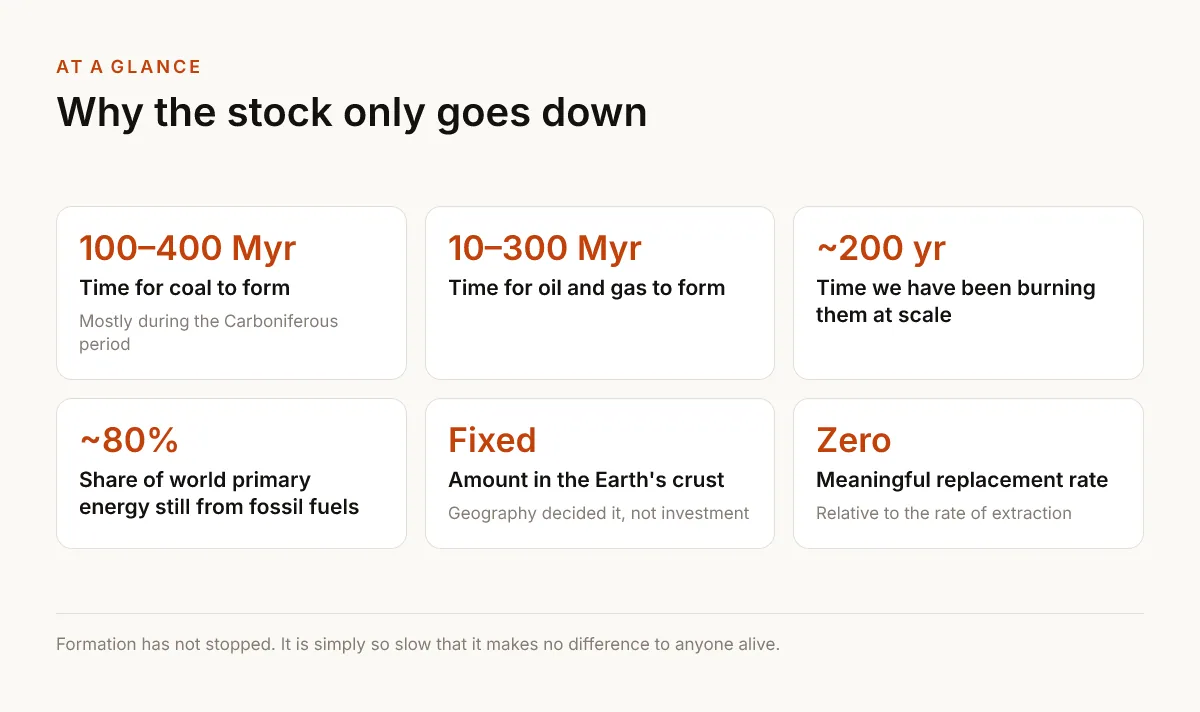
Key takeaways
- Formation takes 10 to 400 million years; consumption takes decades.
- Exhaustible (non-renewable) resources exist in fixed amounts and cannot be replaced in a human lifetime.
- Inexhaustible resources — sunlight, wind, air — are replenished continuously by natural processes.
- Coal, petroleum and natural gas are the three fossil fuels, all formed from buried organic matter.
- Conservation and alternative sources extend the life of what remains.
When I taught this chapter, the definition never landed. "Exhaustible resources exist in limited quantity" is a sentence students could repeat and not believe, because the world is visibly full of petrol stations and coal trains. Limited did not feel limited.
What worked was putting two numbers side by side: the time it took to make the fuel, and the time we have been burning it. Once you see three hundred million years next to two hundred years, the classification stops being a definition to memorise and becomes something obvious.
#The definition
An exhaustible natural resource (also called non-renewable) is present in the Earth in a limited, fixed amount and cannot be replenished within a human timescale once it is consumed.
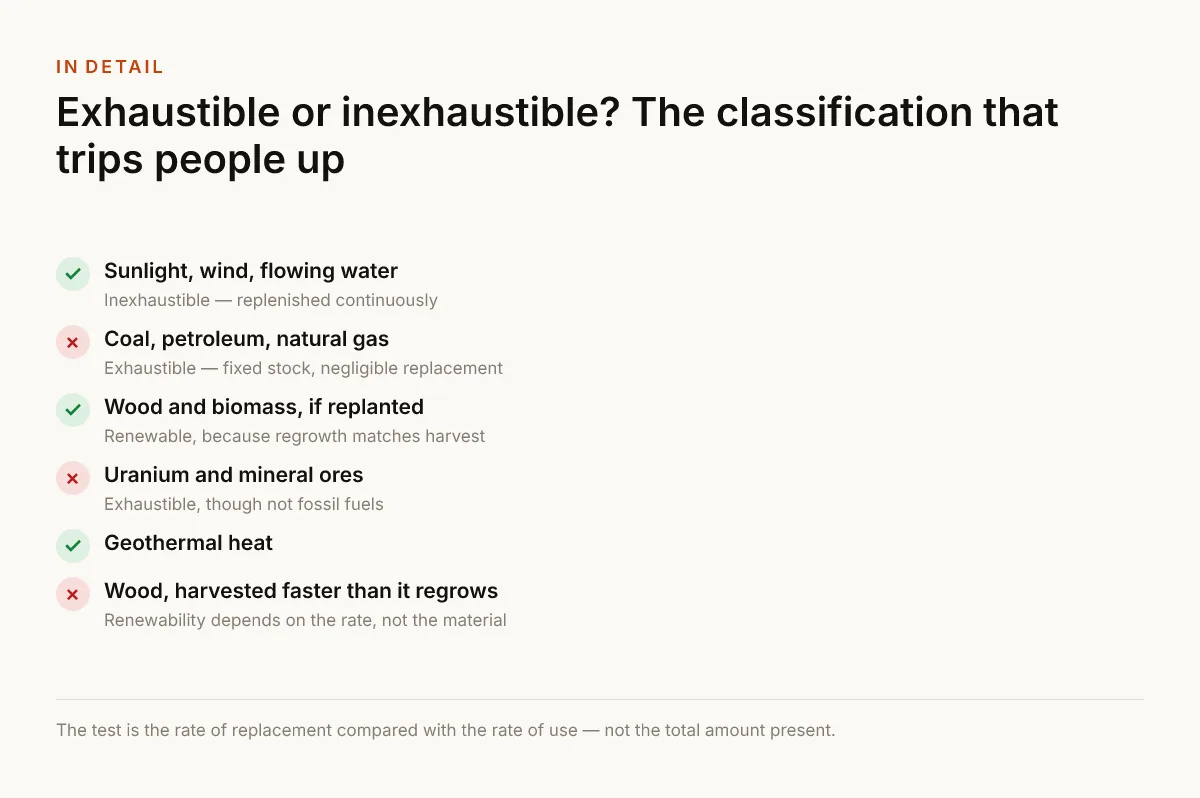
An inexhaustible natural resource is replenished continuously by natural processes and is not meaningfully depleted by being used — sunlight, air, wind.
Coal, petroleum and natural gas belong to the first category. The reason is entirely in how they were made.
#How fossil fuels formed
Between roughly 60 and 400 million years ago, vast quantities of living matter died and were buried before they could fully decay.
Coal formed from land plants — ferns, giant horsetails, early trees — that grew in swampy forests, chiefly during the Carboniferous period. As they died they fell into oxygen-poor water, where decomposition was incomplete. Layers of sediment buried the accumulating peat, and over millions of years, heat and pressure squeezed out water and volatile compounds, progressively enriching the carbon content: peat → lignite → bituminous coal → anthracite.
Petroleum and natural gas formed from microscopic marine organisms — plankton and algae — that settled onto ancient seabeds. Buried under sediment and subjected to heat and pressure in the absence of oxygen, this organic material was converted to liquid hydrocarbons and gas, which then migrated upward through porous rock until trapped beneath an impermeable layer.
Both stories share three requirements: enormous quantities of organic matter, burial without oxygen, and geological time.
#Why that makes them exhaustible
Put the two timescales beside each other:
| Fossil fuels | Human use | |
|---|---|---|
| Time to form | 10–400 million years | — |
| Time to consume a major share of reserves | — | ~200 years |
Formation is not zero today — organic material is still being buried and slowly transformed. But the rate is negligible compared with extraction. Every deposit burned is, for practical purposes, permanently removed from the stock.
This is the core of the answer: the stock is fixed, and the flow of replacement is effectively zero relative to consumption.
#Three supporting reasons
1. The stock is geographically fixed. Fossil fuels exist only where the right ancient conditions occurred. No amount of investment creates a coal seam where the geology did not make one.
2. Extraction gets harder, not easier. The most accessible, highest-quality deposits are used first. What remains is deeper, thinner, more remote or lower grade, requiring more energy to extract — so the effective energy return declines even before the physical resource runs out.
3. Combustion is irreversible. Burning coal converts stored chemical energy into heat, carbon dioxide and ash. There is no natural process that reassembles those products back into coal on any useful timescale.
#Examples for classification questions
| Exhaustible / non-renewable | Inexhaustible / renewable |
|---|---|
| Coal | Sunlight |
| Petroleum | Wind |
| Natural gas | Air |
| Minerals and metal ores | Flowing water |
| Uranium | Geothermal heat |
| Biomass (if replanted) |
A common trap in tests: wood and biomass are renewable, because trees regrow in decades, but only if harvesting is matched by replanting. Renewability depends on the rate of use relative to the rate of replacement — which is the same principle that makes fossil fuels non-renewable.
#What follows from this
Because fossil fuels are exhaustible, two responses follow logically, and both appear in every syllabus that asks this question:
Conservation. Using less of the resource per unit of benefit — efficient appliances and engines, better insulation, public transport instead of single-occupancy cars, switching off what is not in use, maintaining vehicles so they burn fuel efficiently.
Alternative sources. Shifting demand to inexhaustible sources — and to genuinely renewable fuels such as biogas — — solar, wind, hydro, tidal, geothermal — and to renewable fuels such as biogas and biodiesel, so the remaining fossil stock lasts longer and its emissions fall.
#The compact answer
Fossil fuels are exhaustible natural resources because they were formed from the remains of plants and animals buried in the Earth millions of years ago under conditions of high heat and pressure. This process is extremely slow, so the quantity present in the Earth's crust is limited and fixed. Since they are consumed much faster than they can be formed, the reserves keep decreasing and will eventually be exhausted. They cannot be replenished within a human lifetime, which is why they are called non-renewable.
Frequently asked questions
Explain why fossil fuels are exhaustible natural resources.
Fossil fuels formed from the remains of plants and animals buried under sediment millions of years ago and transformed by heat and pressure. That process is extraordinarily slow, so the amount stored in the Earth's crust is effectively fixed. Because we extract and burn them at a rate millions of times faster than they form, the stock steadily depletes and will eventually be exhausted — which is exactly what makes them exhaustible, or non-renewable, resources.
What is the difference between exhaustible and inexhaustible resources?
Exhaustible resources exist in limited quantity and can be used up — coal, petroleum, natural gas and minerals. Inexhaustible resources are replenished continuously by natural processes and are not depleted by use — sunlight, air, and wind. The distinction is about the rate of replacement, not about the total amount present.
How long will fossil fuels last?
Published reserve-to-production ratios suggest roughly 50 years for oil and gas and over 100 years for coal at current rates, but these figures shift as new reserves are found, extraction technology improves and consumption changes. The reliable statement is not a date but a direction: the resource is finite and is being drawn down.
Are fossil fuels still forming today?
Yes, in principle. Organic matter is still being buried in sediments and will, over geological time, become hydrocarbons. But the rate is so slow relative to consumption that it is irrelevant to human supply. For every barrel forming, the world burns tens of millions.
Sources
Every figure above traces back to one of these. If you find one that does not, tell us and we will fix it.
- [1]Coal explained — U.S. Energy Information Administration
- [2]Fossil fuels — International Energy Agency
- [3]Fossil fuels — Our World in Data
Written by
Priya Raman — Energy science editor
Taught school science for eight years, then moved into writing about combustion and energy. Still explains things the way you would to a class.
- MSc Chemistry
- Eight years teaching physical science
- Science curriculum writer