Why LPG Is a Better Domestic Fuel Than Wood
LPG gives roughly three times the heat per kilogram, with no smoke or ash — which makes the switch a health intervention, not just convenience.
Key takeaways
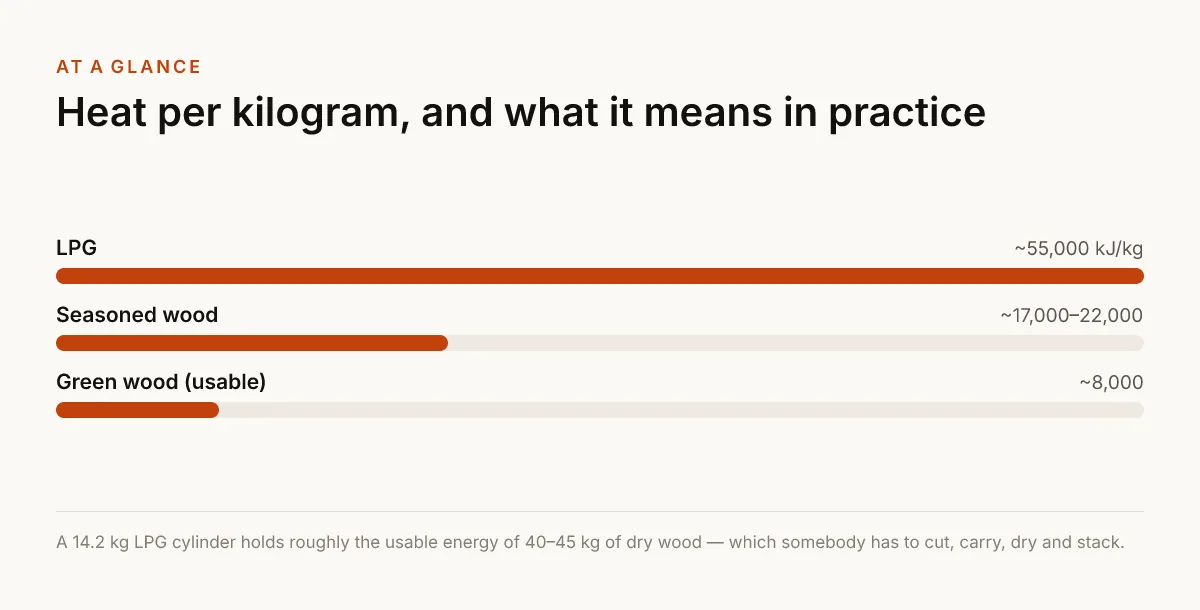
- LPG: ~55,000 kJ/kg. Wood: ~17,000–22,000 kJ/kg — roughly a threefold difference.
- LPG leaves no ash and produces no smoke; wood produces both heavily.
- LPG ignites instantly and its heat output is adjustable; wood is slow and hard to control.
- Burning wood indoors is a leading cause of household air pollution and respiratory disease.
- Using wood drives deforestation; LPG does not — though it is a non-renewable fossil fuel.
This looks like a dry comparison question, and it is actually one of the most consequential in the whole syllabus.
The reason is the third item on the list below. Calorific value and convenience matter, but the thing that changes lives is what stops going into the air of a small kitchen where somebody stands for three hours a day.
#The five reasons
#1. Much higher calorific value
| Fuel | Calorific value (kJ/kg) |
|---|---|
| LPG | ~55,000 |
| Wood (seasoned) | ~17,000–22,000 |
| Wood (green) | ~8,000 usable |
LPG delivers roughly three times the heat per kilogram of good dry wood, and closer to six times that of green wood.
The practical consequence is quantity. A 14.2 kg LPG cylinder holds about 780 MJ of energy. Getting that from wood requires roughly 40–45 kg — which someone has to cut, carry, dry, store and stack.
#2. It burns completely, without smoke or ash
LPG is a gas mixed with air before combustion, so it burns with a clean blue flame producing only carbon dioxide and water:
C3H8 + 5 O2 -> 3 CO2 + 4 H2O
Wood is a solid with variable moisture and structure. It burns in stages and rarely completely, producing:
- Fine particulate matter and soot
- Carbon monoxide
- Unburnt hydrocarbons, including formaldehyde and benzene
- Polycyclic aromatic hydrocarbons, some carcinogenic
- Ash requiring disposal
This is the health argument, and it is not marginal. Household air pollution from solid fuel cooking is associated with millions of premature deaths worldwide each year, concentrated among women and young children who spend the most time near the stove.
#3. Instant ignition and precise control
LPG lights immediately with a match or spark and reaches full heat within seconds. The flame is adjusted by a knob, from a simmer to full output instantly, and stops the moment it is turned off.
Wood must be kindled, takes time to reach useful heat, cannot easily be turned down, and continues burning after cooking finishes. Fuel is consumed whether or not it is being used.
#4. Easy storage and handling
A cylinder is compact, sealed, weatherproof and delivered. Wood requires drying for six to twenty-four months, dry covered storage space, protection from rain and insects, and physical labour — collecting firewood consumes hours of household time daily in many places, almost always women's and children's time.
#5. No deforestation
Wood for fuel drives forest degradation where harvesting outpaces regrowth, with knock-on effects: soil erosion, loss of watershed function, habitat loss, and further hours spent walking to find fuel.
LPG does not require cutting anything. This is why LPG access programmes are framed as environmental and gender-equity policy as much as energy policy.
#Side-by-side
| Property | LPG | Wood |
|---|---|---|
| Calorific value | ~55,000 kJ/kg | ~17,000–22,000 kJ/kg |
| Smoke | None | Heavy |
| Ash | None | Considerable |
| Ignition | Instant | Slow, needs kindling |
| Control | Precise, immediate | Poor |
| Utensils | Stay clean | Blacken with soot |
| Storage | Sealed cylinder | Needs dry space, long seasoning |
| Preparation labour | None | High |
| Renewable | No | Yes, if replanted |
| Cost | Purchased | Often free to gather |
#Where wood still wins
An honest answer notes two points:
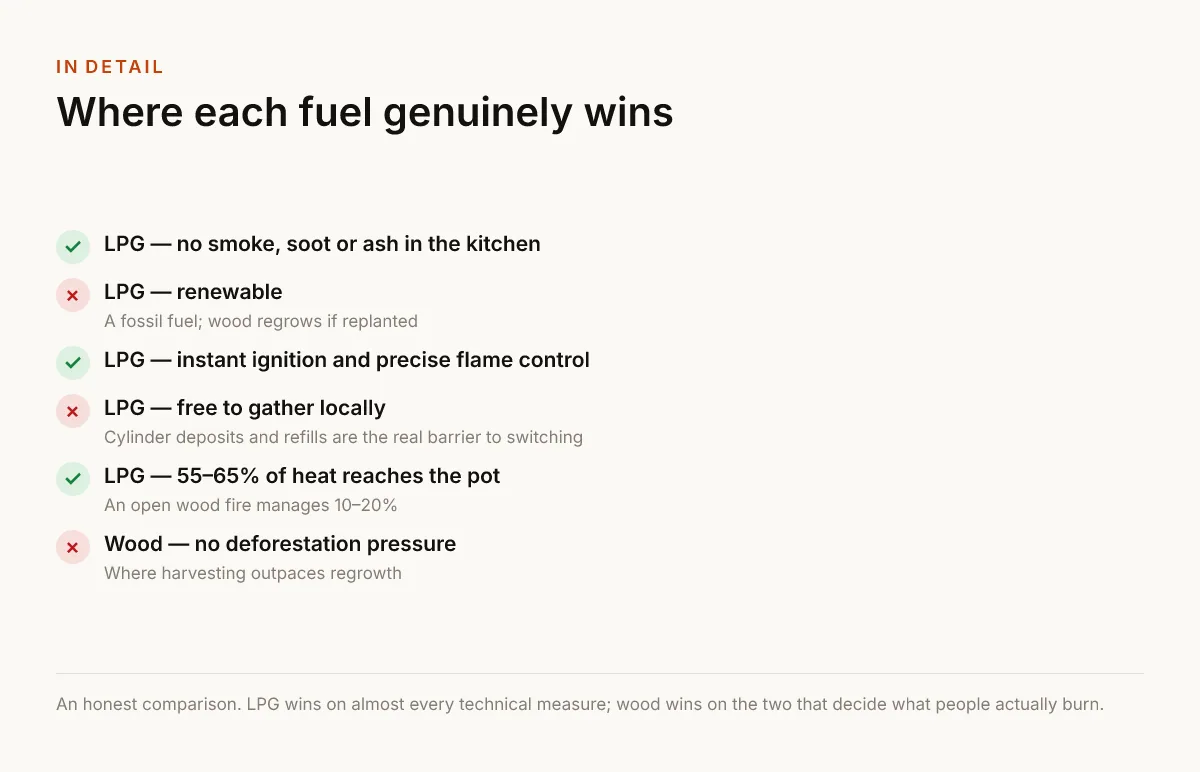
Renewability. Wood regrows; LPG does not. Sustainably harvested wood is roughly carbon-neutral in a way fossil LPG is not.
Cost and access. Wood may be gathered at no monetary cost, while LPG requires cylinder deposits, refill payments and a delivery network. That is precisely why subsidy and distribution programmes exist — the barrier to switching is almost always cash flow and availability, not preference.
The efficiency gap partly offsets this: an open wood fire delivers only 10–20% of its energy to the pot, against 55–65% for an LPG burner. So the effective fuel gap is even wider than the calorific values alone suggest.
The physics underneath is calorific value, and the reason wet wood performs even worse than the table suggests is covered in green wood is unfit as fuel.
#The compact answer
LPG is a better domestic fuel than wood because it has a much higher calorific value (about 55,000 kJ/kg compared with 17,000–22,000 kJ/kg for wood), so a small quantity produces a large amount of heat. It burns completely, producing no smoke, soot or ash, so it does not pollute the air or blacken utensils. It ignites instantly and its flame can be easily controlled. It is convenient to store and use, and it does not require cutting down trees.
Frequently asked questions
Give reasons why LPG is a better domestic fuel than wood.
LPG has a much higher calorific value, so less fuel gives more heat. It burns completely without producing smoke, soot or ash, so it does not pollute the kitchen or blacken utensils. It ignites immediately and its flame can be controlled precisely. It is easy to store and handle in cylinders, and its use does not require cutting down trees.
Is LPG better than wood in every way?
Not in every way. Wood is renewable if replanted and is often free or very cheap where it can be gathered locally, while LPG is a non-renewable fossil fuel that must be bought, delivered and stored in a pressurised cylinder. On calorific value, cleanliness, controllability and health, LPG is clearly better.
Why does wood smoke cause health problems?
Wood burns incompletely at typical stove temperatures, releasing fine particulate matter, carbon monoxide, formaldehyde, benzene and polycyclic aromatic hydrocarbons. Inhaled in an enclosed kitchen for hours daily, these cause respiratory infections, chronic obstructive pulmonary disease, eye problems and heart disease, affecting women and young children most.
What is LPG made of?
Liquefied petroleum gas is mainly propane and butane, obtained from crude oil refining and natural gas processing. It is stored as a liquid under moderate pressure in a steel cylinder and vaporises to a gas when the valve is opened, which is how a small cylinder holds so much energy.
Sources
Every figure above traces back to one of these. If you find one that does not, tell us and we will fix it.
- [1]Household air pollution and health — World Health Organization
- [2]Fuel properties comparison — U.S. Department of Energy, Alternative Fuels Data Center
Written by
Priya Raman — Energy science editor
Taught school science for eight years, then moved into writing about combustion and energy. Still explains things the way you would to a class.
- MSc Chemistry
- Eight years teaching physical science
- Science curriculum writer