The Wood Considered Unfit as Fuel Is Green, Unseasoned Wood
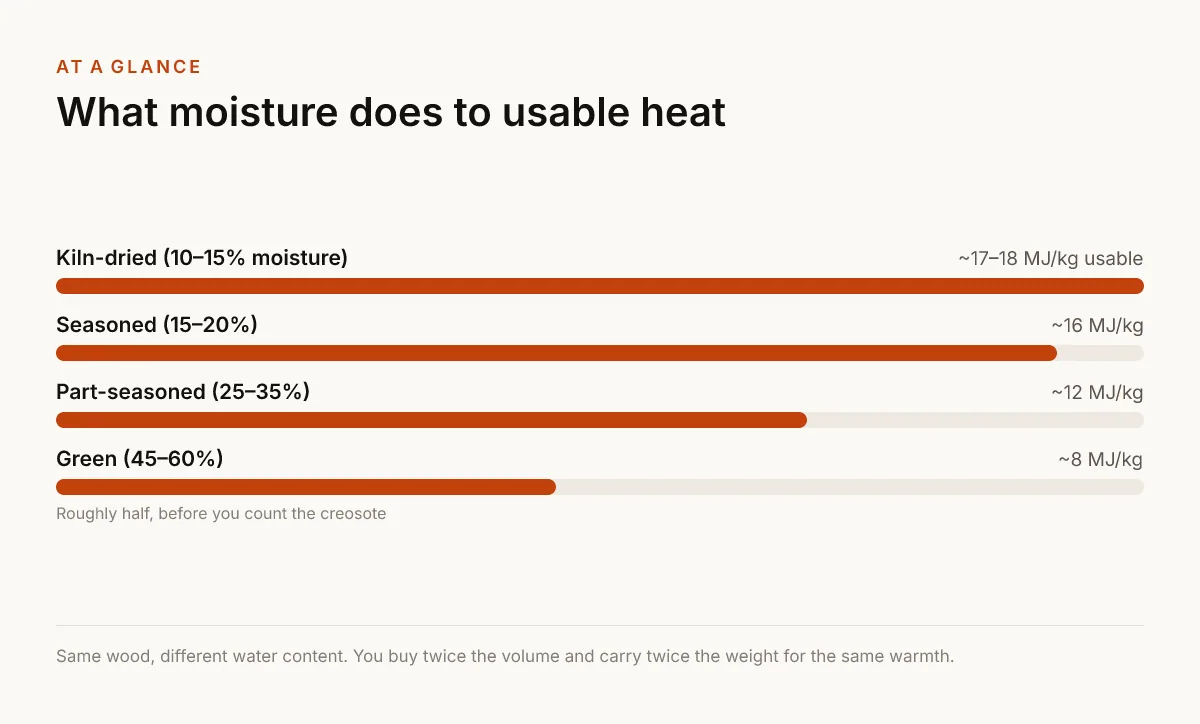
Freshly cut wood can be half water. That moisture halves the usable heat, produces heavy smoke and deposits creosote in your chimney.
Key takeaways
- Green wood can be 45–60% water by weight; seasoned wood is under 20%.
- Evaporating that water absorbs heat that would otherwise warm the room.
- Usable calorific value roughly halves: ~8 MJ/kg green against ~16–19 MJ/kg seasoned.
- Lower flame temperature means incomplete combustion, smoke and carbon monoxide.
- Creosote deposits from cool smoky flue gases are the main cause of chimney fires.
The first time I bought firewood I bought it wrong, and the giveaway was the sound. Put a green log on a hot fire and it hisses — that is water boiling out of the wood, using heat you paid for to make steam you do not want.
I got through that load feeling like the stove was underpowered. It was not. Roughly half of what I had bought was water, and the other half was busy evaporating it.
#What "green wood" means
Green or unseasoned wood is freshly cut timber that has not been dried. A living tree transports water continuously, so wood taken straight from a felled trunk carries a great deal of it.
| Wood condition | Moisture content | Suitability |
|---|---|---|
| Green / freshly cut | 45–60% | Unfit as fuel |
| Air-dried, partly seasoned | 25–35% | Poor |
| Seasoned | 15–20% | Good |
| Kiln-dried | 10–15% | Excellent |
Moisture content here is expressed on a wet basis: the mass of water as a fraction of total mass. Green wood at 50% is literally half water.
#Why the water matters so much
Water in wood does not merely dilute the fuel. It actively consumes heat.
To turn one kilogram of water at 20 °C into steam requires:
- Heating to 100 °C: about 336 kJ
- Latent heat of vaporisation: about 2,260 kJ
Around 2,600 kJ per kilogram of water, all of it taken from the fire and carried up the flue as invisible vapour.
Burn one kilogram of green wood at 50% moisture:
Dry wood content: 0.5 kg x ~19 MJ/kg  = 9.5 MJ released
Water present:    0.5 kg x ~2.6 MJ/kg = 1.3 MJ consumed
Net available:                          ~8.2 MJ/kg
Against seasoned wood at 15% moisture delivering roughly 16 MJ/kg of usable heat, green wood gives about half. You buy twice the wood, carry twice the weight and stack twice the volume for the same warmth.
#The knock-on effects
The heat loss is only the beginning, because the cooler fire causes everything else.
Lower flame temperature. Wood burns in two stages: water and volatile gases are driven off, then those volatiles burn above the fuel bed. That second stage needs high temperature. A fire cooled by evaporating water never gets hot enough to burn its own volatiles properly.
Heavy smoke. Unburnt volatiles leave as visible smoke — which is fuel you paid for, going up the chimney unburned. Wood smoke is also a significant source of fine particulate pollution, and in many areas the reason for burning restrictions.
Carbon monoxide. The same incomplete combustion that produces smoke produces carbon monoxide. In an appliance with a poor flue, that becomes a household hazard rather than an efficiency problem.
Creosote in the flue. Cool, tar-laden flue gases condense on chimney walls as creosote — a flammable deposit that builds into a layer capable of igniting. Chimney fires burn at extreme temperatures and can crack liners and spread into the building structure. Burning wet wood is the single largest contributor.
Difficult lighting and poor control. Green wood is hard to light, hisses, spits and produces an unresponsive fire.
#How to season wood properly
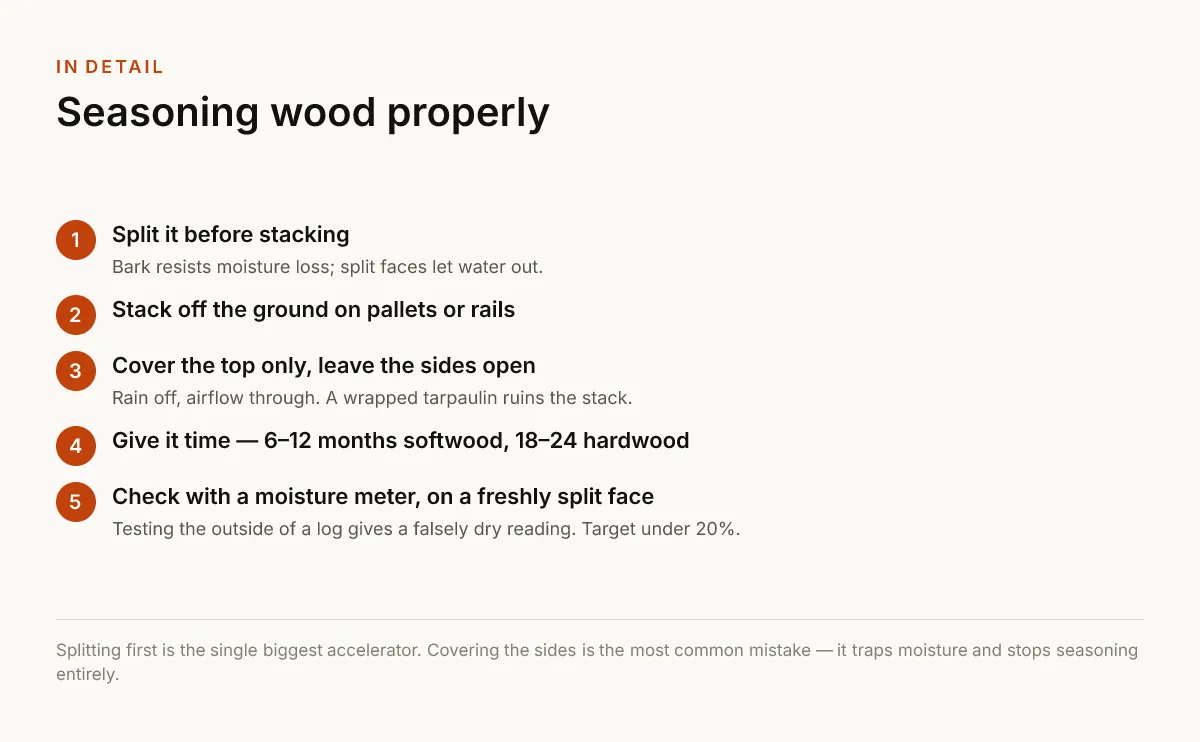
- Split it first. Bark resists moisture loss; split faces let water escape. Splitting is the single biggest accelerator of drying.
- Stack off the ground on pallets or rails so moisture is not drawn up from soil.
- Cover the top only. Rain must be kept off, but sides must stay open for airflow. Wrapping a stack in a tarpaulin traps moisture and prevents seasoning entirely.
- Choose a sunny, breezy spot.
- Allow enough time. Six to twelve months for softwoods, eighteen to twenty-four for dense hardwoods like oak.
- Verify with a moisture meter. They cost very little. Split a log and test the freshly exposed inner face — testing the outside of a log gives a falsely dry reading.
#Signs of well-seasoned wood
- Cracks radiating from the end grain
- Bark loose or falling off
- Grey, weathered colour rather than fresh
- Noticeably lighter than a green log of the same size
- A sharp knock when two pieces are struck together, rather than a dull thud
#Other wood that should not be burned
Green wood is the standard answer, but several other categories are genuinely unfit and worth knowing:
- Treated or painted timber — releases arsenic, chromium, lead and dioxins
- Plywood, MDF, chipboard — adhesives release formaldehyde and other toxics
- Driftwood — salt content produces corrosive and toxic compounds on burning
- Rotten or mouldy wood — low calorific value and airborne spores
- Large quantities of unseasoned resinous softwood — accelerates creosote build-up
The underlying principle is calorific value and how moisture destroys it, and the smoke it produces is incomplete combustion in action.
#The compact answer
The wood considered unfit as fuel is green or unseasoned wood — freshly cut wood with high moisture content, often 45–60% water. Much of the heat produced is used up in evaporating this water, so its usable calorific value is roughly half that of seasoned wood. It burns at a lower temperature, produces heavy smoke and carbon monoxide, and deposits creosote in chimneys.
Frequently asked questions
The wood considered unfit as fuel is which type?
Green or unseasoned wood — freshly cut wood that has not been dried. Its high moisture content, often 45–60%, means much of the combustion heat is used to evaporate water rather than to provide useful heating, and it burns poorly with heavy smoke.
How long does wood need to season?
Typically six to twenty-four months depending on species, split size, climate and stacking. Split, stacked off the ground and covered on top with open sides, softwoods may season in six to twelve months and dense hardwoods such as oak in eighteen to twenty-four. The target is under 20% moisture content, which a cheap moisture meter can verify.
Why does wet wood produce more smoke?
Evaporating water cools the fire, and the volatile gases driven out of the wood need high temperature to burn completely. At the lower temperature these volatiles escape unburnt as visible smoke, tar and carbon monoxide instead of being consumed in the flame.
What is creosote and why does it matter?
Creosote is a tarry deposit that forms when cool, smoke-laden flue gases condense on the inside of a chimney. It accumulates as a flammable layer, and it is the principal cause of chimney fires. Burning dry wood at a proper temperature dramatically reduces its formation.
Sources
Every figure above traces back to one of these. If you find one that does not, tell us and we will fix it.
- [1]Household air pollution and health — World Health Organization
- [2]Carbon Monoxide's Impact on Indoor Air Quality — U.S. Environmental Protection Agency
Written by
Dana Kerr — Editor — heating, stoves and indoor air
Twelve winters spent testing heaters in cold, draughty buildings, and a slightly obsessive interest in what a flame is actually doing.
- EPA 608 certified
- Former HVAC service writer
- 12 years covering domestic heating