Flueless Gas Heaters Explained: How They Are Legal, and Where They Are Not
Catalytic burners and oxygen depletion sensors make flueless gas fires legal in many places — but the room-size and ventilation rules are strict.
Key takeaways
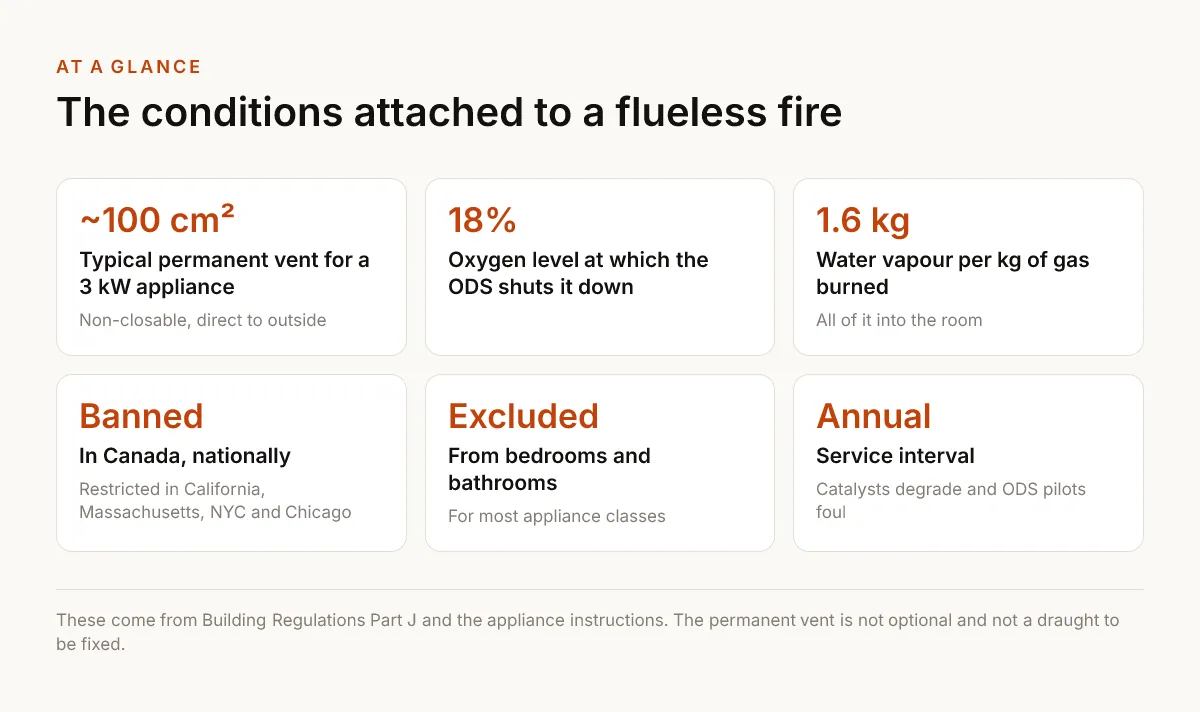
- Flueless fires need a permanent, non-closable air vent — typically around 100 cm² for a 3 kW appliance in the UK.
- Room volume minimums apply; a small sealed room cannot legally take a flueless fire.
- Canada prohibits vent-free heaters nationally; California, Massachusetts and several cities restrict or ban them.
- Installation must be by a registered gas professional (Gas Safe in the UK, licensed installer in the US).
- The appliance moves 100% of its heat and 100% of its water vapour into the room.
I can usually predict what I will find before I get through the door on a flueless fire call-out. Nine times out of ten, somebody has boarded over the air vent.
They are not being reckless. The vent is a hole in an external wall in the room you are trying to heat. It whistles. Blocking it makes the room feel warmer straight away. Nobody ever explained that the vent is part of the appliance, and that without it the whole safety case falls over.
So: a gas fire with no chimney sounds like it should not be allowed. It is allowed, under specific conditions, and those conditions are what this guide is about.
#How they burn clean enough
A conventional gas fire vents its combustion products up a flue precisely because they contain things you should not breathe. A flueless appliance addresses the problem at source:
- Catalytic converter. Many flueless fires pass combustion products over a catalyst that oxidises residual carbon monoxide to carbon dioxide and unburnt hydrocarbons to CO₂ and water. Manufacturers cite exhaust CO in single-digit ppm under test.
- Precision burner aeration. Vent-free burners are engineered for a very specific gas/air mix and are extremely sensitive to being run outside it — which is why they must be installed for the correct gas type and never modified.
- Oxygen depletion sensor. A pilot arrangement calibrated to extinguish and close the gas valve when room oxygen falls to about 18%.
The result under laboratory conditions is genuinely clean. The result in a real room depends on whether the room supplies the air the test assumed.
#The room rules
This is where flueless appliances are actually regulated, and the numbers are unforgiving.
United Kingdom. Building Regulations Part J and the manufacturer's instructions govern. A flueless space heater generally requires:
- A permanent, non-closable air vent to outside — commonly around 100 cm² of free area for a 3 kW appliance, with the exact figure per the appliance instructions.
- An openable window or equivalent in the room.
- A minimum room volume, stated per appliance, typically excluding rooms below a stated size.
- Installation and commissioning by a Gas Safe registered engineer. This is a legal requirement, not a warranty condition.
- Exclusion from bedrooms and bathrooms for most appliance classes.
United States. The relevant standard is ANSI Z21.11.2, adopted through state and local code. Where permitted, typical requirements include input-rating caps by room type (notably in bedrooms and bathrooms), minimum room volumes tied to BTU input, and an ODS on every unit. Canada prohibits vent-free gas heaters nationally. Within the US, California and Massachusetts restrict them, and cities such as New York and Chicago ban them.
Because this is local code, the only correct answer to "can I install one?" is: check with your local building or gas authority before buying.
#The permanent vent is not optional and not a draught
Almost every flueless installation failure has the same cause: someone sealed the air vent.
It happens for understandable reasons. The vent is a hole in an external wall in a room being deliberately heated; it whistles, it lets cold air in, and blocking it makes the room feel warmer immediately. It also removes the fixed ventilation the entire safety case is built on, converting a compliant appliance into an unvented flame in a sealed box.
If your flueless fire came with an air vent, that vent is part of the appliance. Blocking it, boxing it in behind furniture, or fitting a closable hit-and-miss cover over it invalidates the installation.
#Water vapour, again
Methane combustion:
CH4 + 2 O2 -> CO2 + 2 H2O
Roughly 1.6 kg of water per kilogram of gas burned, all of it into the room, because there is no flue. For a 3 kW fire running four hours a day, that is a meaningful daily moisture load added to a house that also has people, showers and cooking in it.
The visible symptom is condensation on glass. The expensive symptom appears months later as mould in the corners of external walls and behind furniture on cold walls. If you install a flueless fire, expect to manage humidity actively — which usually means the permanent vent plus periodic purge ventilation, and possibly a dehumidifier in the shoulder seasons.
#Flueless vs the alternatives
| Flueless | Balanced flue | Conventional flue | |
|---|---|---|---|
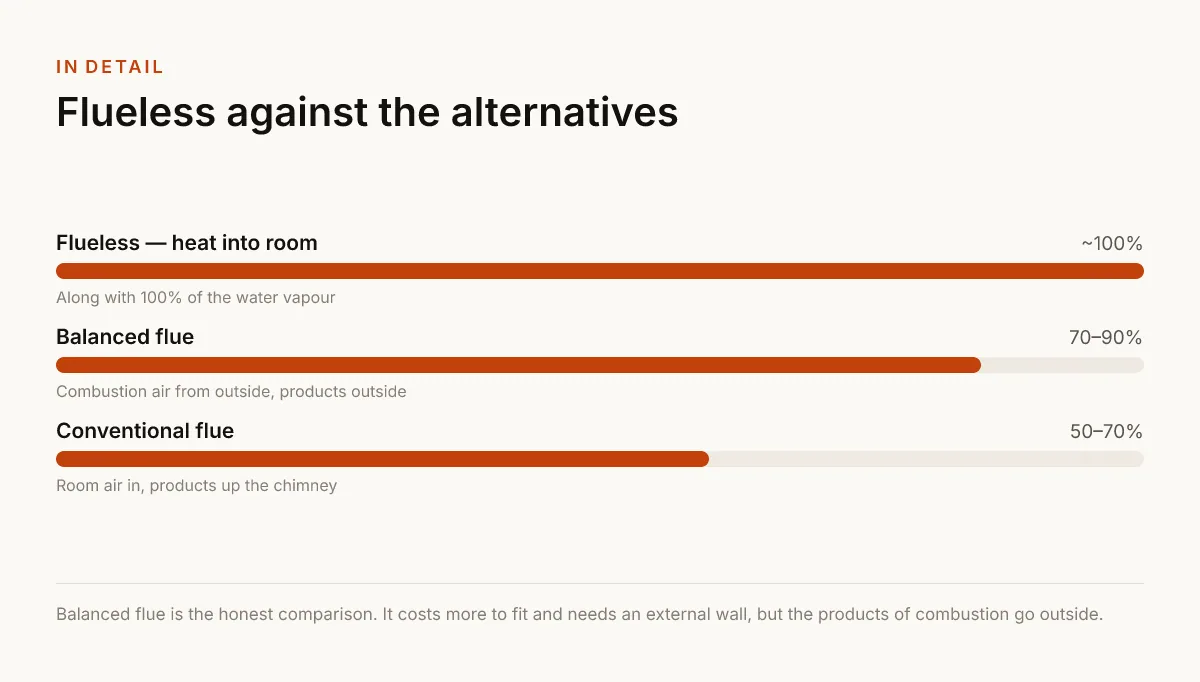
| Efficiency into room | ~100% | 70–90% | 50–70% |
| Combustion air source | Room | Outside | Room |
| Products of combustion | Into room | Outside | Outside |
| Chimney needed | No | No (wall terminal) | Yes |
| Water vapour indoors | All of it | None | None |
| Install cost | Lowest | Medium | Highest if lining needed |
Balanced flue is the honest comparison. It needs an external wall and a terminal, and it costs more to fit, but it draws combustion air from outside and sends products of combustion outside while still hitting 80–90% efficiency. In any room where you plan to sit for hours every evening, it is the better appliance, and the efficiency deficit against flueless is smaller than the air-quality advantage is large.
#Sensible use
If you have a compliant flueless fire installed by a registered engineer:
- Treat it as supplementary, occasional heating — an hour or two of top-up heat, not a primary heat source running all evening.
- Keep the permanent vent clear, always.
- Fit a CO alarm to EN 50291 or UL 2034 in the room anyway. The ODS protects against oxygen depletion; the alarm covers the failure modes the ODS does not see.
- Service annually. Catalysts degrade, ODS pilots foul, and injectors block.
- Watch the windows. Persistent condensation while it runs means the room is not getting the air exchange the design assumed.
Flueless gas heating is real engineering, legally installed in millions of homes. It is also the appliance class where the gap between "installed to the manufacturer's instructions" and "installed the way people actually live with it" does the most damage.
The mechanism the ODS is protecting against is incomplete combustion, and every flueless installation should also have a certified CO alarm in the room.
Frequently asked questions
Are flueless gas fires safe?
Correctly specified, professionally installed and used in a room with the required permanent ventilation, they meet recognised safety standards and burn very cleanly. The risks come from installation in undersized rooms, blocked or deliberately sealed air vents, and use as a primary all-day heat source rather than as supplemental heating.
Do flueless gas fires cause condensation?
Yes. Complete combustion of methane produces roughly 1.6 kg of water vapour per kilogram of gas burned and, with no flue, all of it enters the room. In an under-ventilated or poorly insulated room this shows up as streaming windows and, over a season, mould on cold external walls.
Where are vent-free gas heaters banned?
Canada bans them nationally. In the US, California and Massachusetts restrict them, and cities including New York and Chicago have their own prohibitions; several other states limit them by room type or input rating. Always check current local code — the picture changes and enforcement is local.
Can a flueless gas fire go in a bedroom?
Generally no for room heaters of usual size. UK guidance excludes bedrooms and bathrooms for most flueless appliances, and US codes cap input ratings in bedrooms and bathrooms sharply where they are permitted at all. Sleeping spaces are exactly the wrong place for an unvented flame.
Sources
Every figure above traces back to one of these. If you find one that does not, tell us and we will fix it.
- [1]Gas safety in the home — UK Health and Safety Executive
- [2]Carbon Monoxide's Impact on Indoor Air Quality — U.S. Environmental Protection Agency
Written by
Marcus Hale — Contributing gas engineer
Working Gas Safe engineer. Services flued and flueless appliances all week and fact-checks everything on this site that involves a gas pipe.
- Gas Safe registered (UK)
- 15 years in the field
- CCN1, CENWAT, HTR1 assessed