Indoor Fuel Cost Per Hour: Kerosene vs Propane vs Natural Gas vs Electric
Cost per usable kWh for every common indoor heating fuel, with the arithmetic shown so you can redo it at your own prices.
Key takeaways
- Compare fuels on cost per usable kWh, never on cost per gallon or per litre.
- Energy content: kerosene ≈ 37.5 kWh/US gal, propane ≈ 26.8 kWh/US gal, natural gas ≈ 0.293 kWh/cu ft.
- Unvented heaters put ~100% of the fuel energy in the room — along with 100% of the water vapour and combustion products.
- A heat pump at COP 3 beats every combustion fuel per unit of delivered heat where electricity is under ~3x the gas price.
- Run costs shift with local fuel prices; the formula matters more than the table.
Someone once told me confidently that their kerosene heater was cheaper to run than their electric one, and they were right — but not for the reason they thought, and not by nearly as much as they believed.
The problem is that fuel prices are quoted in units that cannot be compared. Cents per gallon, dollars per cylinder, pence per therm. A gallon of propane and a gallon of kerosene hold very different amounts of energy, so the price per gallon tells you almost nothing.
There is only one number worth comparing, and it takes about a minute to work out.
#The formula
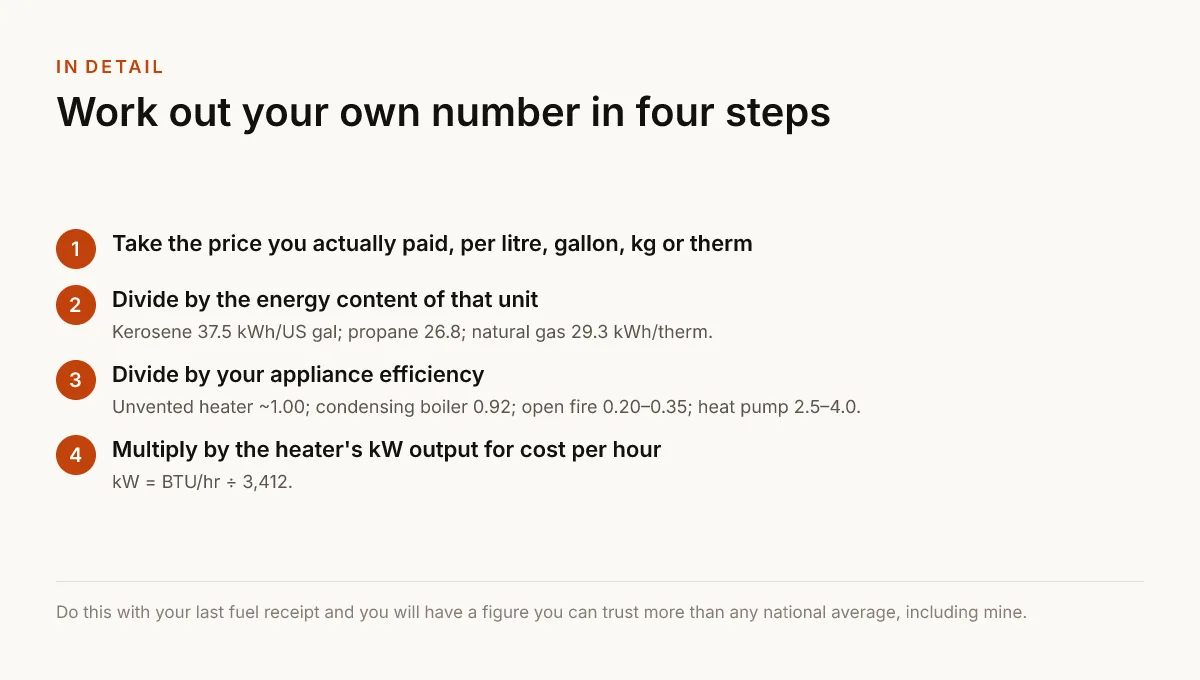
cost per usable kWh = (price per unit) / (kWh per unit x appliance efficiency)
Three inputs. The first you read off a pump or a bill. The second is physics. The third is the appliance.
#Energy content by fuel
| Fuel | Unit | Energy per unit |
|---|---|---|
| Kerosene (1-K) | US gallon | 37.5 kWh (128,000 BTU) |
| Kerosene (1-K) | litre | 9.9 kWh |
| Propane | US gallon | 26.8 kWh (91,500 BTU) |
| Propane | kg | 13.8 kWh |
| Natural gas | cubic foot | 0.293 kWh (1,000 BTU) |
| Natural gas | therm | 29.3 kWh (100,000 BTU) |
| Heating oil | US gallon | 40.6 kWh (138,500 BTU) |
| Anthracite coal | kg | 8.6 kWh |
| Electricity | kWh | 1.0 kWh |
#Appliance efficiency
| Appliance | Usable fraction |
|---|---|
| Unvented kerosene/propane heater | ~1.00 |
| Vented gas room heater | 0.70–0.80 |
| Modern condensing gas boiler | 0.90–0.94 |
| Open solid-fuel fire | 0.20–0.35 |
| Closed stove, well operated | 0.65–0.80 |
| Resistance electric heater | 1.00 |
| Air-source heat pump | 2.5–4.0 (COP) |
#Worked examples at mid-2026 prices
Kerosene at $4.50/US gal, unvented heater:
4.50 / (37.5 x 1.00) = $0.120 per usable kWh
Propane at $4.20/US gal, unvented heater:
4.20 / (26.8 x 1.00) = $0.157 per usable kWh
Natural gas at $1.60/therm, vented heater at 0.75:
1.60 / (29.3 x 0.75) = $0.073 per usable kWh
Natural gas at $1.60/therm, condensing boiler at 0.92:
1.60 / (29.3 x 0.92) = $0.059 per usable kWh
Electricity at $0.16/kWh, resistance heater:
0.16 / (1 x 1.00) = $0.160 per usable kWh
Electricity at $0.16/kWh, heat pump at COP 3:
0.16 / (1 x 3.00) = $0.053 per usable kWh
#The ranking
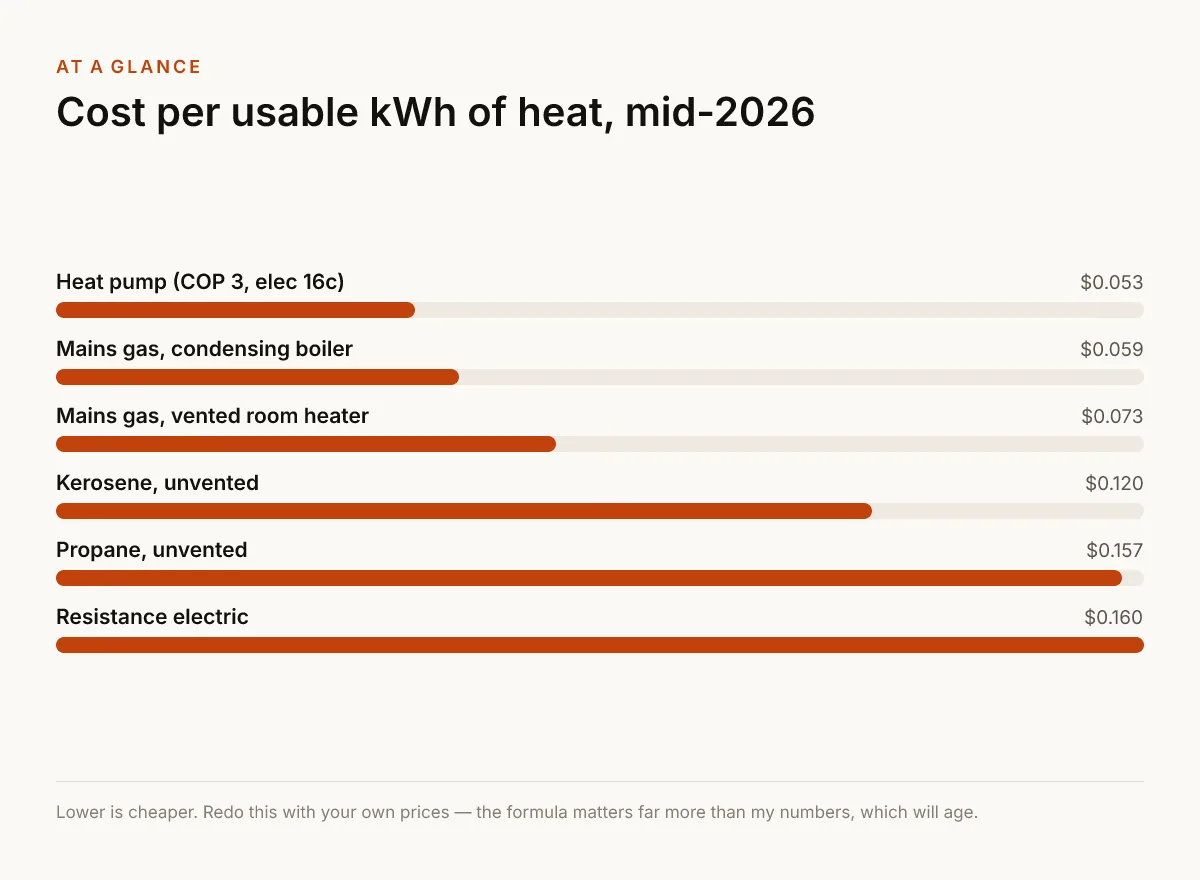
- Heat pump — $0.053
- Mains gas, condensing — $0.059
- Mains gas, vented room heater — $0.073
- Kerosene, unvented — $0.120
- Propane, unvented — $0.157
- Resistance electric — $0.160
Two things fall out of this. First, portable fuel heaters are mid-table, not cheap. Their reputation for cheap heat comes from comparing them against resistance electric at peak tariff, which is the most expensive option on the list. Second, if you have a gas main, you already have the cheapest combustion heat available, and a portable propane or kerosene heater is a step backwards on cost as well as on air quality.
#Cost per hour, by heater size
Once you have cost per kWh, hourly cost is just output times price. Divide BTU/hr by 3,412 to get kW.
| Heater | Output | kW | Cost/hr (kerosene @ $0.12) | Cost/hr (propane @ $0.157) |
|---|---|---|---|---|
| Small radiant | 9,000 BTU/hr | 2.64 | $0.32 | $0.41 |
| Mid radiant | 15,000 BTU/hr | 4.40 | $0.53 | $0.69 |
| Large convection | 23,000 BTU/hr | 6.74 | $0.81 | $1.06 |
| Tank-top radiant | 30,000 BTU/hr | 8.79 | $1.05 | $1.38 |
An eight-hour evening on a mid-size kerosene heater is therefore roughly $4.25; the same evening on propane is about $5.50. Neither is trivial across a winter, and neither is the disaster that headline electricity prices suggest.
#What the arithmetic leaves out
Duty cycle. These figures assume continuous full output. A thermostatic heater in a moderately insulated room may run 40–60% of the time, cutting real cost proportionally. A wick heater without thermostatic control genuinely does run flat out.
Zonal heating. The strongest cost argument for a portable heater is not its cost per kWh — it is that heating one occupied room at $0.81/hr beats heating a whole house at $0.06/kWh when the house needs 8 kW to hold temperature. Fuel choice and heating strategy are separate decisions, and the strategy usually saves more money.
Water vapour and ventilation losses. Unvented "100% efficient" heating requires you to open a window. Some of the heat you paid for leaves through that opening, and the moisture load has its own costs in condensation and, eventually, fabric damage. The honest efficiency of an unvented heater in a properly ventilated room is meaningfully below 1.0 — it is just that nobody can put a clean number on it.
Standing charges and delivery minimums. Propane cylinder exchange carries a premium over bulk refill; kerosene bought in 5-gallon jugs at a hardware store can run 40% above bulk pump prices. Buy in the largest quantity you can store safely and legally.
#Redo it with your own numbers
Prices move, and regional spreads are large. Take your last fuel receipt, divide by the energy content in the table, divide by your appliance efficiency, and you have a number you can trust more than any national average — including this one.
The energy content figures come from calorific value, and the safety conditions attached to the cheapest options are in are kerosene heaters safe indoors and propane heater ventilation.
Frequently asked questions
Is it cheaper to run a kerosene heater or electric heater?
Usually kerosene, but the gap is smaller than people assume. At $4.50/gal, kerosene delivers heat at about 12 cents per usable kWh; resistance electric at $0.16/kWh delivers at 16 cents. Under a cheap overnight tariff, or against an air-source heat pump at COP 3 (roughly 5 cents per delivered kWh), electricity wins outright.
How much does it cost to run a 23,000 BTU kerosene heater for 8 hours?
23,000 BTU/hr is about 6.74 kW. Over 8 hours that is 53.9 kWh, or about 1.44 US gallons of kerosene. At $4.50 a gallon, roughly $6.47 for the night — assuming continuous full output, which most heaters do not run at.
Why is propane more expensive than natural gas per unit of heat?
Propane is delivered by truck in pressurised cylinders and priced as a retail commodity with distribution costs baked in; natural gas arrives by pipeline as a regulated utility. Per usable kWh, piped natural gas is typically two to four times cheaper, which is why propane dominates only where there is no gas main.
Do unvented heaters really run at 100% efficiency?
At the appliance, effectively yes: with no flue there is nowhere for heat to escape except the room. That number is honest about energy and silent about air quality — the same absence of a flue that keeps the heat inside keeps the water vapour, nitrogen dioxide and any carbon monoxide inside too.
Sources
Every figure above traces back to one of these. If you find one that does not, tell us and we will fix it.
- [1]Energy conversion calculators — U.S. Energy Information Administration
- [2]Fuel properties comparison — U.S. Department of Energy, Alternative Fuels Data Center
- [3]Carbon dioxide emissions coefficients by fuel — U.S. Energy Information Administration
Written by
Dana Kerr — Editor — heating, stoves and indoor air
Twelve winters spent testing heaters in cold, draughty buildings, and a slightly obsessive interest in what a flame is actually doing.
- EPA 608 certified
- Former HVAC service writer
- 12 years covering domestic heating