Calorific Value of a Fuel: Definition, Units and How to Calculate It
Calorific value is the heat from burning one kilogram of fuel completely. Expressed in kJ/kg, and here is how it is measured and compared.
Key takeaways
- Calorific value = heat produced ÷ mass of fuel burned.
- Unit: kJ/kg for solids and liquids, kJ/m³ for gases; SI unit J/kg.
- Higher calorific value means less fuel needed for the same heat.
- Gross (higher) calorific value includes the latent heat of condensing water vapour; net (lower) does not.
- Measured in the laboratory with a bomb calorimeter.
The lesson that finally made this land was not a definition. It was a shopping question: is a cylinder of LPG expensive?
You cannot answer that from the price on the cylinder, because what people actually mean is "expensive for the amount of cooking it does". To answer that, you need to know how much heat is in a kilogram of the stuff — which is calorific value.
Once the class saw it as the conversion between a price and a result, the unit and the formula stopped being things to memorise.
#Definition
The calorific value of a fuel is the amount of heat energy produced when one unit mass of the fuel is burned completely in oxygen.
Two words in that sentence carry weight:
- Completely — all the carbon becomes carbon dioxide and all the hydrogen becomes water. Incomplete combustion releases less heat and produces carbon monoxide and soot.
- Unit mass — one kilogram, for solids and liquids. Gases are measured per unit volume instead, because a kilogram of gas is an awkward quantity to picture.
#Units
| Fuel type | Common unit | SI unit |
|---|---|---|
| Solid | kJ/kg | J/kg |
| Liquid | kJ/kg | J/kg |
| Gas | kJ/m³ | J/m³ |
Where older or regional units appear:
- cal/g or kcal/kg — 1 cal = 4.184 J, so 1 kcal/kg = 4.184 kJ/kg
- MJ/kg — 1 MJ/kg = 1,000 kJ/kg
- BTU/lb — common in North American engineering; 1 BTU/lb ≈ 2.326 kJ/kg
- kWh/kg — used in energy costing; 1 kWh = 3,600 kJ
The exam-standard answer to "calorific value is expressed in" is kJ/kg.
#Typical values
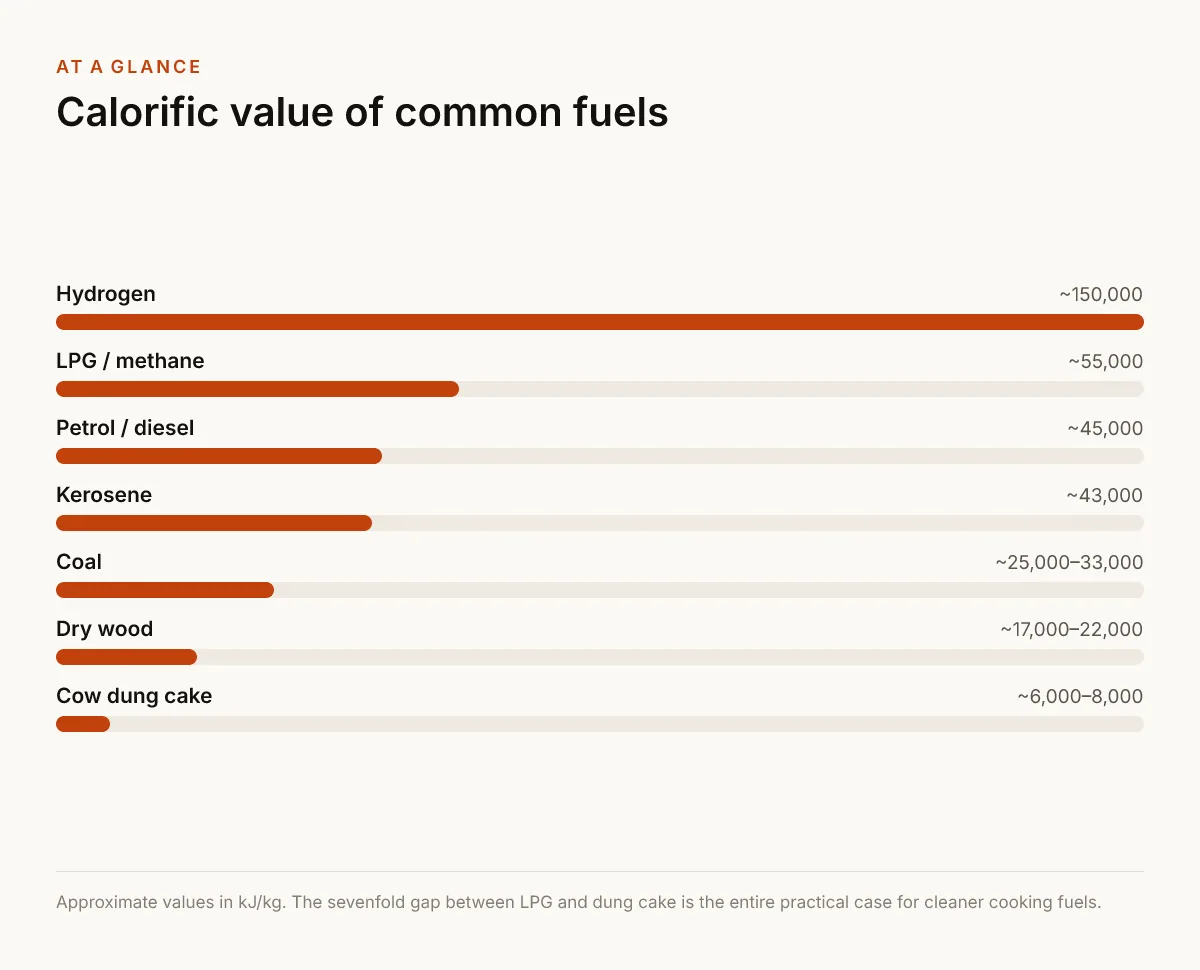
| Fuel | Calorific value (kJ/kg) |
|---|---|
| Hydrogen | ~150,000 |
| Methane / natural gas | ~55,000 |
| LPG | ~55,000 |
| Petrol | ~45,000 |
| Kerosene | ~43,000 |
| Diesel | ~45,000 |
| Biogas | ~35,000–40,000 |
| Anthracite coal | ~30,000–35,000 |
| Charcoal | ~30,000 |
| Bituminous coal | ~25,000–33,000 |
| Dry wood | ~17,000–22,000 |
| Cow dung cake | ~6,000–8,000 |
Two things stand out. Hydrogen is far ahead of everything else by mass, which is why it is the standard answer to "which fuel has the highest calorific value". And the gap between LPG and cow dung is about sevenfold, which is the entire practical argument for cleaner domestic fuels.
#How it is measured
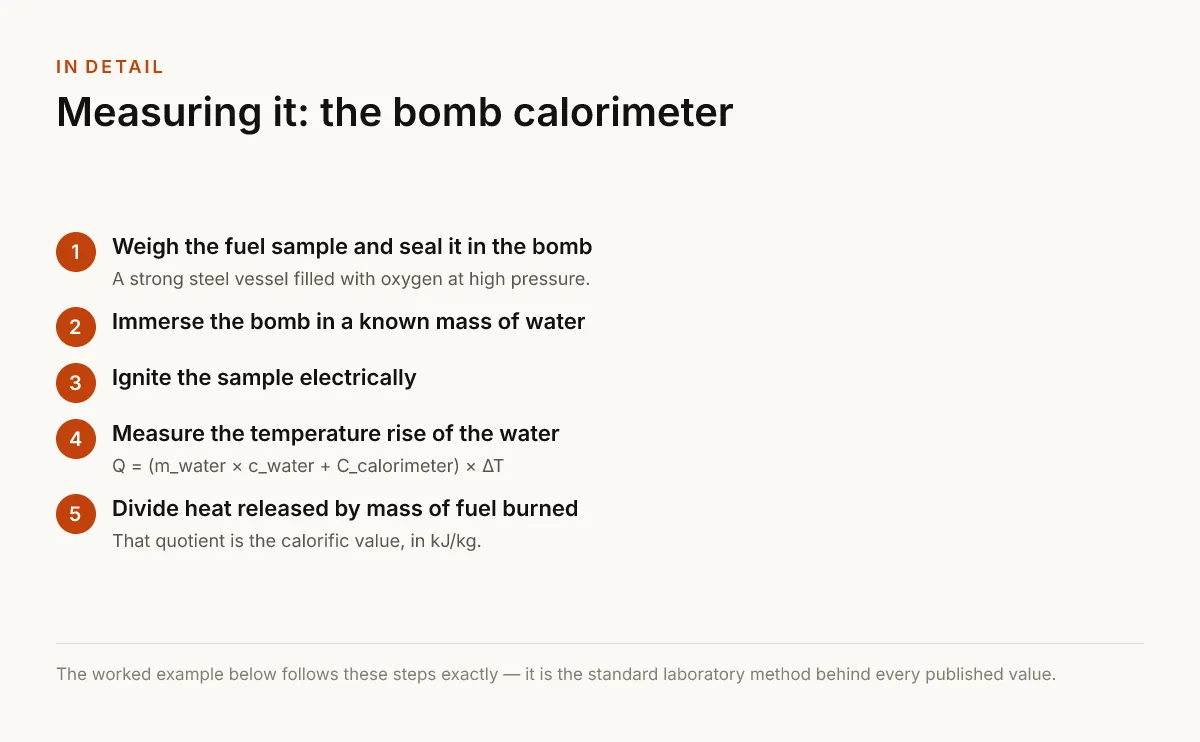
The laboratory instrument is a bomb calorimeter:
- A weighed sample of fuel is sealed in a strong steel vessel — the "bomb" — filled with oxygen at high pressure.
- The bomb is immersed in a known mass of water.
- The sample is ignited electrically.
- The temperature rise of the water is measured precisely.
The heat released is then:
Q = (m_water x c_water + C_calorimeter) x ΔT
and the calorific value is:
CV = Q / mass of fuel burned
Worked example. Burning 2 g of a fuel raises the temperature of 2 kg of water by 5.4 °C. Taking the specific heat capacity of water as 4.2 kJ/kg°C and ignoring the calorimeter's own capacity:
Q = 2 x 4.2 x 5.4 = 45.36 kJ
CV = 45.36 kJ / 0.002 kg = 22,680 kJ/kg
That is roughly the value of a good bituminous coal.
#Gross versus net calorific value
Burning any hydrogen-containing fuel produces water. Whether you count the energy released when that water condenses gives two different figures:
- Gross (higher) calorific value — GCV/HCV. Includes the latent heat of condensation. This is what a bomb calorimeter measures, because the vessel cools and the water condenses inside it.
- Net (lower) calorific value — NCV/LCV. Excludes it, because in most real appliances the water leaves up the flue as vapour and the latent heat goes with it.
The difference is typically 5–10%, and larger for hydrogen-rich fuels. Condensing boilers are named for exactly this: they cool the flue gas enough to condense the water and recover that latent heat, which is how they achieve efficiencies quoted above 90% on a net basis.
#What affects a fuel's calorific value
- Carbon and hydrogen content. Hydrogen releases far more heat per kilogram than carbon, so hydrogen-rich fuels rate higher.
- Moisture. Water absorbs heat to evaporate and contributes none, which is why green wood performs so much worse than seasoned wood.
- Ash and mineral matter. Incombustible, and so pure dead weight — the reason high-ash coal delivers less heat per tonne.
- Oxygen already in the fuel. Partially oxidised fuels such as ethanol and wood have less energy left to release.
#Why it matters practically
Calorific value converts a price into a cost of heat:
cost per unit of heat = fuel price per kg ÷ calorific value
A fuel at half the price per kilogram but one-third the calorific value is more expensive to use, not less. This is the arithmetic behind every honest heating-fuel comparison, and it is why cost per kilowatt-hour, not cost per litre or per cylinder, is the number worth comparing.
Two follow-ons worth reading: which fuel has the highest calorific value, and why moisture in green wood destroys so much of the value the table promises.
#The compact answer
The calorific value of a fuel is the amount of heat energy produced by the complete combustion of one kilogram of the fuel. It is expressed in kilojoules per kilogram (kJ/kg) for solid and liquid fuels and kilojoules per cubic metre (kJ/m³) for gaseous fuels. Its SI unit is J/kg. A good fuel has a high calorific value.
Frequently asked questions
Calorific value of a fuel is expressed in which unit?
In kilojoules per kilogram (kJ/kg) for solid and liquid fuels, and kilojoules per cubic metre (kJ/m³) for gaseous fuels. The SI unit is joule per kilogram (J/kg). Older texts use calories per gram or, in some engineering contexts, BTU per pound.
What is the calorific value of a fuel?
The calorific value of a fuel is the amount of heat energy produced by the complete combustion of one kilogram of that fuel. For example, the calorific value of LPG is about 55,000 kJ/kg, meaning burning one kilogram of LPG completely releases roughly 55,000 kilojoules of heat.
How do you calculate calorific value?
Divide the total heat energy released by the mass of fuel burned: calorific value = heat produced (in kJ) ÷ mass of fuel (in kg). In a laboratory the heat is measured with a bomb calorimeter, using Q = mcΔT for the surrounding water and the calorimeter's own heat capacity.
What is the difference between gross and net calorific value?
Gross (or higher) calorific value includes the latent heat recovered when the water vapour formed during combustion condenses. Net (or lower) calorific value excludes it, because in most real appliances the water leaves as vapour. Net values are lower, typically by 5–10%, and are the more realistic figure for ordinary equipment.
Sources
Every figure above traces back to one of these. If you find one that does not, tell us and we will fix it.
- [1]Energy conversion calculators — U.S. Energy Information Administration
- [2]Fuel properties comparison — U.S. Department of Energy, Alternative Fuels Data CenterSource of the energy content figures used in the table.
Written by
Priya Raman — Energy science editor
Taught school science for eight years, then moved into writing about combustion and energy. Still explains things the way you would to a class.
- MSc Chemistry
- Eight years teaching physical science
- Science curriculum writer