The SI Unit of Specific Fuel Consumption
Specific fuel consumption is fuel mass per unit of energy produced. Its SI unit is kg/J; engineers quote g/kWh, and jet engines kg/(N·h).
Key takeaways
- SFC = fuel mass flow rate ÷ power output.
- SI unit: kg/J, equivalently kg/(W·s).
- Practical unit for engines: g/kWh; typical diesel values around 200–250 g/kWh.
- Lower SFC means a more efficient engine.
- Jet engines use thrust specific fuel consumption instead, in kg/(N·h).
Here is a fact that sounds wrong: the most fuel-efficient engine in common use is the enormous two-stroke diesel in a container ship, burning tonnes of fuel an hour.
It makes sense as soon as you stop measuring fuel per hour and start measuring fuel per unit of work delivered. That measure is specific fuel consumption, and it is the only fair way to compare a ship engine with a scooter.
#Definition and formula
Specific fuel consumption (SFC) is the mass of fuel consumed per unit of power output per unit time.
SFC = fuel mass flow rate / power output
Dimensionally:
SFC = (kg/s) / W = kg / (W·s) = kg/J
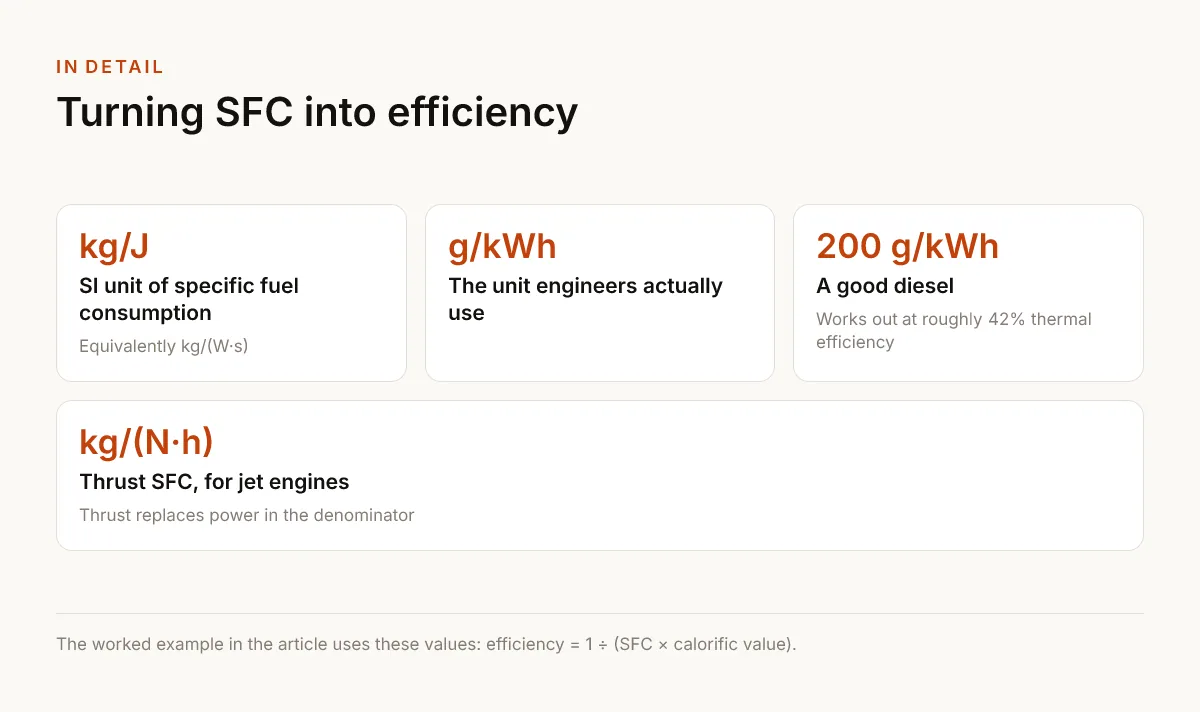
Since a watt-second is a joule, the SI unit of specific fuel consumption is kg/J.
#Why kg/J is impractical, and what is used instead
The SI unit produces awkward numbers. A good diesel engine has an SFC of around 0.00000006 kg/J — six followed by eight leading zeros, which nobody can read at a glance.
Engineering practice therefore uses grams per kilowatt-hour (g/kWh):
1 g/kWh = 1 x 10^-6 kg / 3.6 x 10^6 J = 2.78 x 10^-13 kg/J
Typical values become readable:
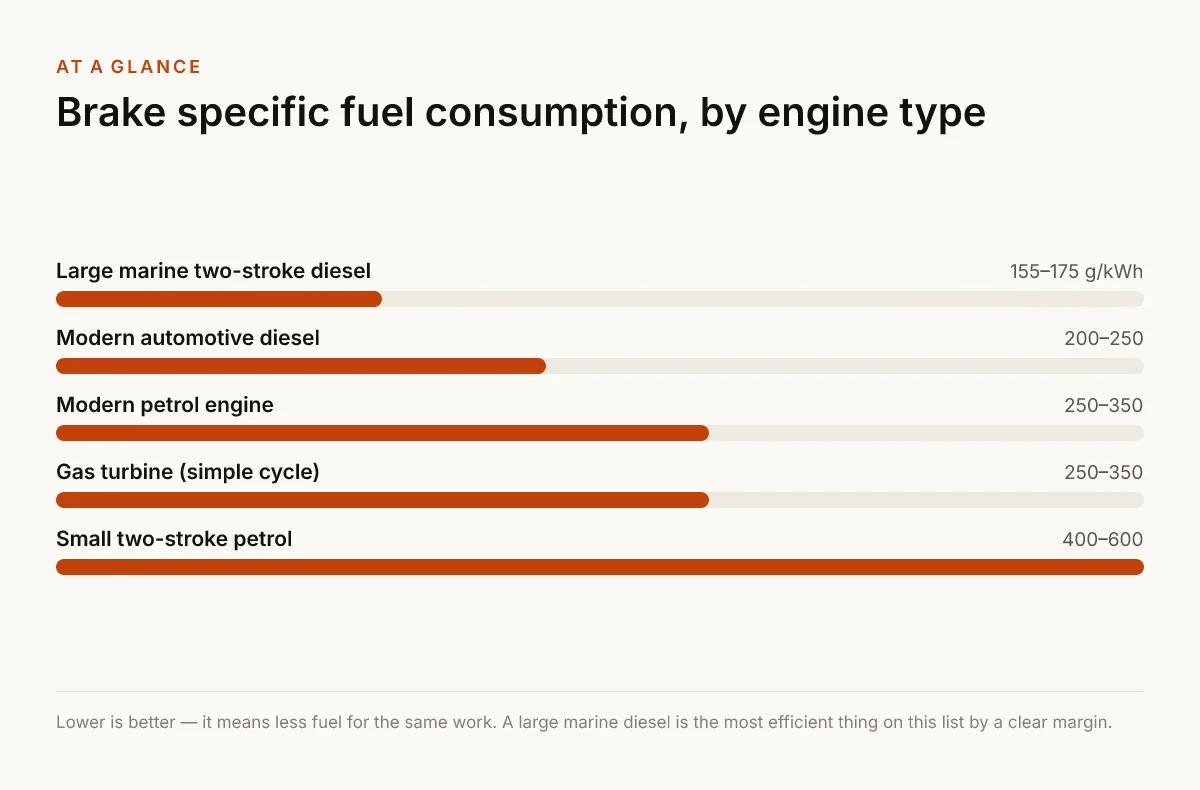
| Engine type | Typical BSFC (g/kWh) |
|---|---|
| Large marine two-stroke diesel | 155–175 |
| Modern automotive diesel | 200–250 |
| Modern petrol engine | 250–350 |
| Petrol engine at part load | 350–500 |
| Small two-stroke petrol | 400–600 |
| Gas turbine (simple cycle) | 250–350 |
Older texts and US practice may use lb/(hp·h); 1 lb/(hp·h) ≈ 608 g/kWh.
#Brake, indicated and other variants
The measurement point matters:
- Brake specific fuel consumption (BSFC) — measured against brake power at the output shaft, i.e. useful work delivered. This is the standard comparative figure.
- Indicated specific fuel consumption (ISFC) — measured against indicated power developed inside the cylinder, before friction and pumping losses. Always lower than BSFC.
The difference between them is the mechanical loss in the engine.
#The link to efficiency
SFC and thermal efficiency are two views of the same quantity:
thermal efficiency = 1 / (SFC x calorific value)
Worked example. A diesel engine with BSFC = 200 g/kWh, fuel calorific value 43 MJ/kg:
Fuel energy per kWh = 0.200 kg x 43,000 kJ/kg = 8,600 kJ
Output per kWh      = 3,600 kJ
Efficiency          = 3,600 / 8,600 = 41.9%
So a BSFC of 200 g/kWh corresponds to roughly 42% thermal efficiency — about right for a good modern diesel.
This relationship is why SFC is the more useful workshop number: it is measured directly from fuel mass and shaft power, without needing to assume anything about the fuel.
#Jet engines: thrust specific fuel consumption
An aircraft engine in cruise produces thrust, not shaft power, so the denominator changes:
TSFC = fuel mass flow rate / thrust
Dimensionally kg/(N·s) in SI, usually quoted as kg/(N·h) or, in US practice, lb/(lbf·h).
| Engine | Approx. cruise TSFC |
|---|---|
| Early turbojet | 0.10–0.12 kg/(N·h) |
| Low-bypass turbofan | 0.075–0.085 kg/(N·h) |
| Modern high-bypass turbofan | 0.055–0.065 kg/(N·h) |
The roughly 45% improvement from early turbojets to modern turbofans is most of the reason air travel became affordable.
#Why the metric matters
Comparing across sizes. A ship engine burns thousands of times more fuel per hour than a car engine and is more efficient. Only a specific measure reveals that.
Operating cost. For an airline or shipping line, fuel dominates operating cost, so a few percent in SFC decides fleet purchases.
Design and tuning. Engineers map BSFC across the whole speed-load range. The resulting contour map — the "BSFC island" — shows where an engine is most efficient, and hybrid powertrains are controlled specifically to keep the engine inside that island.
#Related but different measures
Do not confuse SFC with these:
- Fuel economy — distance per volume (km/L, mpg). A vehicle measure, not an engine measure.
- Fuel consumption rate — volume or mass per hour (L/h). Says nothing about output.
- Heat rate — for power stations, energy input per unit electrical output (kJ/kWh or BTU/kWh).
SFC is the engine-level measure that removes both size and fuel type from the comparison.
The related property for diesel fuel quality is cetane number, and for the fuel itself, calorific value — both appear in the efficiency formula.
#The compact answer
Specific fuel consumption is the mass of fuel consumed per unit of energy produced. Its SI unit is kg/J, equivalently kg/(W·s). In practice it is expressed in g/kWh for engines, and as thrust specific fuel consumption in kg/(N·h) for jet engines. A lower value indicates a more efficient engine.
Frequently asked questions
The SI unit of specific fuel consumption is?
Kilogram per joule (kg/J), which is the same as kg/(W·s), since specific fuel consumption is the mass of fuel consumed per unit of energy produced. In practice engineers quote it in grams per kilowatt-hour (g/kWh), which is more convenient in magnitude.
What is brake specific fuel consumption?
Brake specific fuel consumption (BSFC) is the fuel mass flow rate divided by the brake power measured at the engine output shaft. It is the standard way of comparing the fuel efficiency of engines independently of their size, since it expresses fuel used per unit of useful work delivered.
How is specific fuel consumption related to efficiency?
They are inversely related. Thermal efficiency equals 1 divided by the product of SFC and the fuel's calorific value. A lower SFC means less fuel is consumed for the same output, so efficiency is higher. A BSFC of 200 g/kWh with diesel at about 43 MJ/kg corresponds to roughly 42% thermal efficiency.
What is thrust specific fuel consumption?
For jet engines, power output is not the meaningful measure — thrust is. Thrust specific fuel consumption is the fuel mass flow rate divided by thrust produced, with SI unit kg/(N·s), commonly quoted as kg/(N·h) or lb/(lbf·h). Modern high-bypass turbofans achieve roughly 0.055 kg/(N·h) in cruise.
Sources
Every figure above traces back to one of these. If you find one that does not, tell us and we will fix it.
- [1]Fuel properties comparison — U.S. Department of Energy, Alternative Fuels Data Center
- [2]Energy conversion calculators — U.S. Energy Information Administration
Written by
Priya Raman — Energy science editor
Taught school science for eight years, then moved into writing about combustion and energy. Still explains things the way you would to a class.
- MSc Chemistry
- Eight years teaching physical science
- Science curriculum writer