Ignition Temperature: Why a Fuel Must Be Heated Before It Burns
A fuel must reach its ignition temperature before it burns. What that means, why it varies so widely, and why not every combustible is a fuel.
Key takeaways
- Ignition temperature is the lowest temperature at which a substance catches fire and keeps burning.
- Below it, combustion cannot start no matter how much oxygen is present.
- Petrol ignites at about 246–280 °C but produces ignitable vapour below room temperature, hence its danger.
- A high ignition temperature makes a fuel hard to light; a low one makes it hazardous to store.
- Not every combustible substance is a fuel — cost, availability, safety and by-products matter too.
The blank in "a fuel must be heated to its ___ before it starts burning" is ignition temperature. That is the mark.
The reason it is worth more than the mark is that it answers a question everyone has had while failing to light a fire: why does a match set paper alight instantly and do nothing at all to a log? Same match, same oxygen, same wood chemistry. The answer is entirely about heat, and it leads directly to the more important safety concept of flash point.
#Definition
Ignition temperature is the lowest temperature at which a substance catches fire and continues to burn without any further supply of external heat.
Three conditions must be met simultaneously for combustion:
- Fuel — a combustible substance
- Oxygen — usually from the air, typically at least 16% concentration
- Heat — enough to reach the ignition temperature
Remove any one and combustion stops. That is the basis of all fire fighting: water removes heat, a fire blanket removes oxygen, a firebreak removes fuel.
#Why heating is necessary
Combustion is a chemical reaction, and chemical reactions need activation energy. At room temperature, the molecules of paper and the oxygen around them are in constant contact and nothing happens, because they lack the energy to break the existing bonds and start reacting.
Heating supplies that activation energy. Once the reaction starts, it releases more heat than it needs to keep going — which is why it sustains itself after the match is removed. Ignition temperature is simply the threshold at which that self-sustaining condition is reached.
This is also why kindling exists. A log will not reach its ignition temperature from a match, because its mass conducts heat away faster than a match supplies it. Thin kindling has little mass and heats quickly, and it then supplies enough sustained heat to bring the log up to temperature.
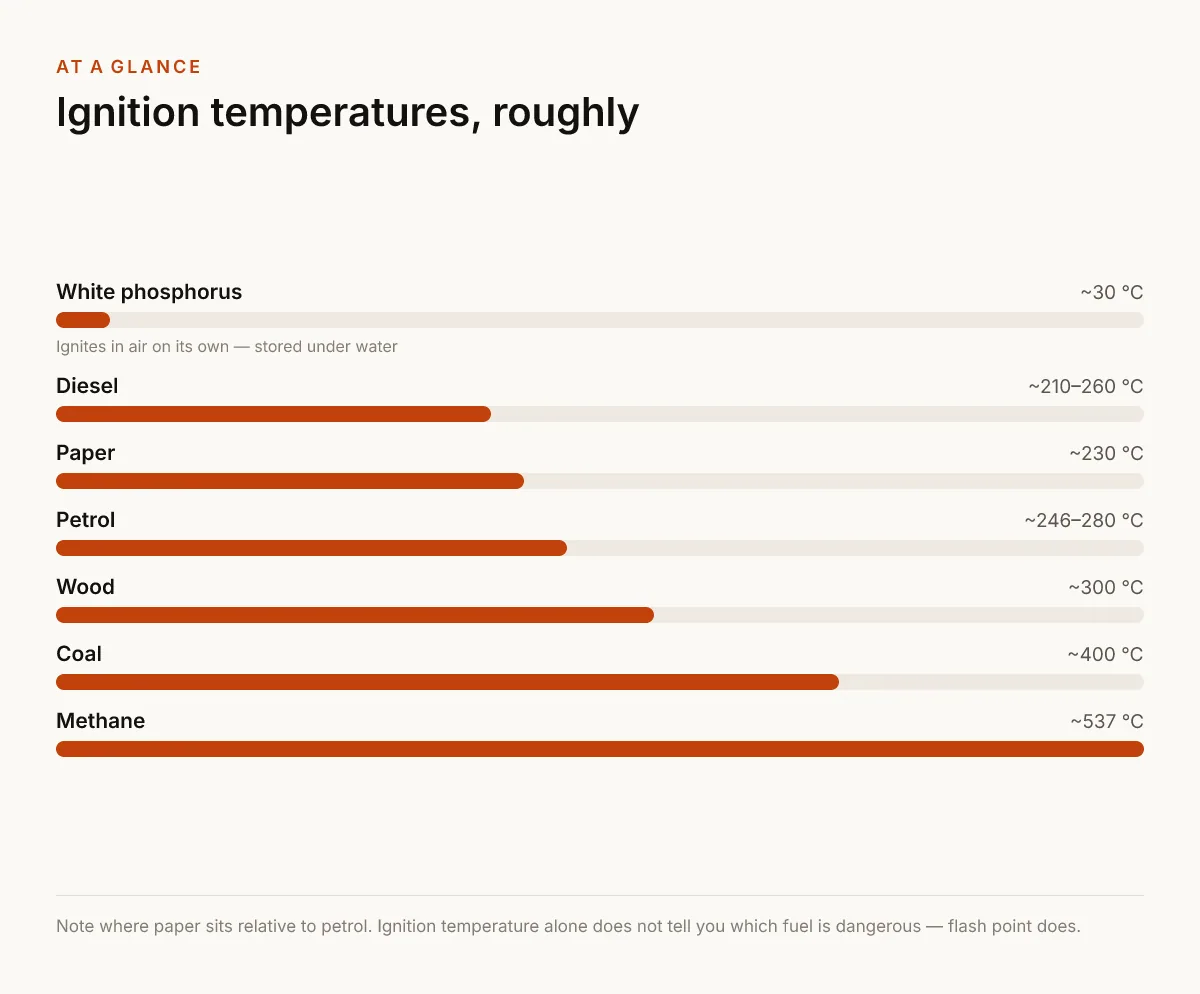
#Typical ignition temperatures
| Substance | Approximate ignition temperature |
|---|---|
| White phosphorus | ~30 °C |
| Petrol | ~246–280 °C |
| Kerosene | ~220–295 °C |
| Diesel | ~210–260 °C |
| Paper | ~230 °C |
| Wood | ~300 °C |
| Coal | ~400 °C |
| Methane | ~537 °C |
| Hydrogen | ~500–571 °C |
| Charcoal | ~350 °C |
White phosphorus is the extreme case: it ignites spontaneously in air at ordinary temperatures, which is why it is stored under water and is not a fuel.
#The petrol paradox
Petrol's ignition temperature is around 246 °C — higher than paper's. Yet petrol is far more dangerous. Why?
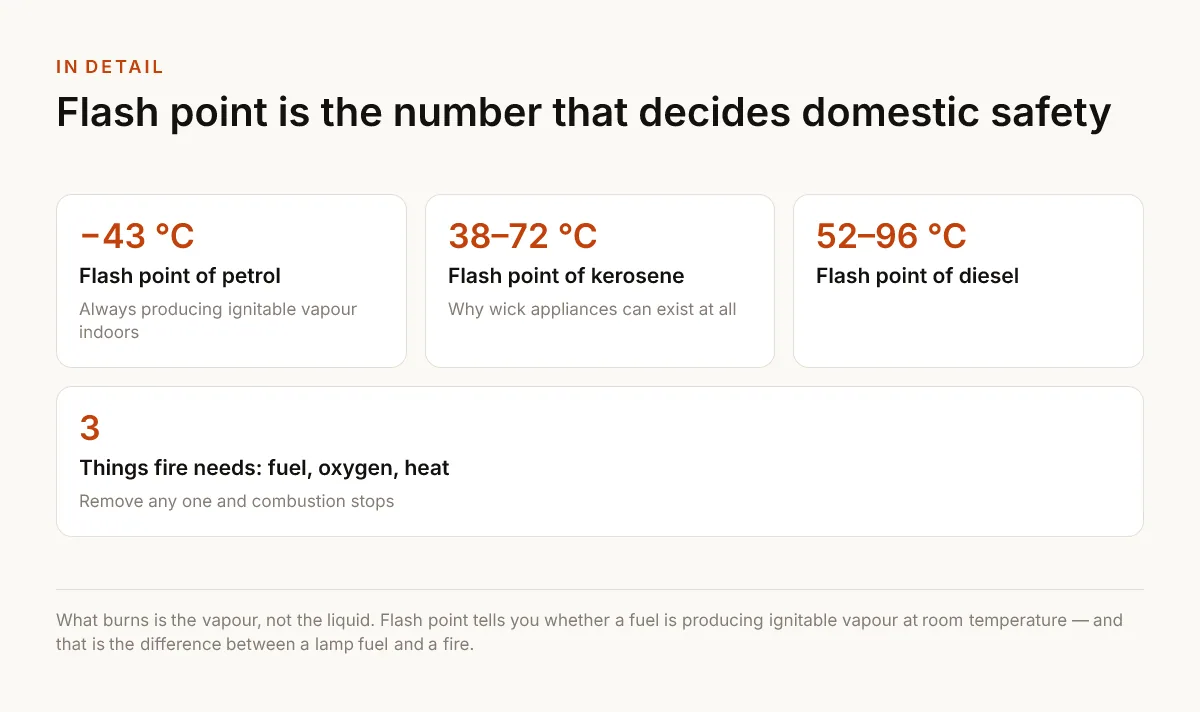
Because ignition temperature is not the whole story for liquids. What burns is the vapour, not the liquid, and the relevant measure is the flash point: the lowest temperature at which a liquid produces enough vapour to form an ignitable mixture with air.
| Fuel | Flash point | Ignition temperature |
|---|---|---|
| Petrol | ~−43 °C | ~246 °C |
| Kerosene | ~38–72 °C | ~220 °C |
| Diesel | ~52–96 °C | ~210 °C |
Petrol produces ignitable vapour at any ordinary temperature, so a spark near an open container finds a ready fuel-air mixture. Kerosene at room temperature does not produce enough vapour to ignite from a spark; it has to be heated first, or drawn up a wick where a small quantity is heated by the flame itself.
This is the entire reason kerosene appliances can exist for domestic use while petrol appliances cannot, and why putting petrol in a kerosene heater is catastrophic rather than merely inefficient.
#Why an ideal fuel has a moderate ignition temperature
Both extremes create problems:
Too low. The fuel may ignite accidentally from ambient heat, friction or a small spark. Storage and transport become hazardous. Spontaneous combustion in coal stockpiles and haystacks is a real phenomenon caused by slow oxidation raising internal temperature to the ignition point.
Too high. The fuel is hard to light and may need a supporting fuel to start. Pulverised coal in a power station requires oil or gas burners to light off, precisely for this reason.
A moderate value gives safe storage and practical ignition — one of the standard characteristics of a good fuel.
#Why not every combustible substance is a fuel
This is the natural follow-up question, and the answer is that combustibility is necessary but nowhere near sufficient. A practical fuel must also:
- Have a worthwhile calorific value — magnesium burns brilliantly but is far too valuable and reactive to burn for heat
- Be available in quantity at acceptable cost
- Be safe to store and handle — sodium burns but reacts violently with water
- Burn at a controllable rate — an explosive is combustible and useless as a fuel
- Produce acceptable by-products — many plastics burn readily but release dioxins and hydrogen chloride
So: all fuels are combustible, but not all combustible substances are fuels.
This is the mechanism behind two practical guides: why green wood is so hard to burn, and why kerosene rather than petrol is the liquid fuel used in homes.
#The compact answer
A fuel must be heated to its ignition temperature before it starts burning. Ignition temperature is the lowest temperature at which a substance catches fire and continues to burn. Below this temperature, the fuel will not burn even if oxygen is available. A good fuel should have a moderate ignition temperature — neither so low that it catches fire accidentally, nor so high that it is difficult to ignite.
Frequently asked questions
A fuel must be heated to its ___ before it starts burning.
Ignition temperature. This is the lowest temperature at which a substance catches fire and continues to burn without further external heating. Below this temperature, combustion will not begin even in the presence of plenty of oxygen.
What is meant by a fuel having a high ignition temperature?
It means the fuel needs to be heated to a high temperature before it will catch fire. Such a fuel is safer to store because accidental ignition is unlikely, but it is inconvenient to light and may need a supporting fuel or a strong ignition source to start.
Why are all combustible substances not used as fuels?
Because being combustible is only one requirement. A usable fuel must also have a reasonable calorific value, be available in adequate quantity at acceptable cost, be safe to store and transport, burn at a controllable rate, and not produce excessively harmful products. Substances such as magnesium, sodium or many plastics burn readily but fail one or more of these tests.
What is the difference between flash point and ignition temperature?
Flash point is the lowest temperature at which a liquid gives off enough vapour to form a mixture that will flash momentarily when an ignition source is applied. Ignition temperature is the temperature at which the substance catches fire and continues burning without an external source. Petrol's flash point is about −43 °C while its ignition temperature is around 246 °C.
Sources
Every figure above traces back to one of these. If you find one that does not, tell us and we will fix it.
- [1]Fuel properties comparison — U.S. Department of Energy, Alternative Fuels Data Center
- [2]Carbon Monoxide's Impact on Indoor Air Quality — U.S. Environmental Protection Agency
Written by
Priya Raman — Energy science editor
Taught school science for eight years, then moved into writing about combustion and energy. Still explains things the way you would to a class.
- MSc Chemistry
- Eight years teaching physical science
- Science curriculum writer