Carbon Monoxide Alarms for Fuel-Burning Rooms: Placement, Standards and Limits
Where to mount a CO alarm, which standard to buy, what the ppm numbers mean, and why a compliant alarm can stay silent at harmful levels.
Key takeaways
- Certification matters more than features: UL 2034 or EN 50291, not a generic 'CO sensor'.
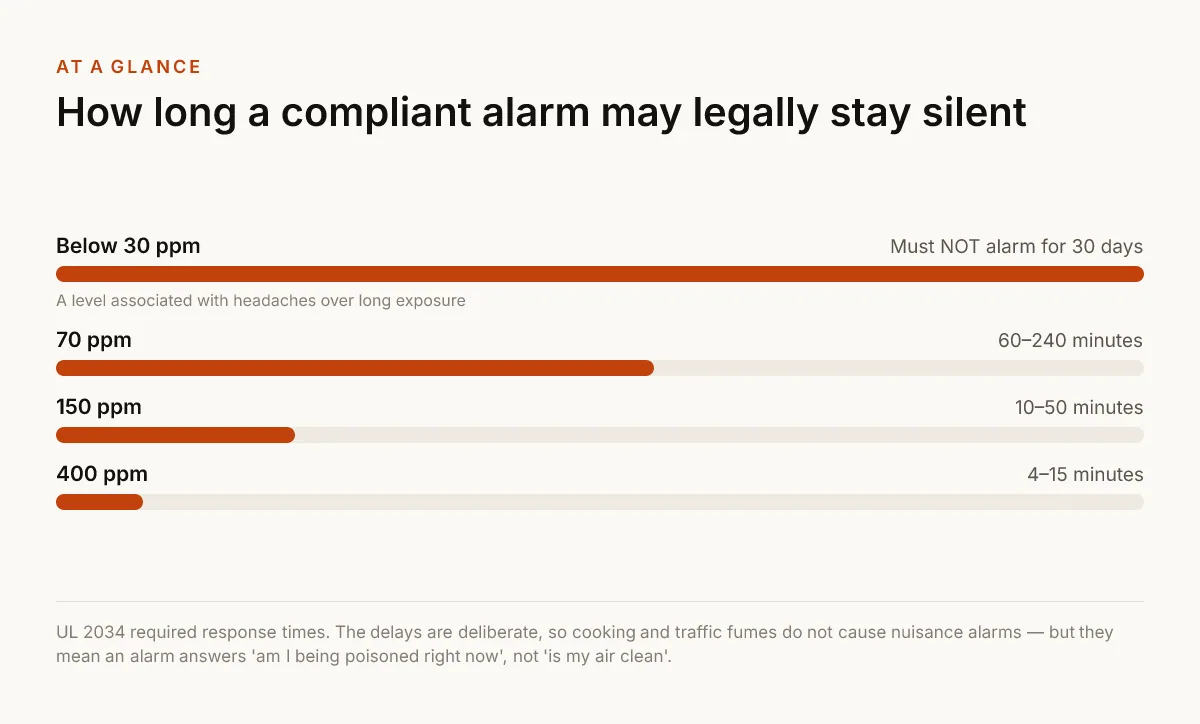
- A UL 2034 alarm must not sound below 30 ppm and may take up to 8 hours at 70 ppm — by design, to avoid nuisance alarms.
- Mount at breathing height, 1–3 m from the appliance; CO is close to air density and moves with room currents.
- Electrochemical sensors age out. Replace the whole unit at its stated expiry, typically 7–10 years.
- If the alarm sounds, evacuate first and call emergency services from outside. Do not ventilate and re-enter.
I keep a cheap digital CO monitor next to whatever heater I am testing, and the most useful thing on it is not the alarm. It is the peak-hold reading.
The alarm tells you when you are in acute danger. The peak tells you what the air was doing at 3am while everyone was asleep. Those turn out to be very different questions, and most households only own a device that answers the first one.
This is not an argument against alarms. Please own one — for a room with a flame in it, it is the cheapest genuinely life-saving thing you can buy. It is an argument for knowing what your alarm is promising, because the standard it is built to is more specific, and more limited, than almost anyone realises.
#Buy to a standard, not to a feature list
Two certifications matter:
- UL 2034 — the North American standard for single-station CO alarms.
- EN 50291 — the European/UK standard, split into EN 50291-1 (domestic) and -2 (recreational vehicles and boats).
Either one guarantees a tested response curve, an audible level, a fault indicator and an end-of-life signal. A cheap "CO sensor" module with no certification mark guarantees none of those, and low-end sensors are notorious for both false silence and false alarms.
If you burn fuel in a caravan, boat or camper, buy specifically to EN 50291-2 (or the RV-rated equivalent), which is tested for vibration and temperature swings that break domestic units.
Combined smoke/CO alarms are fine and convenient, but note the placement conflict below: smoke alarms want ceiling mounting, CO alarms want breathing height. Where a combined unit forces a compromise, most manufacturers validate ceiling mounting for their combined product — follow that product's instruction rather than the general rule.
#Where to mount it
CO is nearly the same density as air (28 vs 29 g/mol). It does not layer on the floor like propane, nor pool at the ceiling like smoke. It moves with room air currents and with the warm plume from the appliance.
The practical placement:
- In the room containing the appliance, on a wall at breathing height (roughly 1.5 m / 5 ft), or per the manufacturer's stated height.
- 1 to 3 metres horizontally from the heater or stove. Closer, and you get nuisance alarms from normal ignition transients; further, and detection lags.
- Outside every sleeping area, and on every level of the home.
- Not within 30 cm of a corner, directly above a heat source, in the path of a window, door or extractor, in a damp bathroom, or in an unheated space outside the alarm's rated temperature range.
One alarm in a hallway is a common setup and a weak one. The alarm should be where the fuel burns and where you sleep.
#What the alarm is not doing for you
This is the part that surprises people. UL 2034 deliberately specifies a delayed response at low concentrations to prevent nuisance alarms from cooking, traffic and normal appliance cycling:
| Concentration | Required alarm behaviour (UL 2034) |
|---|---|
| Below 30 ppm | Must not alarm within 30 days |
| 70 ppm | Must alarm between 60 and 240 minutes |
| 150 ppm | Must alarm between 10 and 50 minutes |
| 400 ppm | Must alarm between 4 and 15 minutes |
Read the first row again. A fully compliant alarm will sit silent indefinitely at 29 ppm — a level that WHO indoor air guidance would not accept over a working day, and that is associated with headaches and impaired concentration over weeks of exposure.
So a standard alarm answers the question "am I about to be acutely poisoned?" It does not answer "is my heater quietly making my family ill all winter?" If you burn fuel indoors regularly, consider a low-level CO monitor (these display from around 5–10 ppm) in addition to, not instead of, a certified alarm. The certified alarm is the legally recognised life-safety device; the low-level monitor is your diagnostic.
#Reading the display
Alarms with a digital readout usually show current concentration and a peak-since-reset value. The peak reading is the useful one: check it after a night's heating. A peak of 0–5 ppm is a heater burning properly in adequate air — the signature of complete combustion. Repeated peaks of 20–40 ppm mean the combustion or the ventilation is wrong even though the alarm never sounded — investigate before the pattern worsens.
#When the alarm sounds
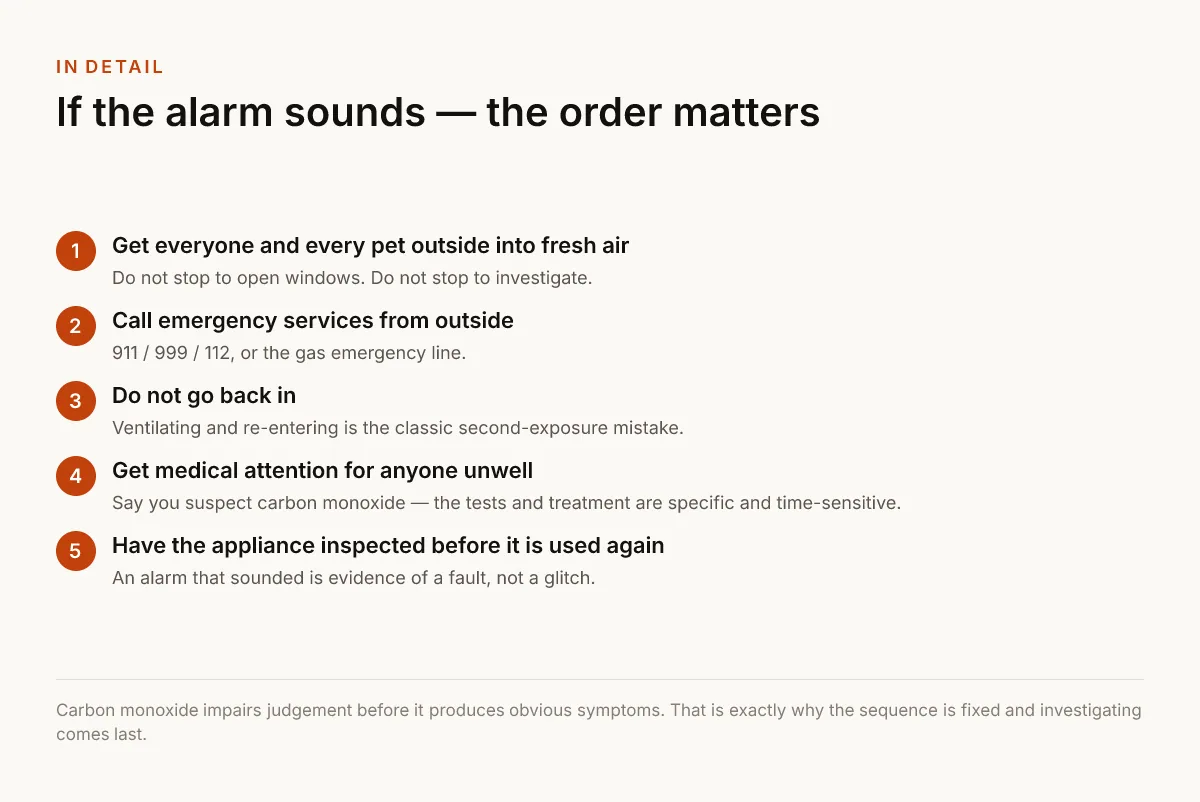
The sequence matters, because CO impairs judgement before it produces obvious symptoms:
- Get everyone and every pet outside into fresh air immediately. Do not stop to open windows, do not stop to switch off the appliance if that costs time, do not investigate.
- Call emergency services (911 / 999 / 112) from outside. Ask for the fire service or the gas emergency line.
- Do not re-enter until responders declare the property safe. Ventilating and going back in is the classic second-exposure mistake, and it has killed people who survived the first.
- Seek medical attention for anyone with headache, nausea, dizziness, confusion or drowsiness. Tell the clinician it is a suspected CO exposure — treatment and blood testing differ from flu care.
- Have the appliance inspected by a qualified engineer before it is used again. An alarm that sounded is evidence of a fault, not a glitch.
#Maintenance that actually gets done
- Monthly: press the test button. This tests the horn and electronics, not the sensor.
- Every six months: vacuum the vents, check the manufacture date.
- Annually: replace batteries in battery models unless it is a sealed 10-year unit.
- At end of life: replace the unit. The date is printed on the back. Electrochemical sensors drift and dry out on a clock, regardless of use.
A sealed-battery, 10-year, digital-display alarm certified to the right standard costs less than a tank of kerosene. In a room with an unvented heater it is not an accessory — it is the only instrument you have that reports on the one hazard you cannot see, smell or taste.
Frequently asked questions
Where should a carbon monoxide alarm be placed in a room with a heater?
At breathing height on a wall, roughly 1 to 3 metres horizontally from the appliance, not directly above it and not in the plume. Add one outside each sleeping area. Avoid within 30 cm of corners, windows, doors, extractors and cooking appliances, where readings are unrepresentative.
Does carbon monoxide rise or sink?
Neither meaningfully. CO has a molar mass of 28 g/mol against air's 29, so it is very slightly lighter and effectively mixes with room air, carried by convection currents rather than stratifying. That is why breathing-height placement is recommended rather than ceiling or floor.
What CO ppm level is dangerous?
Health guidance treats sustained exposure above about 9 ppm over 8 hours as undesirable indoors. 70 ppm produces headache and fatigue over several hours; 150–200 ppm causes disorientation and is life-threatening within hours; above 400 ppm becomes dangerous within roughly an hour. Effects depend on both concentration and duration.
Do CO alarms expire?
Yes. The electrochemical cell degrades whether or not it ever detects CO. Units carry a manufacture date and an end-of-life date, usually 7 to 10 years out, after which many models chirp continuously. Replace the alarm rather than the battery at that point.
Sources
Every figure above traces back to one of these. If you find one that does not, tell us and we will fix it.
- [1]Carbon Monoxide's Impact on Indoor Air Quality — U.S. Environmental Protection AgencyExposure levels and health effects.
- [2]Household air pollution and health — World Health Organization
- [3]UL 2034, Standard for Single and Multiple Station Carbon Monoxide Alarms — UL SolutionsSource of the required alarm response times quoted above.
- [4]Gas safety in the home — UK Health and Safety Executive
Written by
Dana Kerr — Editor — heating, stoves and indoor air
Twelve winters spent testing heaters in cold, draughty buildings, and a slightly obsessive interest in what a flame is actually doing.
- EPA 608 certified
- Former HVAC service writer
- 12 years covering domestic heating