Can Fossil Fuels Be Made in a Laboratory?
Synthetic hydrocarbons can be made in a lab, but true fossil fuels cannot — the geological conditions and timescales cannot be reproduced.
Key takeaways
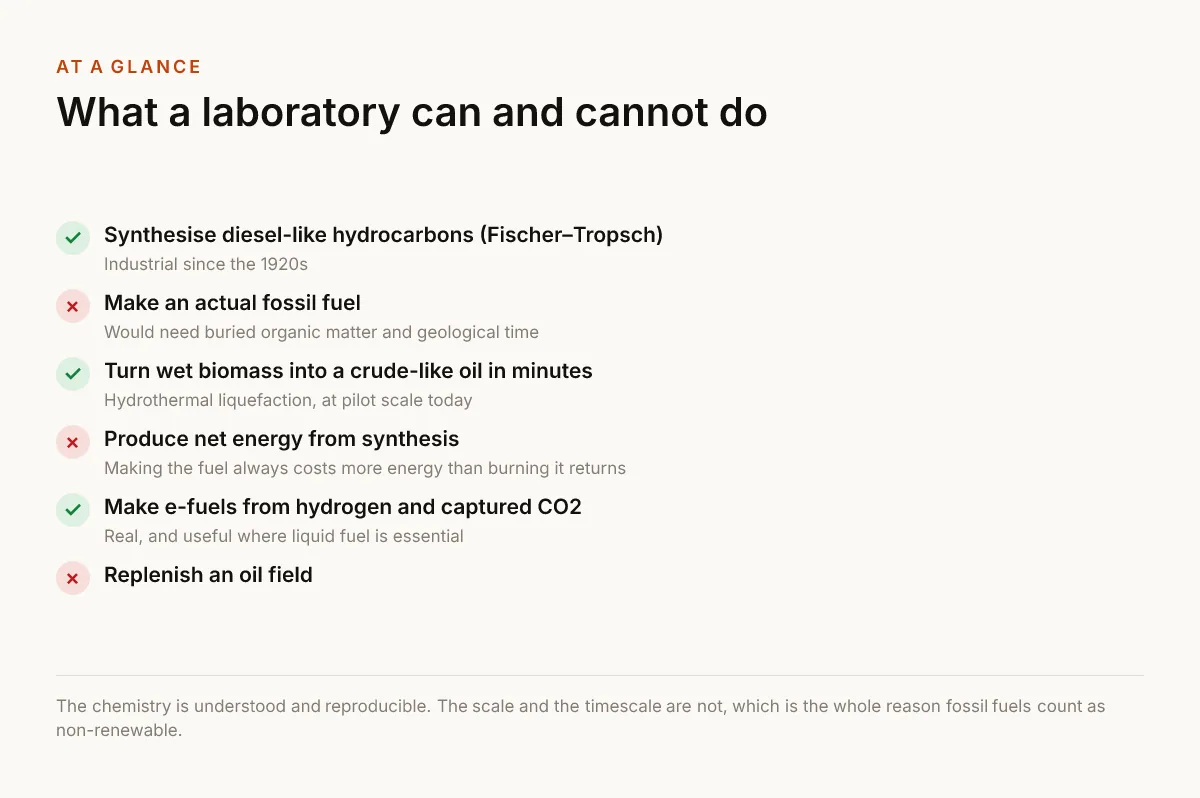
- The statement 'fossil fuels can be made in the laboratory' is false.
- The barrier is time and scale, not chemistry — the reactions are understood.
- Synthetic fuels (Fischer–Tropsch, e-fuels, synthetic crude) are real but are not fossil fuels.
- Making synthetic hydrocarbons costs more energy than burning them returns.
- This is precisely why fossil fuels are classed as exhaustible and non-renewable.
This one is a true/false question with a genuinely interesting answer, because the naive reasoning is not stupid. We know what petroleum is made of. We can make those molecules. So why is the answer still no?
Because "fossil fuel" is not a description of a molecule. It is a description of where the molecule came from — and that turns out to matter enormously, for carbon accounting as much as for classification.
#Why the answer is no
Fossil fuel formation requires four things simultaneously:
- Enormous quantities of organic matter. Not a beaker of algae — entire swamp forests and continuous rain of marine plankton over millions of square kilometres.
- Rapid burial without oxygen. The material must be sealed away before decomposers consume it.
- Sustained heat and pressure. Provided by kilometres of overlying rock at temperatures of roughly 60–150 °C.
- Geological time. Tens to hundreds of millions of years.
A laboratory can supply the second and third conditions easily. It cannot supply the first at meaningful scale, and it categorically cannot supply the fourth. That is the whole argument, and it is the same argument that makes fossil fuels non-renewable.
#What laboratories can do
The chemistry is not mysterious, which is why this question is more interesting than it first appears.
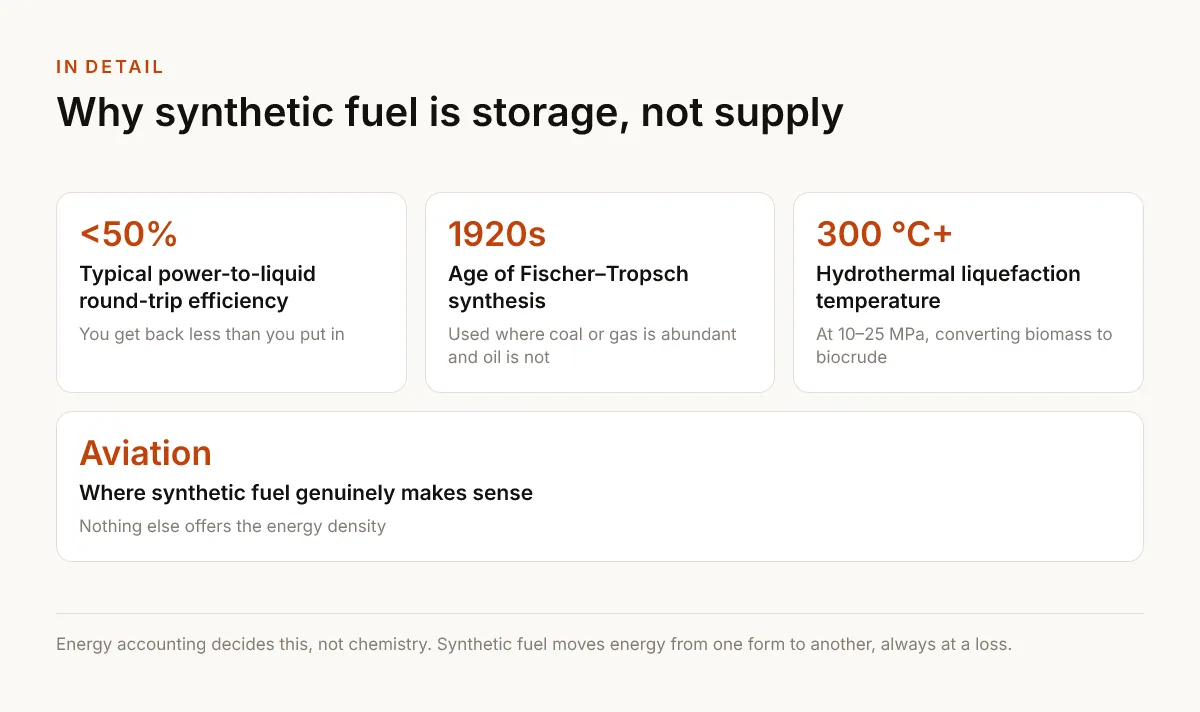
Hydrothermal liquefaction. Heating wet biomass — algae, sewage sludge, agricultural residue — to around 300–350 °C at 10–25 MPa for a few minutes produces a viscous "biocrude" broadly resembling crude oil. Reactors doing this exist at pilot scale today. What comes out is a biofuel, not petroleum: its carbon came from plants grown recently.
Fischer–Tropsch synthesis. A catalytic process converting synthesis gas — carbon monoxide and hydrogen — into liquid hydrocarbons:
(2n+1) H2 + n CO -> CnH(2n+2) + n H2O
Developed in the 1920s and used industrially where crude oil is unavailable but coal or gas is abundant. The product is genuine synthetic diesel and kerosene, usable in ordinary engines.
Power-to-liquid e-fuels. Hydrogen from electrolysis is combined with captured carbon dioxide to synthesise hydrocarbons. Chemically identical output, entirely different origin.
In all three cases, hydrocarbons are made. In none of them is a fossil fuel made.
#Why origin decides the classification
This is the conceptual heart of the question. A fossil fuel is defined by where its carbon came from, not by its molecular formula.
Methane from a gas well and methane from a biogas plant are the same molecule, CH₄, indistinguishable by any chemical test. One is a fossil fuel and one is not, because one is fossil carbon that has been out of the atmosphere for 300 million years and the other is carbon a cow ate last week.
That distinction is not pedantry — it is the entire basis of carbon accounting. Burning biogas returns recently absorbed carbon to the atmosphere, roughly balancing the cycle. Burning natural gas adds carbon that was not part of the active cycle at all.
#The energy accounting problem
Even setting classification aside, synthetic fuels do not solve the resource problem, because of the first law of thermodynamics.
Making a hydrocarbon means assembling carbon and hydrogen into high-energy chemical bonds. That takes energy input — and inevitably more energy than you recover on burning, since no process is perfectly efficient. Typical power-to-liquid pathways return well under half the electrical energy put in.
Synthetic fuel is therefore a storage and transport medium, not an energy source. It converts electricity — which must come from somewhere — into a dense, portable liquid. That is genuinely valuable where nothing else works, notably long-haul aviation, and pointless where a wire or a battery would do.
#What this tells you about fossil fuels
The reason fossil fuels are so useful is exactly the reason they cannot be manufactured: nature spent hundreds of millions of years, across an entire planet, doing the energy-intensive work of concentrating dilute sunlight into dense chemical fuel, and stored the result underground for free.
We are spending that inheritance in a few centuries — which is the practical meaning of exhaustible. No laboratory can replenish it, which is the practical meaning of "exhaustible".
#The compact answer
False. Fossil fuels cannot be made in a laboratory. They are formed by natural processes over millions of years from huge quantities of dead organisms buried under high pressure and temperature in the absence of air. These conditions and this timescale cannot be reproduced artificially. Synthetic hydrocarbons can be manufactured, but they are synthetic fuels, not fossil fuels, and their production consumes more energy than they release.
Frequently asked questions
Can fossil fuels be made in the laboratory? True or false.
False. Fossil fuels are formed by natural processes acting on huge quantities of buried organic matter over millions of years under specific conditions of heat, pressure and absence of oxygen. Those conditions and that timescale cannot be reproduced in a laboratory, which is why fossil fuels are non-renewable.
But we can make synthetic petrol, so why does that not count?
Because a fossil fuel is defined by origin, not by molecular formula. Fischer–Tropsch synthesis produces hydrocarbons chemically similar to diesel from carbon monoxide and hydrogen, but they are synthetic fuels made from a feedstock, not fuels formed from fossilised organisms. Classification follows the source.
Why can't we just speed up the natural process?
Some steps can be accelerated — hydrothermal liquefaction converts biomass into a crude-like oil in minutes at high temperature and pressure. What cannot be reproduced is the scale: hundreds of millions of tonnes of organic matter, buried across whole regions, concentrated by geology into deposits. Laboratory output is measured in grams.
Does making synthetic fuel solve the energy problem?
No, because of energy accounting. Synthesising hydrocarbons requires more energy input than the fuel releases when burned, so synthetic fuel is a way of storing and transporting energy from another source, not a way of creating it. It only makes sense where liquid fuel is essential, such as aviation.
Sources
Every figure above traces back to one of these. If you find one that does not, tell us and we will fix it.
- [1]Fossil fuels — International Energy Agency
- [2]
Written by
Priya Raman — Energy science editor
Taught school science for eight years, then moved into writing about combustion and energy. Still explains things the way you would to a class.
- MSc Chemistry
- Eight years teaching physical science
- Science curriculum writer