Incomplete Combustion of Fuel Leads to the Formation of Carbon Monoxide and Soot
Burning fuel in too little oxygen makes carbon monoxide, soot and unburnt hydrocarbons — with far less heat and a hazard you cannot smell.
Key takeaways
- Products of incomplete combustion: carbon monoxide, carbon particles (soot), unburnt hydrocarbons, water.
- Cause: insufficient oxygen supply to the flame.
- A yellow, smoky, flickering flame indicates incomplete combustion; a blue flame indicates complete combustion.
- Carbon monoxide is odourless, colourless and highly poisonous — it binds haemoglobin far more strongly than oxygen.
- Incomplete combustion also wastes fuel, releasing far less heat per kilogram.
Block the air holes on a gas burner and watch what happens. The flame goes from blue to yellow, it gets lazier, the bottom of the pan starts to blacken, and the room gets a faint sharp smell.
That is incomplete combustion, demonstrated in about four seconds, and every single hazard in this guide is contained in that little experiment. Same gas, same burner, same room — only the air supply changed.
#The two reactions
Complete combustion — plentiful oxygen. Taking methane as the example:
CH4 + 2 O2 -> CO2 + 2 H2O (maximum heat released)
All the carbon is fully oxidised to carbon dioxide and all the hydrogen to water.
Incomplete combustion — limited oxygen. There is not enough to fully oxidise the carbon, so two other outcomes appear:
2 CH4 + 3 O2  ->  2 CO + 4 H2O      (carbon monoxide)
CH4 + O2      ->  C + 2 H2O          (carbon as soot)
In practice all three products form at once, in proportions that depend on how oxygen-starved the flame is.
#The complete list of products
| Product | Formed when | Consequence |
|---|---|---|
| Carbon monoxide (CO) | Oxygen partially insufficient | Highly poisonous |
| Carbon particles (soot) | Oxygen severely insufficient | Smoke, deposits, lung damage |
| Unburnt hydrocarbons | Fuel escapes unreacted | Smog formation, wasted fuel |
| Water vapour | Always | Harmless, but adds humidity |
| Carbon dioxide | Partly, alongside the above | Greenhouse gas |
The standard exam answer is carbon monoxide and carbon particles (soot).
#Why less heat is released
This is the practical cost, and it follows directly from the chemistry.
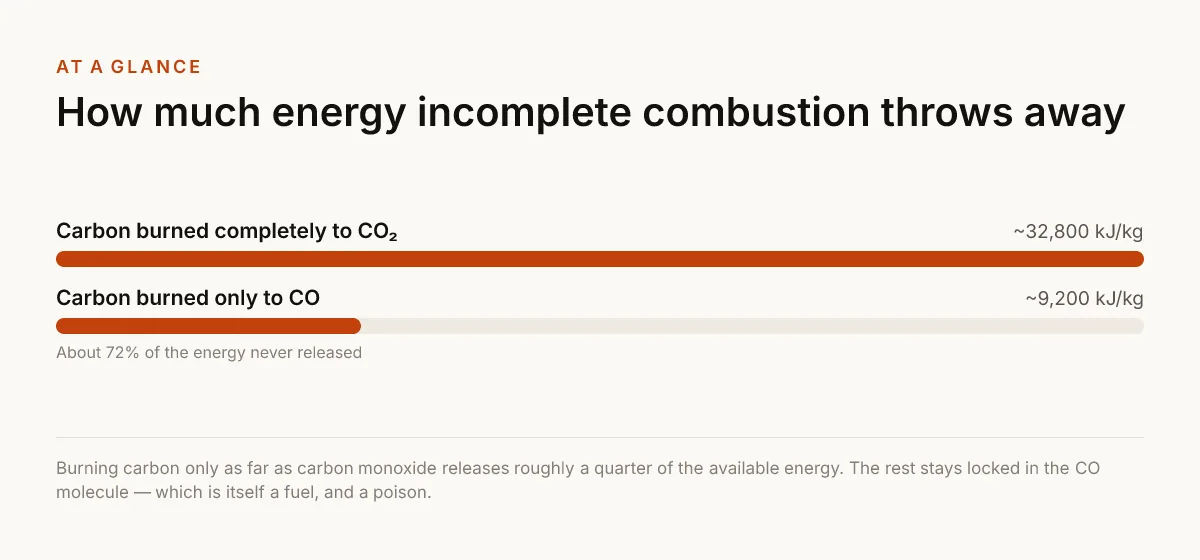
Oxidising carbon to carbon dioxide is a two-stage energy release: carbon to carbon monoxide, then carbon monoxide to carbon dioxide. Incomplete combustion stops after the first stage, so a large part of the available energy is left locked in the carbon monoxide molecule — which is itself a fuel, and will burn if it later meets oxygen.
Approximate figures for burning carbon:
- Complete, to CO₂: about 32,800 kJ/kg
- Incomplete, to CO: about 9,200 kJ/kg
Roughly 72% of the energy is left unreleased. Every sooty flame is wasting most of its fuel.
#How to recognise it
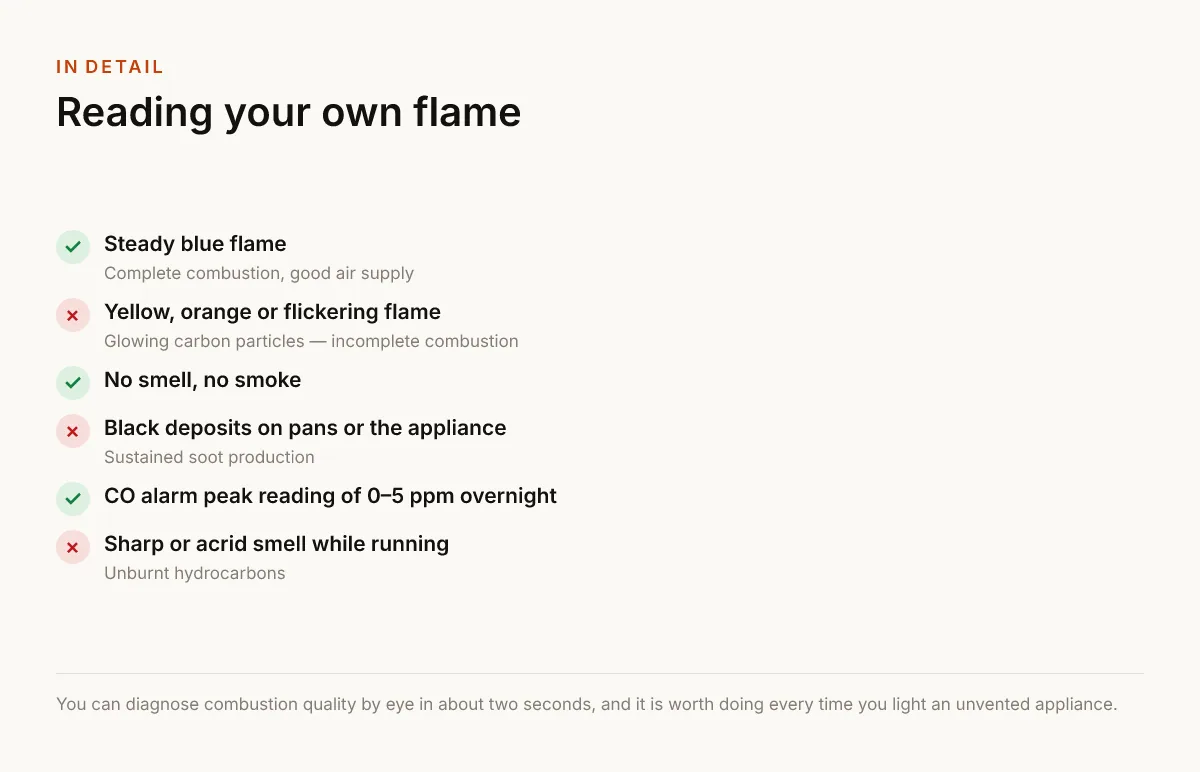
You can diagnose combustion quality by eye:
| Observation | Meaning |
|---|---|
| Steady blue flame | Complete combustion, good air supply |
| Yellow or orange flickering flame | Incomplete combustion, glowing carbon particles |
| Visible smoke | Heavy soot production |
| Black deposits on pans or the appliance | Sustained incomplete combustion |
| Sharp or acrid smell | Unburnt hydrocarbons |
A gas burner with its air holes blocked demonstrates this in seconds: the flame turns from blue to yellow, the heat output drops, and the pan blackens. Clearing the air holes reverses it.
#Why carbon monoxide is the serious hazard
Soot is dirty and unhealthy over time. Carbon monoxide can kill in an afternoon.
Haemoglobin, the oxygen-carrying protein in blood, binds carbon monoxide roughly 200–250 times more strongly than it binds oxygen. Inhaled CO forms carboxyhaemoglobin, progressively removing haemoglobin from oxygen transport. Tissues starve of oxygen even though breathing continues normally.
What makes it so dangerous in practice:
- No warning. Colourless, odourless, tasteless.
- Deceptive symptoms. Headache, nausea, dizziness, fatigue, confusion — routinely mistaken for flu or food poisoning.
- Impaired judgement. By the time it is affecting you, your ability to recognise the problem and act on it is already reduced.
- Cumulative. Exposure builds over hours at concentrations that seem tolerable.
Distinguishing signs worth memorising: everyone in the building feels unwell at once, including pets; and symptoms improve outdoors and return indoors.
#Where incomplete combustion happens
- Unvented heaters in sealed rooms — the heater consumes room oxygen until the flame is starved
- Blocked burners and dirty wicks — carbon deposits disrupt the fuel–air mixture
- Blocked or damaged flues — combustion products recirculate instead of leaving
- Charcoal indoors — smouldering solid fuel with restricted internal oxygen access; a leading cause of fatal poisonings
- Engines running in enclosed spaces — generators and vehicles in garages
- Old or poorly serviced boilers — the classic domestic CO source
#How to prevent it
- Supply adequate air. Ventilation openings sized to the appliance, kept clear and unblocked.
- Maintain the appliance. Clean burners, trim or replace wicks, service annually.
- Keep flues clear. Sweep chimneys, check terminals are not blocked by nests or debris.
- Use the right fuel grade. Contaminated or wet fuel burns poorly by nature.
- Fit a carbon monoxide alarm certified to UL 2034 or EN 50291 in every room with a fuel-burning appliance.
- Never bring outdoor equipment indoors — charcoal, generators, camping stoves.
If an alarm sounds, get everyone outside first and call emergency services from outside. Do not ventilate and re-enter to investigate.
This is the mechanism behind the safety rules in are kerosene heaters safe indoors and propane heater ventilation, and the reason a certified CO alarm belongs in any room with a flame in it.
#The compact answer
Incomplete combustion of a fuel occurs when the supply of oxygen is insufficient. It leads to the formation of carbon monoxide, unburnt carbon particles (soot) and unburnt hydrocarbons, along with water vapour. It produces a yellow smoky flame, releases much less heat than complete combustion, and generates carbon monoxide, which is a poisonous gas.
Frequently asked questions
Incomplete combustion of fuel leads to the formation of what?
Carbon monoxide, unburnt carbon particles known as soot, and unburnt hydrocarbons, together with water vapour. This happens when there is not enough oxygen for all the carbon in the fuel to be converted into carbon dioxide.
What is the difference between complete and incomplete combustion?
Complete combustion occurs in a plentiful supply of oxygen and converts all carbon to carbon dioxide and all hydrogen to water, releasing the maximum heat with a clean blue flame. Incomplete combustion occurs in a limited oxygen supply, producing carbon monoxide and soot along with carbon dioxide and water, releasing much less heat, with a yellow smoky flame.
Why is carbon monoxide dangerous?
Because it binds to haemoglobin in the blood roughly 200 to 250 times more strongly than oxygen does, forming carboxyhaemoglobin and preventing the blood from carrying oxygen to tissues. It is colourless, odourless and tasteless, so there is no natural warning, and its early symptoms — headache, nausea, dizziness — are easily mistaken for flu.
Why does a yellow flame indicate incomplete combustion?
The yellow colour comes from tiny particles of unburnt carbon glowing white-hot in the flame. Their presence means carbon is not being fully oxidised, which is exactly the definition of incomplete combustion. A blue flame indicates that combustion is complete and that no glowing carbon particles are present.
Sources
Every figure above traces back to one of these. If you find one that does not, tell us and we will fix it.
- [1]Carbon Monoxide's Impact on Indoor Air Quality — U.S. Environmental Protection Agency
- [2]Household air pollution and health — World Health Organization
Written by
Priya Raman — Energy science editor
Taught school science for eight years, then moved into writing about combustion and energy. Still explains things the way you would to a class.
- MSc Chemistry
- Eight years teaching physical science
- Science curriculum writer