Why Carbon and Its Compounds Are Used as Fuels
Carbon compounds burn in air releasing large amounts of heat, store easily and are abundant — which is why nearly every practical fuel is one.
Key takeaways
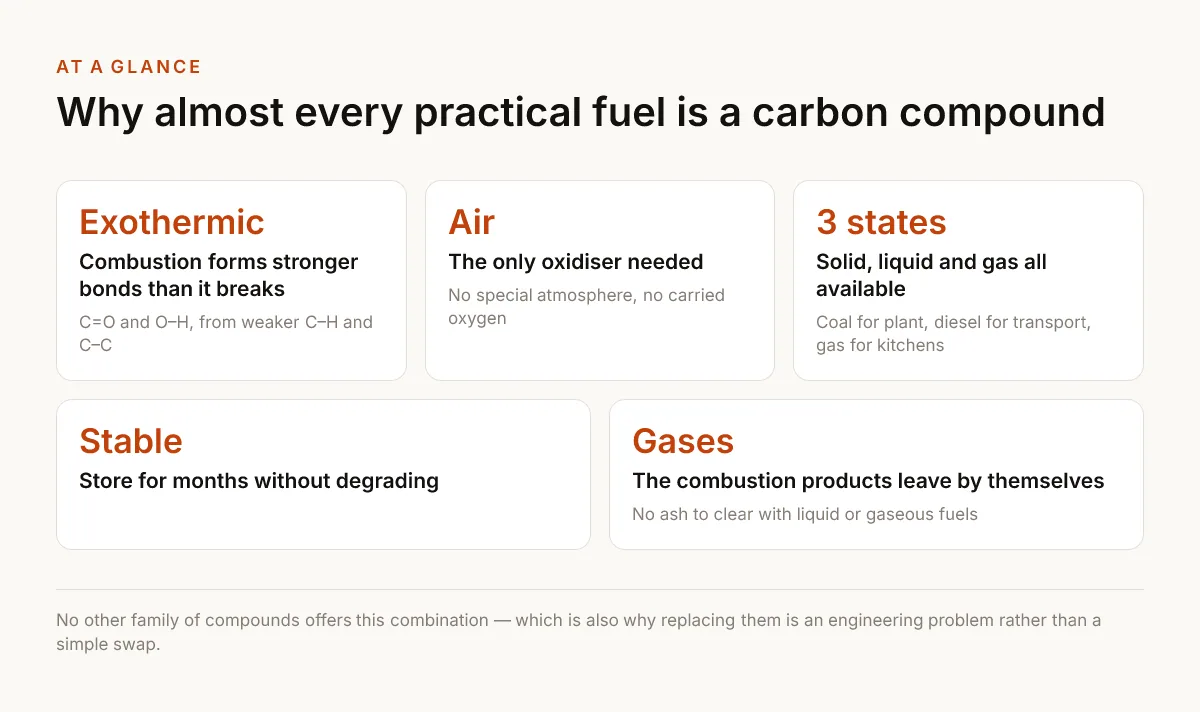
- Combustion of carbon compounds is strongly exothermic, releasing large amounts of heat per kilogram.
- They burn in air without needing an exotic oxidiser.
- They exist as solids, liquids and gases, so a suitable form exists for every application.
- They are abundant as coal, petroleum, natural gas and biomass.
- The products, carbon dioxide and water, are gases that leave the appliance easily — though CO₂ drives climate change.
Write out every fuel you can think of — coal, petrol, diesel, kerosene, LPG, natural gas, wood, charcoal, ethanol, biogas — and one thing is true of all of them. They are carbon compounds, or carbon itself.
That is not a coincidence, and it is not just because carbon happens to be lying around. There are specific properties that make carbon compounds unusually good at being fuels, and they are the same properties that make them hard to replace.
#1. Their combustion is strongly exothermic
Burning a carbon compound in oxygen produces carbon dioxide and water:
CH4 + 2 O2  ->  CO2 + 2 H2O + heat
C + O2      ->  CO2 + heat
These reactions release large amounts of energy, and the reason lies in bond energetics.
Combustion breaks the relatively weak C–H and C–C bonds in the fuel and the O=O bond in oxygen, then forms the much stronger C=O bonds in carbon dioxide and O–H bonds in water. Energy is absorbed to break bonds and released when bonds form. Because the bonds formed are stronger than those broken, the reaction releases a net surplus as heat.
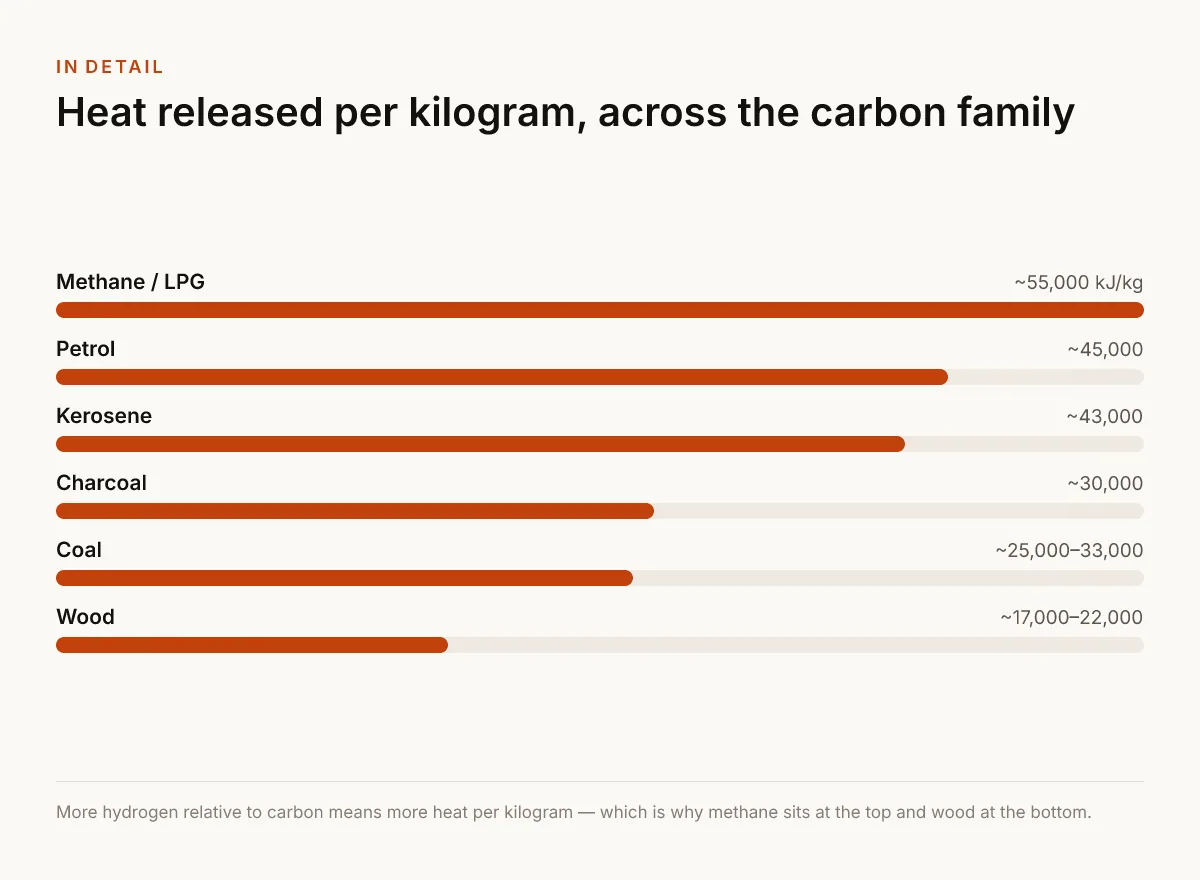
The more C–H bonds a fuel contains per unit mass, the more heat it releases — which is exactly why methane (four C–H bonds per carbon) rates higher than coal (mostly C–C).
#2. They have high calorific values
| Fuel | Calorific value (kJ/kg) |
|---|---|
| Methane / natural gas | ~55,000 |
| LPG | ~55,000 |
| Petrol | ~45,000 |
| Kerosene | ~43,000 |
| Charcoal | ~30,000 |
| Coal | ~25,000–33,000 |
| Wood | ~17,000–22,000 |
Even at the bottom of this table, wood delivers far more heat per kilogram than most non-carbon alternatives available at similar cost.
#3. They burn in ordinary air
Carbon compounds react with atmospheric oxygen at accessible temperatures. No exotic oxidiser is needed, no special atmosphere, no containment beyond ordinary appliance design.
This sounds trivial until you consider alternatives. Many substances release more energy per kilogram in some reaction or other, but require an oxidiser that must itself be manufactured and carried — which is why rockets carry liquid oxygen and cars do not.
#4. They exist in all three states
| State | Fuel | Best suited to |
|---|---|---|
| Solid | Coal, charcoal, wood | Bulk industrial heat, steel making, static plant |
| Liquid | Petrol, diesel, kerosene | Transport, where energy density per litre matters |
| Gas | Natural gas, LPG, biogas | Domestic cooking and heating, clean controllable flames |
This range is unusual and extremely useful. A single family of compounds supplies a dense pumpable liquid for aircraft, a clean controllable gas for a kitchen, and a cheap bulk solid for a power station.
#5. They are abundant
Carbon compounds are available as coal, petroleum, natural gas, wood, agricultural waste and biogas. Carbon is the fourth most abundant element in the universe by mass and forms an enormous variety of stable compounds — a property called catenation, its unusual ability to bond to itself in chains and rings.
That structural versatility is why carbon supports millions of compounds while most elements support a handful, and why the fuel family is so broad.
#6. Storage and transport are straightforward
Carbon-based fuels are chemically stable at ordinary temperatures. Petrol stored for a year is still petrol. They can be pumped, piped, shipped, poured and carried, and they do not self-discharge the way a battery does.
Compare hydrogen: higher calorific value, but requiring 700 bar compression or cryogenic cooling, and embrittling the metals used to contain it.
#7. The products are gases that leave by themselves
Complete combustion produces carbon dioxide and water vapour, both gases at flame temperature. They flow out of the appliance without needing to be cleared, unlike ash, which must be physically removed.
Gaseous and liquid carbon fuels leave essentially no residue at all — a large part of why gas replaced coal in kitchens.
#The disadvantages, stated plainly
The same chemistry that makes carbon compounds useful causes the problems:
- Carbon dioxide is an unavoidable product of complete combustion, and it is the principal greenhouse gas.
- Carbon monoxide and soot appear whenever the oxygen supply is inadequate.
- Sulphur dioxide comes from sulphur impurities in coal and heavy oils.
- Non-renewable for fossil-derived carbon compounds, though biomass and biogas are renewable.
None of this contradicts the reasons above. Carbon compounds are used as fuels because they are exceptionally good at being fuels; the costs are attached to that same property, which is why the search for alternatives is difficult rather than obvious.
The same chemistry produces the problems: carbon dioxide and the other disadvantages, and carbon monoxide and soot when the air supply is short.
#The compact answer
Carbon and its compounds are used as fuels because they burn in air with the release of a large amount of heat, giving them high calorific values. They are readily available as coal, petroleum and natural gas, exist as solids, liquids and gases suited to different uses, leave little ash on burning, and are easy to store and transport.
Frequently asked questions
Why are carbon and its compounds used as fuels?
Because they burn in air releasing a large amount of heat — they have high calorific values — and they do so readily and controllably. They are abundantly available as coal, petroleum, natural gas and biomass, occur in solid, liquid and gaseous forms suited to different uses, leave little ash, and are easy to store and transport.
Which carbon compounds are used as fuels?
Methane and other hydrocarbons in natural gas, propane and butane in LPG, the petrol, kerosene and diesel fractions of petroleum, carbon itself in coal and charcoal, and alcohols such as ethanol. Carbohydrates in wood and biomass are also carbon compounds burned as fuel.
Why do carbon compounds release so much energy on burning?
Because the products, carbon dioxide and water, contain stronger bonds than the reactants, hydrocarbon and oxygen. Combustion breaks weaker C–H and C–C bonds and forms stronger C=O and O–H bonds, and the surplus energy is released as heat. The more C–H bonds a fuel contains, the more heat it releases per kilogram.
What is the disadvantage of using carbon compounds as fuels?
Their combustion releases carbon dioxide, the main greenhouse gas causing global warming, and incomplete combustion produces poisonous carbon monoxide and soot. Fossil-derived carbon compounds are also non-renewable, so supplies are finite.
Sources
Every figure above traces back to one of these. If you find one that does not, tell us and we will fix it.
- [1]Fuel properties comparison — U.S. Department of Energy, Alternative Fuels Data Center
- [2]Energy conversion calculators — U.S. Energy Information Administration
Written by
Priya Raman — Energy science editor
Taught school science for eight years, then moved into writing about combustion and energy. Still explains things the way you would to a class.
- MSc Chemistry
- Eight years teaching physical science
- Science curriculum writer