Cetane Number: What a Higher Cetane Fuel Actually Does
Higher cetane means a shorter ignition delay: smoother diesel combustion, easier cold starts, less knock. And how it differs from octane.
Key takeaways
- Higher cetane number = shorter ignition delay = smoother diesel combustion.
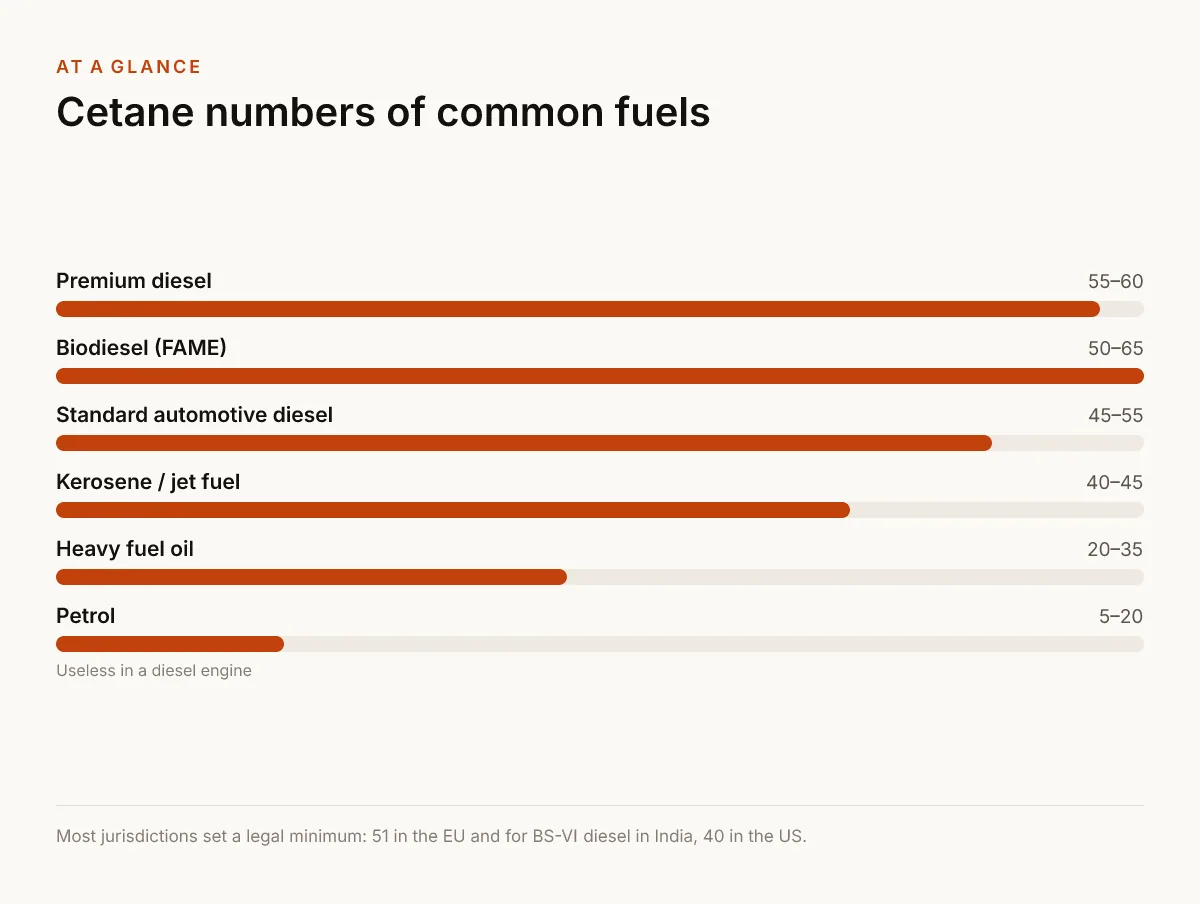
- Typical automotive diesel is 45–55 cetane; premium grades reach 55–60.
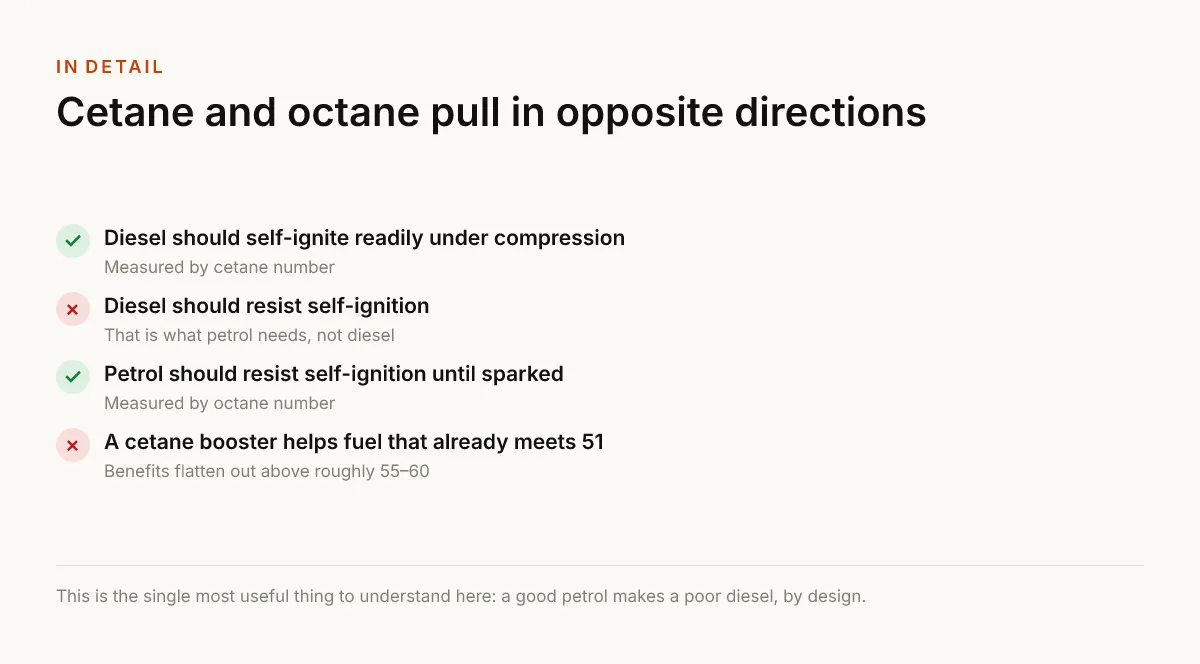
- Cetane and octane are opposites: diesel wants easy self-ignition, petrol wants resistance to it.
- n-cetane (hexadecane) is defined as 100; alpha-methylnaphthalene as 0.
- Too high a cetane number gives no further benefit and can slightly reduce power.
Cetane and octane are the most commonly mixed-up pair in fuel science, and the mix-up matters, because they measure opposite things.
One says "please ignite the instant I inject you". The other says "please do not ignite until I tell you". Once that sits straight in your head, everything else about diesel and petrol fuel quality follows from it.
#What cetane number measures
Cetane number is a measure of a diesel fuel's ignition quality — specifically, how readily it self-ignites when injected into hot compressed air.
A diesel engine has no spark plug. Air is compressed to roughly 15–22:1, which heats it to 500–700 °C, and fuel injected into that hot air ignites spontaneously. How quickly it does so is the ignition delay, and cetane number quantifies it.
#The scale
Two reference compounds define the scale:
- n-Cetane (hexadecane, C₁₆H₃₄) — ignites very readily; assigned 100
- Alpha-methylnaphthalene — ignites reluctantly; assigned 0
A fuel with cetane number 50 behaves like a blend of 50% cetane and 50% of the poor-igniting reference. Testing uses a standardised variable-compression engine (CFR method), with correlation-based cetane index calculations used for routine quality control.
#Typical values
| Fuel | Cetane number |
|---|---|
| Standard automotive diesel | 45–55 |
| Premium diesel | 55–60 |
| Biodiesel (FAME) | 50–65 |
| Kerosene / jet fuel | 40–45 |
| Heavy fuel oil | 20–35 |
| Petrol | 5–20 (useless in a diesel) |
Most jurisdictions set a legal minimum: 51 in the European Union, 40 in the United States, 51 for BS-VI diesel in India.
#What a higher cetane number gives you
Shorter ignition delay. The primary effect from which everything else follows.
Smoother, quieter combustion. With a long ignition delay, a large quantity of fuel accumulates in the cylinder before ignition, then burns almost at once. That sudden pressure rise is diesel knock — the characteristic clatter. Higher cetane means fuel starts burning sooner, so less accumulates and the pressure rise is gentler.
Easier cold starting. Cold air compresses to a lower final temperature, so ignition is harder. Higher cetane fuel ignites at these lower temperatures more reliably, reducing cranking time and cold-start white smoke.
Lower emissions. Shorter delay generally reduces unburnt hydrocarbons and carbon monoxide, and moderating the initial pressure spike can reduce nitrogen oxide formation.
Less vibration and mechanical stress. A gentler pressure rise is easier on bearings, pistons and mounts.
#Cetane versus octane
This is the comparison worth fixing in memory, because the two run in opposite directions:
| Cetane number | Octane number | |
|---|---|---|
| Engine type | Diesel (compression ignition) | Petrol (spark ignition) |
| Measures | Ease of self-ignition | Resistance to self-ignition |
| Desired | Ignite readily | Resist igniting until sparked |
| Higher value means | Shorter ignition delay | Greater knock resistance |
| Reference at 100 | n-Cetane | Iso-octane |
The reason is architectural. A diesel engine wants the fuel to ignite the instant it enters hot air. A petrol engine mixes fuel and air during the intake stroke and compresses the mixture — if that mixture self-ignites before the spark, you get knock, which damages engines. So petrol must resist exactly what diesel must do readily.
Straight-chain hydrocarbons ignite easily, giving high cetane and low octane. Branched and aromatic hydrocarbons resist ignition, giving high octane and low cetane. This is why the same refinery streams cannot serve both purposes, and why putting petrol in a diesel tank is so damaging: besides the lubrication loss, its ignition characteristics are entirely wrong.
#Why more is not always better
Above roughly 55–60, the benefits flatten and a subtle problem appears. Diesel combustion needs a brief period for the injected spray to mix with air. If ignition delay becomes extremely short, fuel begins burning before it has mixed properly, producing fuel-rich zones that generate smoke and slightly reduce power.
This is why "cetane boosters" sold as additives give real benefits on a marginal fuel and essentially none on fuel that already meets a 51 minimum.
#How cetane number is raised
- Refinery processing. Hydrotreating and hydrocracking increase the proportion of straight-chain paraffins.
- Blending. Adding high-cetane streams such as biodiesel or gas-to-liquid diesel.
- Additives. Cetane improvers, typically 2-ethylhexyl nitrate or di-tert-butyl peroxide, which decompose readily under heat to produce free radicals that trigger ignition earlier.
For the engine side of this, see which fuels can be used in an internal combustion engine, and for how fuel quality is measured against work delivered, specific fuel consumption.
#The compact answer
A fuel with a higher cetane number will have a shorter ignition delay. It ignites more readily when injected into the hot compressed air of a diesel engine, giving smoother and quieter combustion, easier cold starting, reduced diesel knock and generally lower emissions. Cetane number measures ignition quality for diesel, unlike octane number, which measures a petrol's resistance to self-ignition.
Frequently asked questions
The fuel with a higher cetane number will have what?
A shorter ignition delay. It self-ignites more readily when injected into hot compressed air, so combustion begins sooner after injection. This gives smoother and quieter running, easier cold starting, less diesel knock and generally lower emissions of unburnt hydrocarbons.
What is cetane number?
Cetane number is a measure of the ignition quality of a diesel fuel, defined against a reference scale where n-cetane (hexadecane) is 100 and alpha-methylnaphthalene is 0. A fuel with a cetane number of 50 ignites like a blend of 50% cetane and 50% of the low-reference compound.
What is the difference between cetane number and octane number?
They measure opposite properties. Cetane number measures how readily a fuel self-ignites under compression, which diesel engines require. Octane number measures a petrol's resistance to self-ignition, which spark-ignition engines require to avoid knock. A high-cetane fuel makes a poor petrol and a high-octane fuel makes a poor diesel.
Is higher cetane always better?
Up to a point. Raising cetane from 40 to about 50 gives clear improvements in noise, cold starting and emissions. Beyond roughly 55–60 the benefits flatten, and a very short ignition delay can begin combustion before the fuel has mixed properly with the air, slightly reducing power and increasing smoke.
Sources
Every figure above traces back to one of these. If you find one that does not, tell us and we will fix it.
- [1]Fuel properties comparison — U.S. Department of Energy, Alternative Fuels Data Center
- [2]Carbon dioxide emissions coefficients by fuel — U.S. Energy Information Administration
Written by
Priya Raman — Energy science editor
Taught school science for eight years, then moved into writing about combustion and energy. Still explains things the way you would to a class.
- MSc Chemistry
- Eight years teaching physical science
- Science curriculum writer