Which Fuels Can Be Used in an Internal Combustion Engine?
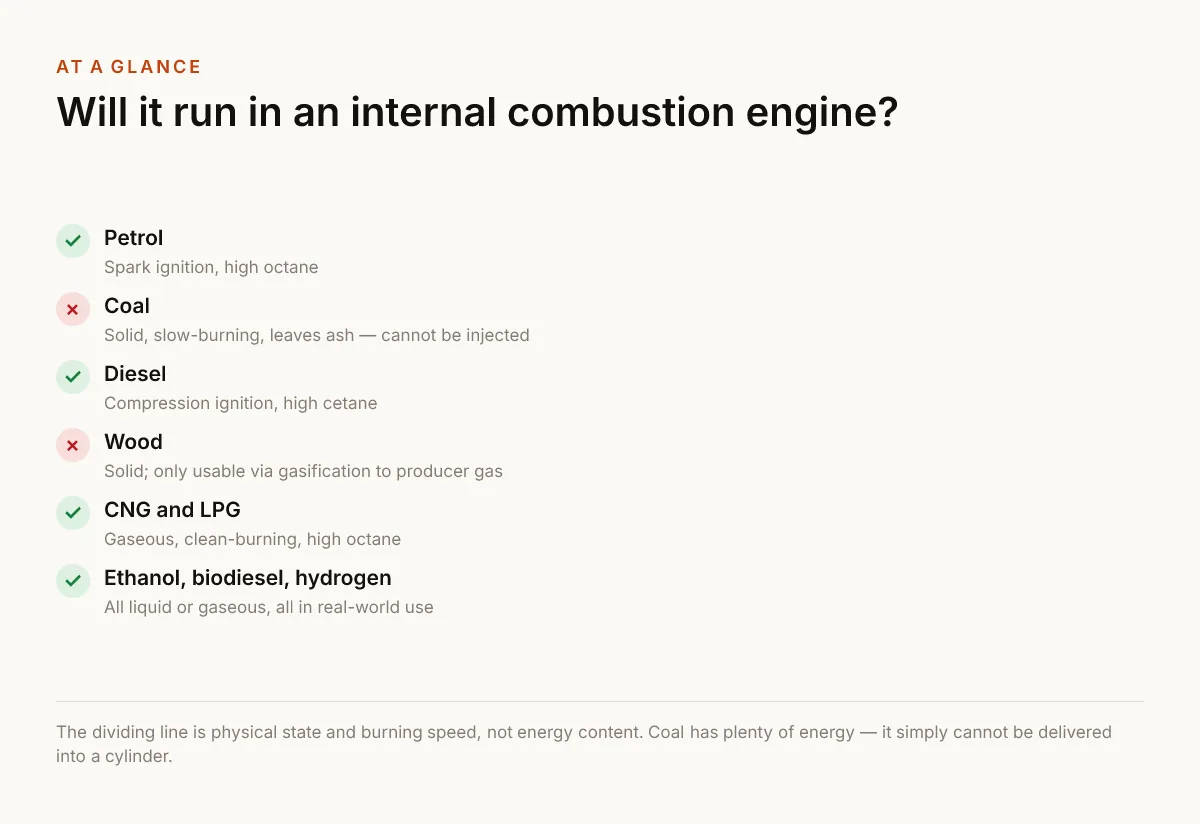
Petrol, diesel, CNG, LPG, ethanol and hydrogen all work in an IC engine. Coal does not — and why explains what these engines need from a fuel.
Key takeaways
- IC engine fuels must be liquid or gaseous, so they can be metered and mixed with air.
- Coal is the standard 'not used' answer: solid, slow-burning and ash-producing.
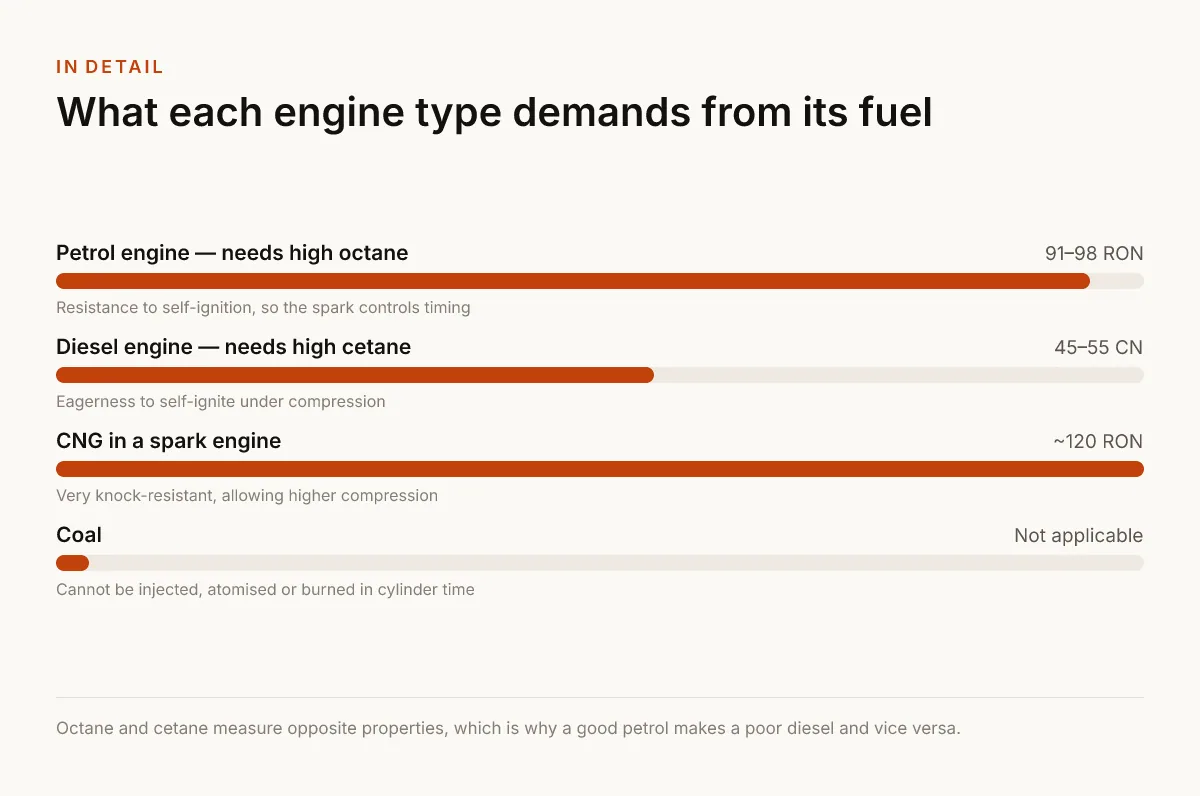
- Spark-ignition engines need high octane; compression-ignition engines need high cetane.
- Hydrogen runs in IC engines and emits no carbon, but storage remains the obstacle.
- Gas turbines are less fussy and will run on natural gas, kerosene, diesel or naphtha.
The reason coal is the answer to "which fuel is not used in an internal combustion engine" is not that coal is a bad fuel. Coal generates a large share of the world's electricity. The reason is that an IC engine asks something very specific of its fuel, and coal cannot deliver it.
#What an IC engine actually needs
Inside a cylinder, the whole combustion event takes a few milliseconds. In that time the fuel must:
- Be metered precisely — injected or mixed in an exact quantity, thousands of times a minute
- Mix with air uniformly — so the charge burns evenly rather than in patches
- Burn very fast — complete within a fraction of a crankshaft revolution
- Leave nothing solid behind — the cylinder bore, rings and valves are precision surfaces
Only liquids and gases satisfy all four.
#Why coal fails on every count
It cannot be metered or atomised. You cannot inject a solid through a nozzle or mix it homogeneously with air in a manifold.
It burns far too slowly. Coal burns from the surface inward. Even the powdered coal used in a power station takes one to two seconds to burn out — and an engine at 2,000 rpm gives it roughly fifteen milliseconds.
It leaves ash. Between 5% and 45% of coal's mass is incombustible mineral matter. Abrasive ash circulating in an engine would score the bore, jam the rings and wreck the valves in minutes.
The only way to run an engine on coal or wood is to convert the solid into a gas first — gasification, producing carbon monoxide and hydrogen. Wood-gas vehicles genuinely existed during wartime fuel shortages, and they worked, but the gas generator was a large hot appliance bolted to the vehicle, and the power output was poor.
#The fuels that do work
| Fuel | Engine type | Notes |
|---|---|---|
| Petrol | Spark ignition | Needs high octane |
| Diesel | Compression ignition | Needs high cetane |
| CNG | Spark ignition | Very knock-resistant, clean |
| LPG | Spark ignition | Clean, easy to store |
| Ethanol | Spark ignition | High octane, blended widely |
| Biodiesel | Compression ignition | Good cetane, from plant oils |
| Hydrogen | Spark ignition | No carbon in the exhaust |
#The octane and cetane split
This is where people get tangled, and it is worth being clear because the two properties run in opposite directions.
A spark-ignition engine compresses a fuel-air mixture and then ignites it with a spark at a chosen moment. If the mixture self-ignites early from compression heat, you get knock, which destroys engines. So petrol must resist self-ignition — that is what a high octane number means.
A compression-ignition engine injects fuel into air already heated by compression, and wants it to ignite immediately. So diesel must self-ignite readily — that is what a high cetane number means.
Same word structure, opposite requirement. It is also why putting petrol in a diesel tank does real damage: the ignition behaviour is entirely wrong, quite apart from the lost lubrication.
CNG's high effective octane, around 120, is a genuine engineering advantage — it allows higher compression ratios, which recovers much of the power that a converted CNG engine otherwise loses.
#Hydrogen in a piston engine
Worth knowing because it comes up as its own question. Hydrogen burns very well in a modified spark-ignition engine, with wide flammability limits and fast flame speed. There is no carbon in the fuel, so the exhaust contains no carbon dioxide, no carbon monoxide, no soot and no unburnt hydrocarbons — only water vapour, plus nitrogen oxides formed from the air at high flame temperature.
The obstacles are entirely upstream: hydrogen has to be manufactured, compressed to 700 bar or liquefied at −253 °C, and distributed, and it embrittles many metals. The engine is the easy part.
#Gas turbines are far less fussy
A related question asks which fuels suit a gas turbine, and the answer is: most of them. Natural gas, kerosene and aviation turbine fuel, diesel, naphtha, and increasingly hydrogen blends.
The reason is architectural. A gas turbine burns fuel continuously in a combustor, rather than in timed explosions synchronised to a moving piston. Nothing depends on the fuel igniting at exactly the right crank angle, so octane and cetane simply do not apply. What matters instead is clean, steady combustion and no ash or contaminants to erode the turbine blades — which is why aviation kerosene is specified so tightly.
#The compact answer
Coal is not used in internal combustion engines. It is a solid, so it cannot be injected or mixed with air inside a cylinder, it burns far too slowly for the milliseconds available, and it leaves abrasive ash that would damage the engine. Petrol, diesel, CNG, LPG, ethanol, biodiesel and hydrogen are all used, because they are liquid or gaseous, burn rapidly and leave no solid residue.
Frequently asked questions
Which is not used in an internal combustion engine as fuel?
Coal. It is a solid, so it cannot be metered, atomised and mixed with air inside a cylinder, it burns far too slowly for the few milliseconds available in a combustion stroke, and it leaves ash that would destroy the cylinder bore, piston rings and valves. Petrol, diesel, CNG, LPG, ethanol, biodiesel and hydrogen are all used.
Why can't a solid fuel be used in an IC engine?
Three reasons. It cannot be injected or mixed uniformly with air, which is essential for controlled combustion. It burns from the surface inward over seconds or minutes, while a cylinder gives it a few milliseconds. And it leaves ash, which is abrasive and would wreck the moving surfaces inside the engine. Solid fuels can only be used indirectly, by first gasifying them.
Can hydrogen run in an internal combustion engine?
Yes. Hydrogen burns readily in a modified spark-ignition engine and emits no carbon dioxide, since there is no carbon in the fuel — only water vapour and some nitrogen oxides formed from the air. The obstacles are storage and supply rather than combustion, because hydrogen needs 700 bar compression or cryogenic cooling.
Which fuel type can be used in a gas turbine?
Natural gas most commonly, and also kerosene or aviation turbine fuel, diesel, naphtha and, increasingly, hydrogen blends. A gas turbine burns fuel continuously in a combustor rather than in timed cylinder events, so it is far less fussy about ignition timing than a piston engine and does not need particular octane or cetane properties.
Sources
Every figure above traces back to one of these. If you find one that does not, tell us and we will fix it.
- [1]Fuel properties comparison — U.S. Department of Energy, Alternative Fuels Data Center
- [2]Hydrogen basics — U.S. Department of Energy, Alternative Fuels Data Center
- [3]Natural gas basics — U.S. Department of Energy, Alternative Fuels Data Center
Written by
Marcus Hale — Contributing gas engineer
Working Gas Safe engineer. Services flued and flueless appliances all week and fact-checks everything on this site that involves a gas pipe.
- Gas Safe registered (UK)
- 15 years in the field
- CCN1, CENWAT, HTR1 assessed