Is CNG More Polluting Than Petrol? No — Here Are the Numbers
CNG produces less carbon dioxide, carbon monoxide, particulate matter and sulphur than petrol. The statement that CNG is more polluting than petrol is false.
Key takeaways
- The statement 'CNG is more polluting than petrol' is false.
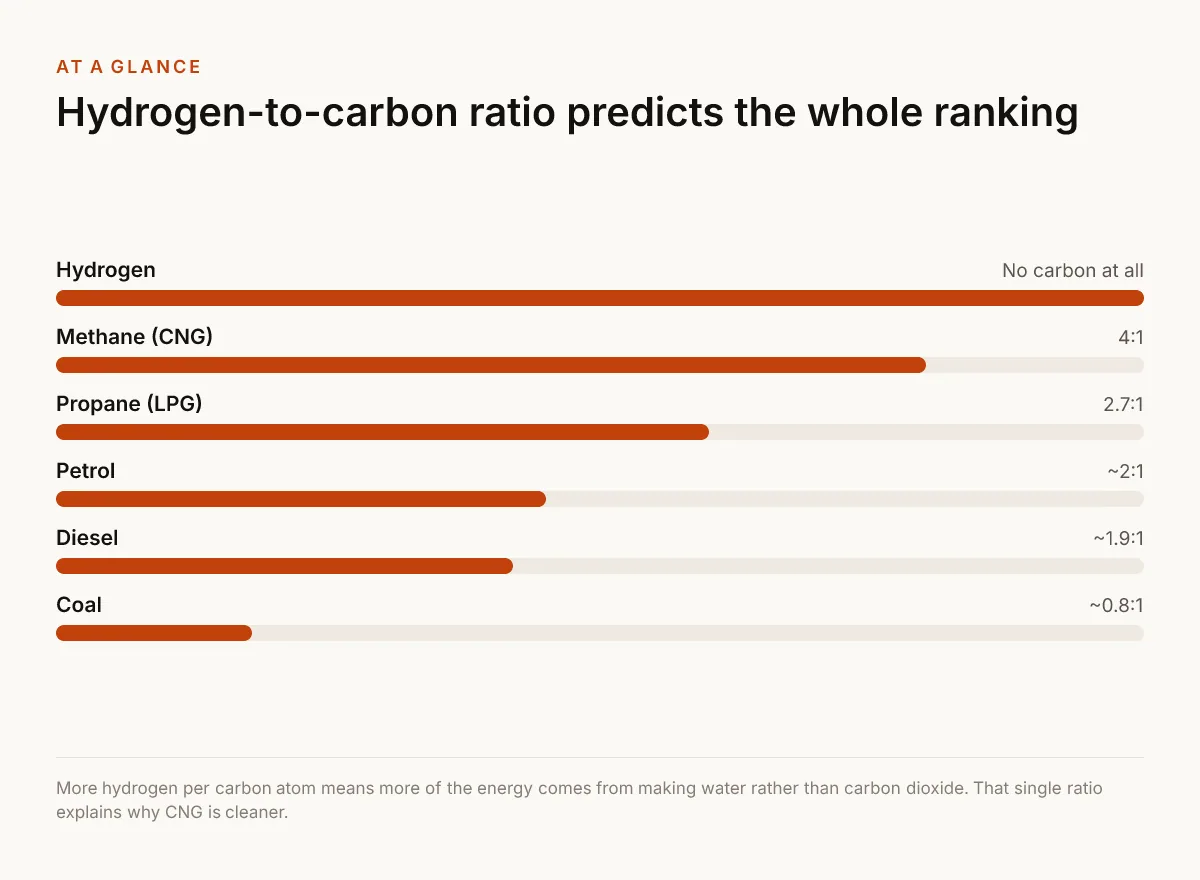
- Methane has the highest hydrogen-to-carbon ratio of any hydrocarbon, so less CO₂ per unit energy.
- CNG vehicles emit very little particulate matter and almost no sulphur dioxide.
- CNG's real climate issue is methane leakage in the supply chain, since methane is a potent greenhouse gas.
- CNG is still a fossil fuel and still emits carbon dioxide — cleaner is not zero.
This one turns up as a true/false statement, and the answer is false — CNG is cleaner than petrol, not dirtier.
What I like about this question is that you do not have to memorise the answer. You can read it straight off the chemical formula, and the same trick then ranks every other fuel for you.
#Why methane burns cleaner
CNG is mainly methane, CH₄ — the simplest hydrocarbon, with four hydrogen atoms for every carbon atom. Petrol is a mixture of C₅–C₁₀ hydrocarbons, with roughly two hydrogen atoms per carbon.
That ratio is the whole story. Burning hydrogen produces water; burning carbon produces carbon dioxide. A fuel with more hydrogen relative to carbon gets more of its energy from the clean half of the reaction.
CH4    + 2 O2   ->  CO2  + 2 H2O
2 C8H18 + 25 O2 -> 16 CO2 + 18 H2O
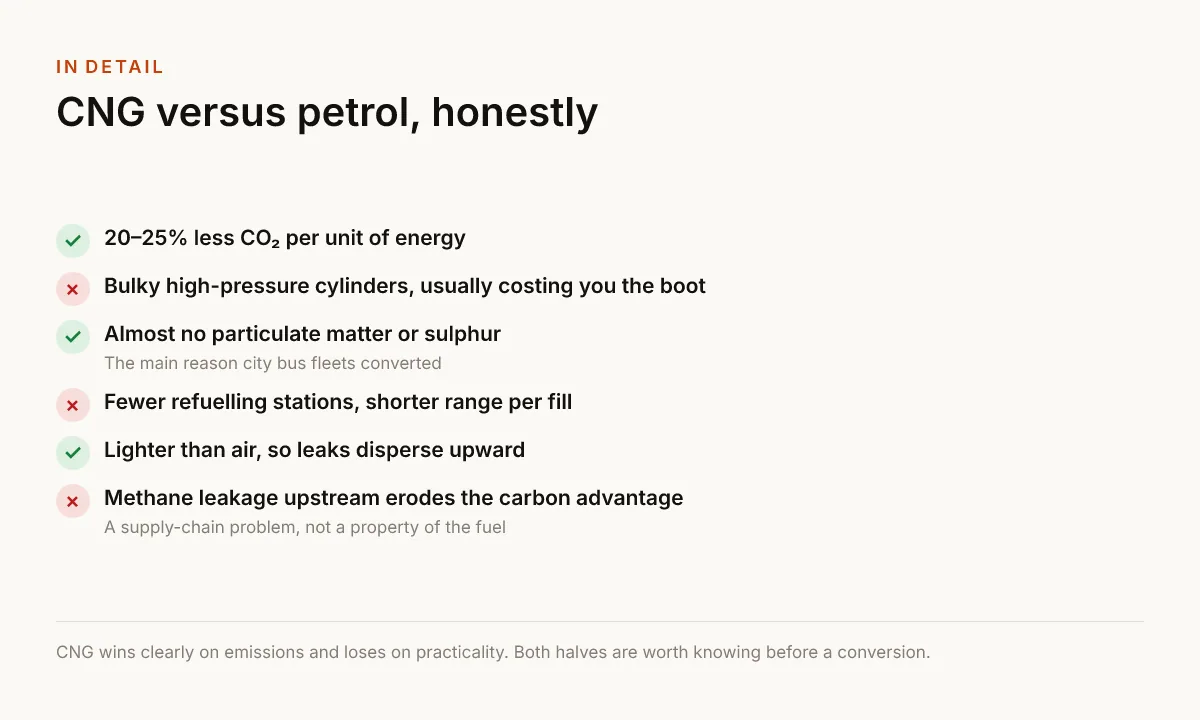
Per unit of energy delivered, methane produces roughly 20–25% less carbon dioxide than petrol.
Three further advantages follow from it being a simple gas:
- It mixes thoroughly with air before combustion, so burning is more complete — less carbon monoxide, fewer unburnt hydrocarbons.
- It contains no heavy aromatics, so almost no particulate matter or soot forms.
- It contains no sulphur or lead, so no sulphur dioxide and no lead compounds.
#The emissions comparison
| Pollutant | CNG vs petrol |
|---|---|
| Carbon dioxide | ~20–25% lower |
| Carbon monoxide | Substantially lower |
| Unburnt hydrocarbons | Lower (non-methane) |
| Nitrogen oxides | Lower to comparable |
| Particulate matter | Very much lower |
| Sulphur dioxide | Negligible |
| Lead / benzene | None |
The particulate difference is why cities with severe air quality problems have mandated CNG for buses, taxis and auto-rickshaws. Delhi's conversion of its public transport fleet to CNG in the early 2000s is the standard case study, and it produced measurable falls in particulate and sulphur dioxide levels.
#The one genuine concern
If there is a serious argument against CNG on environmental grounds, it is not tailpipe emissions — it is methane leakage.
Methane is itself a potent greenhouse gas: roughly 80 times more powerful than carbon dioxide over a twenty-year horizon, and around 28 times over a hundred years. Leaks at wells, in pipelines, at compressors and in vehicle fuel systems release unburnt methane directly.
If leakage across the supply chain exceeds a few percent, it can erode much of the carbon dioxide advantage. This is a supply-chain integrity problem rather than a property of the fuel, and it is why leak detection and repair programmes matter so much in gas systems.
#The real disadvantages of CNG
None of these are about pollution:
Low volumetric energy density. Even at 200–250 bar, CNG holds far less energy per litre than petrol. Vehicles need large, heavy, high-pressure cylinders, usually taking most of the boot.
Limited range and refuelling network. Fewer stations, longer filling times, and less range per fill.
Power reduction. Converted petrol engines typically lose roughly 10% power, since gaseous fuel displaces air in the intake, reducing volumetric efficiency. Purpose-designed CNG engines recover much of this by exploiting methane's high octane rating with higher compression.
Conversion cost. Retrofit kits and cylinder certification are expensive up front, offset over time by lower fuel cost.
#CNG against LPG
| CNG | LPG | |
|---|---|---|
| Composition | Mostly methane | Propane and butane |
| Storage | Gas at 200–250 bar | Liquid at ~8 bar |
| Density vs air | Lighter — rises and disperses | Heavier — pools at floor level |
| Source | Natural gas | Refining and gas processing |
| Safety on leak | Disperses upward | Accumulates in low spaces |
The density difference is a genuine safety distinction. A CNG leak in an open or ventilated space rises and dissipates; an LPG leak collects in pits, basements and floor voids, which is why LPG cylinder storage rules are stricter about below-grade spaces.
#Cleaner is not clean
CNG remains a fossil fuel. It emits carbon dioxide, its reserves are finite, and it is not a green energy source. It is a meaningful improvement on petrol and diesel for urban air quality, and a transitional option rather than a destination.
For the wider ranking, see which is the cleanest fuel, and for how CNG compares with the other bottled gas, the advantages of LPG and CNG.
#The compact answer
False. CNG is less polluting than petrol. Being mainly methane, with the highest hydrogen-to-carbon ratio of any hydrocarbon, it produces about 20–25% less carbon dioxide per unit of energy, much less carbon monoxide and unburnt hydrocarbons, almost no particulate matter, and no sulphur dioxide or lead.
Frequently asked questions
CNG is a more polluting fuel than petrol — true or false?
False. CNG is cleaner than petrol on almost every measure: it produces roughly 20–25% less carbon dioxide per unit of energy, substantially less carbon monoxide and unburnt hydrocarbons, virtually no particulate matter, and essentially no sulphur dioxide or lead.
Why is CNG cleaner than petrol?
Because of its chemistry. CNG is mostly methane, CH₄, which has four hydrogen atoms per carbon atom — the highest ratio of any hydrocarbon. More of the energy comes from burning hydrogen to water and less from burning carbon to carbon dioxide. Methane is also a simple gas that mixes thoroughly with air, so combustion is more complete, and it contains no sulphur, lead or heavy aromatics.
What are the disadvantages of CNG?
Lower energy density by volume, so bulky high-pressure cylinders are needed and boot space is lost; a limited refuelling network; a modest power reduction in converted engines; higher conversion cost; and methane leakage in production and distribution, which matters because methane is a far more potent greenhouse gas than carbon dioxide over short timescales.
Is CNG the same as LPG?
No. CNG is compressed natural gas, mostly methane, stored as a gas at around 200–250 bar. LPG is liquefied petroleum gas, a propane and butane mixture stored as a liquid at much lower pressure. CNG is lighter than air and disperses upward if it leaks, while LPG is heavier than air and pools at floor level.
Sources
Every figure above traces back to one of these. If you find one that does not, tell us and we will fix it.
- [1]Natural gas basics — U.S. Department of Energy, Alternative Fuels Data Center
- [2]Carbon dioxide emissions coefficients by fuel — U.S. Energy Information Administration
Written by
Priya Raman — Energy science editor
Taught school science for eight years, then moved into writing about combustion and energy. Still explains things the way you would to a class.
- MSc Chemistry
- Eight years teaching physical science
- Science curriculum writer