Characteristics of a Good Fuel: What Makes an Ideal Fuel
High calorific value, moderate ignition temperature, low ash and smoke, controlled burning, safe storage — and why no fuel scores full marks.
Key takeaways
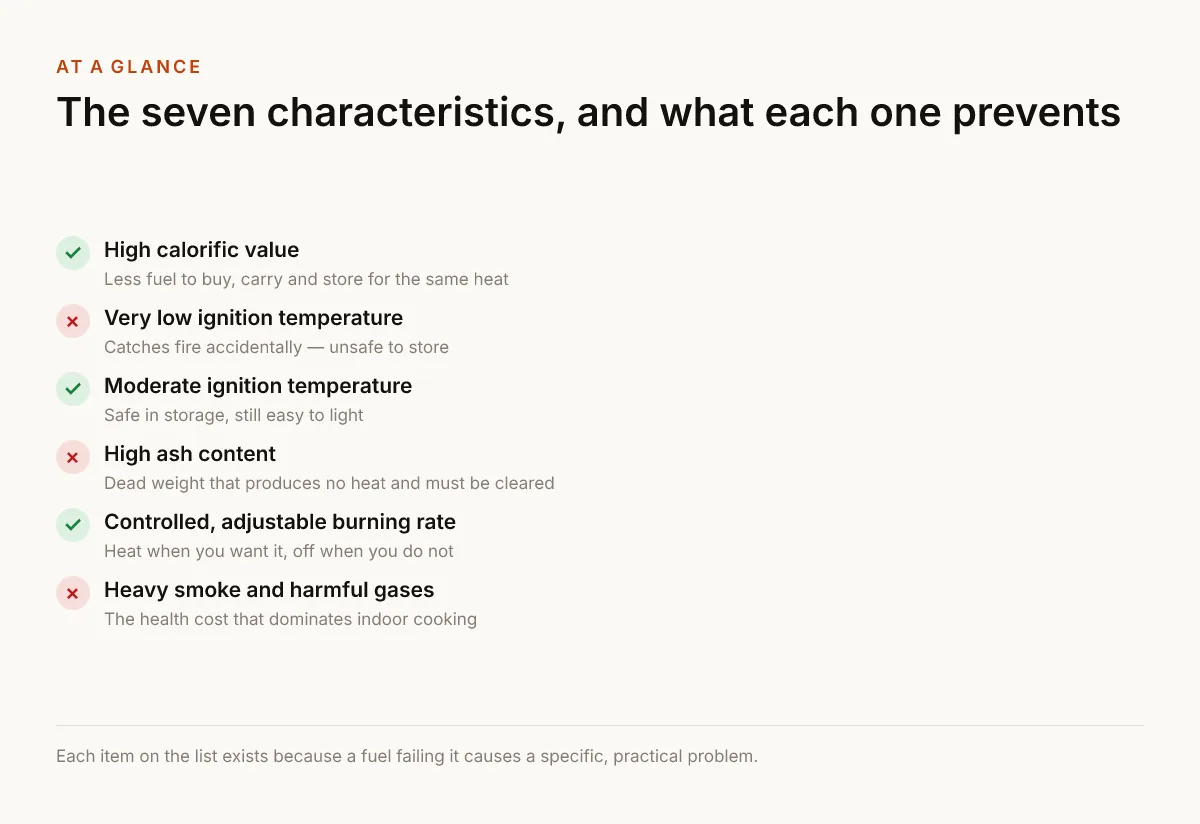
- High calorific value — more heat from less fuel.
- Moderate ignition temperature — neither hard to light nor a fire hazard.
- Low ash, smoke and harmful emissions when burned.
- Cheap, available, and safe and easy to store and transport.
- Controllable burning rate, so heat output can be regulated.
This is one of those questions where the mark scheme wants a list, and the list is genuinely useful — but only if you know why each item is on it.
So here is the checklist, and next to each item, the specific problem a fuel causes when it fails that test. That way you can apply it to a fuel nobody taught you about, which is the actual skill.
#The seven characteristics
#1. High calorific value
Calorific value is the heat released by burning one kilogram of fuel completely. A high value means a small quantity delivers a large amount of heat — so less fuel to buy, carry, store and handle for the same result.
Compare cow dung cake at roughly 7,000 kJ/kg with LPG at around 55,000 kJ/kg. Getting the same heat requires nearly eight times the mass of dung, along with the labour of collecting it and the smoke of burning it.
#2. Moderate ignition temperature
Ignition temperature is the lowest temperature at which a substance catches fire and continues to burn. "Moderate" is doing careful work in this phrase, because both extremes are bad:
- Too low — the fuel may ignite spontaneously in storage or in warm weather. Petrol produces ignitable vapour well below room temperature, which is why petrol handling is dangerous and why petrol must never go into a kerosene appliance.
- Too high — the fuel is hard to light and may need continuous external heat to keep burning, which is impractical.
#3. Low ash content
Ash is incombustible mineral residue. It contributes no heat, must be cleared and disposed of, and can foul grates, burners and boiler tubes. Indian coal with 35–45% ash carries nearly half its weight as material that produces nothing.
Gaseous fuels leave no ash at all, which is a large part of their convenience.
#4. Little smoke and no harmful products
A good fuel burns cleanly, producing carbon dioxide and water rather than carbon monoxide, soot, sulphur dioxide and unburnt particulates.
This is a health criterion above all. Solid biomass burned indoors on open stoves is one of the largest sources of household air pollution worldwide, and switching to LPG or biogas is a public health intervention as much as an energy one.
#5. Controlled and moderate rate of combustion
Heat should be released steadily and adjustably. A fuel that burns explosively is a hazard; one that burns too slowly cannot deliver heat when needed.
Practically, this is about controllability: a gas burner responds to a knob instantly, a wood fire does not. It is why gas replaced solid fuel in kitchens long before efficiency arguments were made.
#6. Easy to store, handle and transport
A good fuel should be safe and convenient to keep and move — non-corrosive, not requiring extreme pressures or temperatures, stable in storage.
This is where hydrogen falls down despite its unmatched calorific value: it needs 700 bar compression or cooling to −253 °C, and it embrittles many metals.
#7. Cheap and readily available
Even a fuel that satisfies every technical requirement is useless if it is unaffordable or unavailable locally. Practical fuel choice is always a compromise between what is best and what is at hand.
#How real fuels score
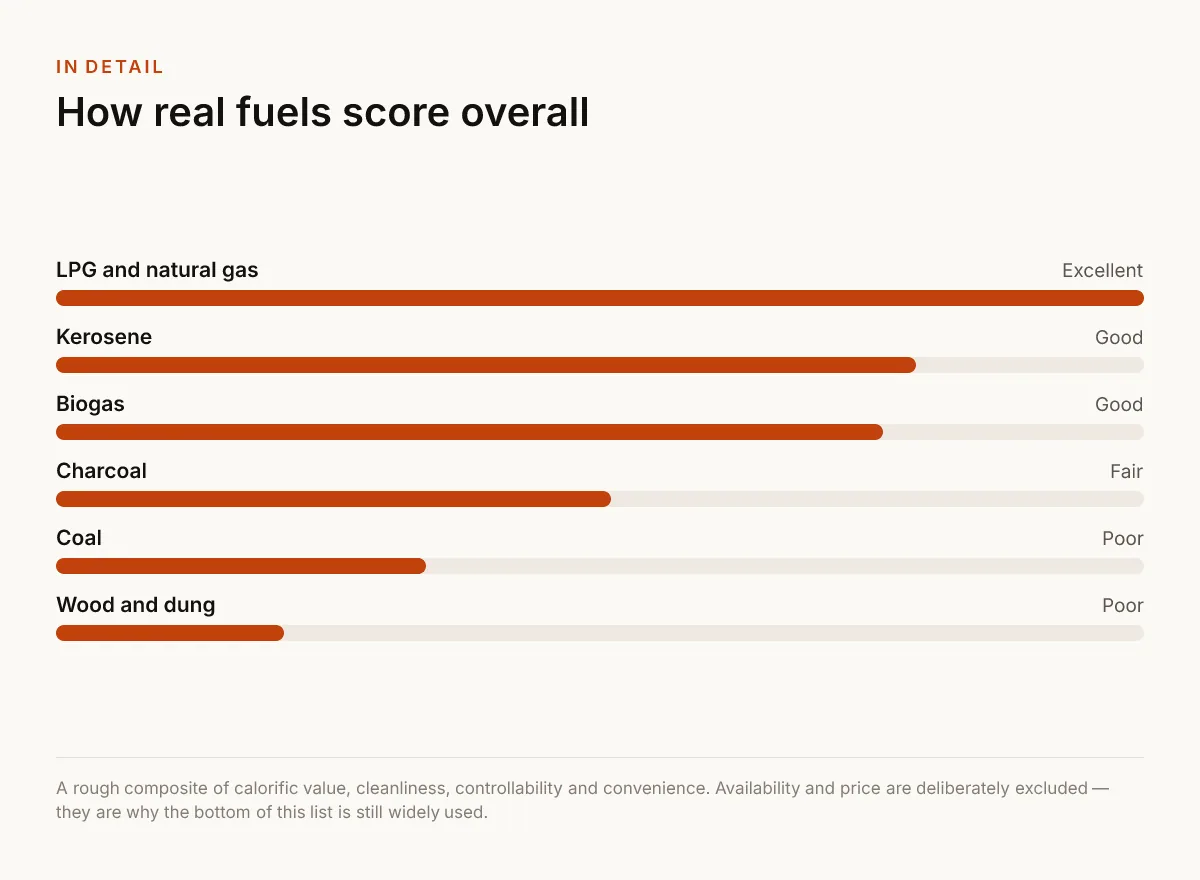
| Fuel | Calorific value | Ash | Smoke | Control | Cost | Overall |
|---|---|---|---|---|---|---|
| LPG | Very high | None | None | Excellent | High | Excellent |
| Natural gas | Very high | None | None | Excellent | Low–moderate | Excellent |
| Kerosene | High | Minimal | Some | Good | Moderate | Good |
| Biogas | Moderate | None | None | Good | Low | Good |
| Charcoal | Moderate | Some | Low | Poor | Low | Fair |
| Coal | Moderate | High | High | Poor | Low | Poor |
| Wood | Low | Moderate | Very high | Poor | Very low | Poor |
| Cow dung | Very low | High | Very high | Poor | Free | Poor |
The pattern is consistent: gaseous fuels score best on every technical criterion and worst on storage complexity and, sometimes, cost. Solid biomass scores best on availability and worst on everything else.
#Why no fuel is ideal
Each candidate fails at least one test:
- Hydrogen — highest calorific value, produces only water, but hard to store, costly to produce, and mostly manufactured from natural gas today.
- LPG and natural gas — clean and controllable, but non-renewable and requiring pressurised or piped supply.
- Coal — abundant and cheap, but high ash, high smoke, high emissions.
- Wood — renewable and available, but low calorific value and heavily smoky.
- Biogas — renewable and clean, but needs feedstock, digester space and warm conditions.
"Ideal fuel" is therefore a reference standard for comparison, not a shopping list you can satisfy.
Two of these characteristics have guides of their own: calorific value, which sets how much fuel you need, and ignition temperature, which decides whether a fuel is safe to keep in the house. For a worked comparison, see why LPG beats wood as a domestic fuel.
#The compact answer
A good fuel is one which has a high calorific value, a moderate ignition temperature, a low content of ash and moisture, and a controlled rate of combustion. It should burn without producing smoke or harmful gases, and should be cheap, easily available, and safe and convenient to store and transport.
Frequently asked questions
A good fuel is one which has what?
A high calorific value, a moderate ignition temperature, a low ash content, and which burns at a controlled and steady rate without producing harmful gases or smoke. It should also be cheap, easily available and easy to store and transport.
State any two characteristics of an ideal fuel.
First, it should have a high calorific value, so that a small quantity produces a large amount of heat. Second, it should have a moderate ignition temperature, so it neither catches fire spontaneously nor requires excessive heating to start burning.
Why should a fuel have a moderate ignition temperature?
If the ignition temperature is too low, the fuel can catch fire accidentally at ordinary temperatures, making storage and handling dangerous. If it is too high, the fuel is difficult to ignite and needs an external heat source to sustain burning. A moderate value gives both safety and convenience.
Which fuel is closest to an ideal fuel?
No fuel is ideal. LPG and natural gas come closest for domestic use — high calorific value, clean burning, no ash, easily controlled — but they need pressurised storage or pipelines and are non-renewable. Hydrogen has the highest calorific value and produces only water, but is difficult and costly to store and distribute.
Sources
Every figure above traces back to one of these. If you find one that does not, tell us and we will fix it.
- [1]Fuel properties comparison — U.S. Department of Energy, Alternative Fuels Data Center
- [2]Household air pollution and health — World Health Organization
Written by
Priya Raman — Energy science editor
Taught school science for eight years, then moved into writing about combustion and energy. Still explains things the way you would to a class.
- MSc Chemistry
- Eight years teaching physical science
- Science curriculum writer