Which of the Following Is Not a Fossil Fuel? How to Answer Every Version
There are only three fossil fuels: coal, petroleum and natural gas. Anything else on the list is the answer, and here is how to spot it.
Key takeaways
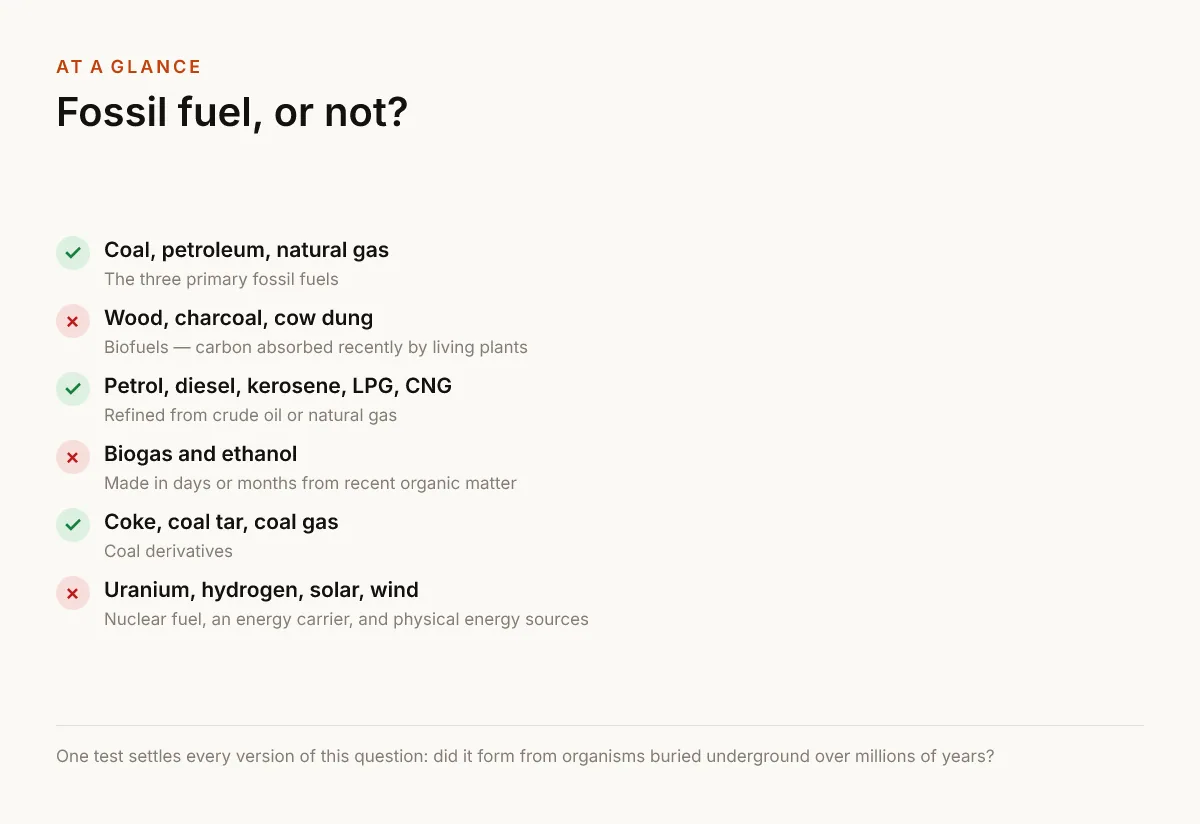
- Only three primary fossil fuels exist: coal, petroleum and natural gas.
- Petroleum products — petrol, diesel, kerosene, LPG, paraffin wax — count as fossil fuels because they come from crude oil.
- Wood, charcoal, biogas, ethanol and cow dung are biofuels, not fossil fuels: their carbon is from living plants.
- Uranium is a nuclear fuel, not a fossil fuel — it is a mineral, not fossilised organic matter.
- Hydrogen is not a fossil fuel even when it is manufactured from natural gas; the element itself is not fossilised organic matter.
This question shows up in every energy chapter, worded a dozen different ways, and students lose marks on it for one reason: they try to remember a list instead of a test.
The list changes with every paper. The test never does. Here is the test, and then the list, so you have both.
#The complete list of fossil fuels
There are exactly three:
- Coal — solid, formed from land plants buried in swamps.
- Petroleum (crude oil) — liquid, formed from marine microorganisms.
- Natural gas — gaseous, mainly methane, formed alongside petroleum.
Everything else called a fossil fuel is a product of one of these three.
#The derivatives that still count
Petroleum is refined by fractional distillation into a family of fuels, and all of them inherit fossil-fuel status because their carbon came out of the ground:
| Product | Source | Fossil fuel? |
|---|---|---|
| Petrol / gasoline | Petroleum | Yes |
| Diesel | Petroleum | Yes |
| Kerosene | Petroleum | Yes |
| LPG | Petroleum refining and gas processing | Yes |
| Paraffin wax | Petroleum | Yes |
| Bitumen | Petroleum | Yes |
| Coke, coal tar, coal gas | Coal | Yes |
| CNG | Natural gas | Yes |
If a question offers petrol or diesel as a possible "not a fossil fuel" answer, it is a trap. They are.
#The things that are not fossil fuels
These are the usual correct answers:
Biofuels — carbon from recently living plants
- Wood and firewood
- Charcoal (made by heating wood)
- Cow dung cakes
- Biogas (gobar gas)
- Ethanol and biodiesel
- Agricultural waste, bagasse, husk
Nuclear fuel — energy from the nucleus, not from burning
- Uranium
- Plutonium
- Thorium
Non-fuel energy sources — no combustion at all
- Solar energy
- Wind energy
- Hydroelectric power
- Tidal and wave energy
- Geothermal energy
Manufactured energy carriers
- Hydrogen
- Electricity
#The single test that resolves every version
Ask one question: did this substance form from the remains of organisms buried underground over millions of years?
- Yes → fossil fuel.
- Formed from plants or animals that were alive recently → biofuel.
- Never was living matter → mineral, nuclear fuel, or a physical energy source.
Wood is the classic answer because it feels like a traditional fuel and burns like one — though green wood barely burns at all. But the tree it came from grew in the last few decades, absorbing carbon dioxide from today's atmosphere. That is a biofuel by definition.
#Two cases that catch people out
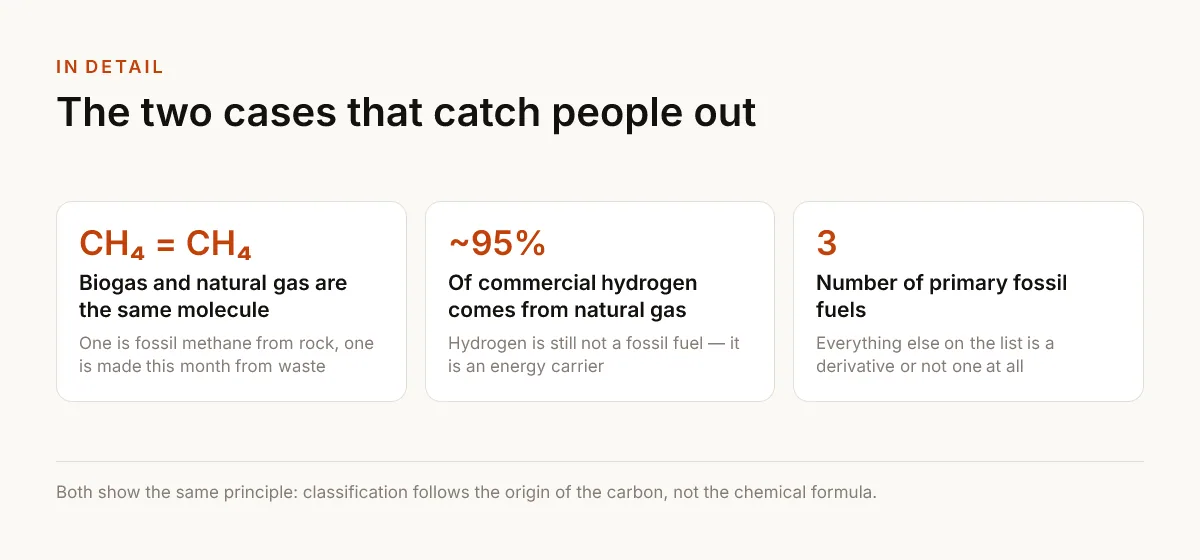
Hydrogen. Most commercial hydrogen today is manufactured by steam reforming of natural gas, so its production is tied to a fossil fuel. The hydrogen itself is still not a fossil fuel — it is an element and an energy carrier. In classification questions the expected answer is that hydrogen is not a fossil fuel.
Biogas versus natural gas. Both are mostly methane, chemically indistinguishable at the molecular level. The classification is not about the molecule but about the origin: natural gas is fossil methane released from ancient rock, biogas is methane made this month from waste by bacteria. Same gas, different resource class.
#Reversed wording
When the question asks which one is a fossil fuel, the options usually contain one of coal, petroleum, natural gas, petrol, diesel, kerosene, LPG or CNG among several renewables. Pick the one from the fossil family.
#Why the distinction matters beyond the exam
The classification is not academic bookkeeping. It determines two things that decide energy policy:
Renewability. Fossil fuels come from a fixed stock that is not being replaced. Biofuels can be regrown; nuclear fuel is finite but not carbon-based; solar and wind are effectively unlimited.
Net carbon. Burning wood or biogas releases carbon that plants absorbed from the air recently, so with replanting the cycle roughly balances. Burning coal releases carbon that has been locked underground for hundreds of millions of years, adding to the atmosphere's active carbon stock. That difference is why two fuels that produce similar carbon dioxide at the point of burning are treated very differently in climate accounting.
#Quick reference
Fossil fuels: coal, petroleum, natural gas, and everything refined from them — petrol, diesel, kerosene, LPG, CNG, coke, coal gas.
Not fossil fuels: wood, charcoal, cow dung, biogas, ethanol, biodiesel, uranium, hydrogen, solar, wind, hydro, tidal, geothermal.
Frequently asked questions
Which of the following is not a fossil fuel: coal, petroleum, natural gas, wood?
Wood. Coal, petroleum and natural gas all formed from organisms buried millions of years ago. Wood comes from trees growing today, which makes it a renewable biofuel rather than a fossil fuel.
Is uranium a fossil fuel?
No. Uranium is a radioactive metal mined as ore. It releases energy by nuclear fission, not by combustion, and it was never living matter. It is a non-renewable resource, but it is a nuclear fuel, not a fossil fuel — a distinction exam questions frequently test.
Is biogas a fossil fuel?
No. Biogas is produced by the anaerobic decomposition of animal dung, sewage or plant waste, and it is made in days or weeks from material that was recently alive. It is a renewable biofuel, even though its main component, methane, is chemically the same molecule as the main component of natural gas.
Is LPG a fossil fuel?
Yes. Liquefied petroleum gas is a mixture of propane and butane obtained from crude oil refining and from natural gas processing. Because it derives directly from fossil sources, it is classed as a fossil fuel, unlike biogas.
Sources
Every figure above traces back to one of these. If you find one that does not, tell us and we will fix it.
- [1]What is energy? Sources of energy — U.S. Energy Information Administration
- [2]Oil and petroleum products explained — U.S. Energy Information Administration
- [3]Basic Information about Landfill Gas — U.S. Environmental Protection AgencyBackground on biogenic methane, for the biogas comparison.
Written by
Priya Raman — Energy science editor
Taught school science for eight years, then moved into writing about combustion and energy. Still explains things the way you would to a class.
- MSc Chemistry
- Eight years teaching physical science
- Science curriculum writer