Why Natural Gas Is Called a Clean Fuel
It burns almost completely, leaves no ash or soot, contains virtually no sulphur, and emits about half the carbon dioxide of coal.
Key takeaways
- Methane has the highest hydrogen-to-carbon ratio of any hydrocarbon, so less CO₂ per unit energy.
- It leaves no ash, soot or residue and produces negligible particulate matter.
- Sulphur is removed during processing, so there is essentially no sulphur dioxide or acid rain.
- It produces about half the carbon dioxide of coal for the same heat.
- It is still a fossil fuel — non-renewable, and it emits carbon dioxide.
Natural gas gets called clean so often that the word has stopped meaning anything specific. It is worth pinning down, because the label is genuinely earned in some respects and genuinely misleading in others.
Here is what it is clean of, what it is not clean of, and the one environmental issue with gas that has nothing to do with burning it.
#What natural gas is
Natural gas is mostly methane (CH₄), typically 70–90%, with smaller amounts of ethane, propane and butane, plus traces of nitrogen and carbon dioxide. Before distribution it is processed to remove water, heavier hydrocarbons, and sulphur compounds such as hydrogen sulphide.
That processing matters: the sulphur is removed before the gas reaches a customer, which is why sulphur dioxide is essentially absent from the flue gas.
#Reason 1: it burns almost completely
Methane is the simplest hydrocarbon, and as a gas it mixes thoroughly with air before ignition. Complete combustion follows:
CH4 + 2 O2 -> CO2 + 2 H2O
Compare a solid fuel, where oxygen has to reach the interior of each lump, and combustion is inevitably partial in places. That is the origin of soot, carbon monoxide and unburnt hydrocarbons — problems a well-adjusted gas burner largely avoids.
#Reason 2: the hydrogen-to-carbon ratio
Methane has four hydrogen atoms per carbon — the highest ratio of any hydrocarbon. More of its energy therefore comes from forming water rather than carbon dioxide.
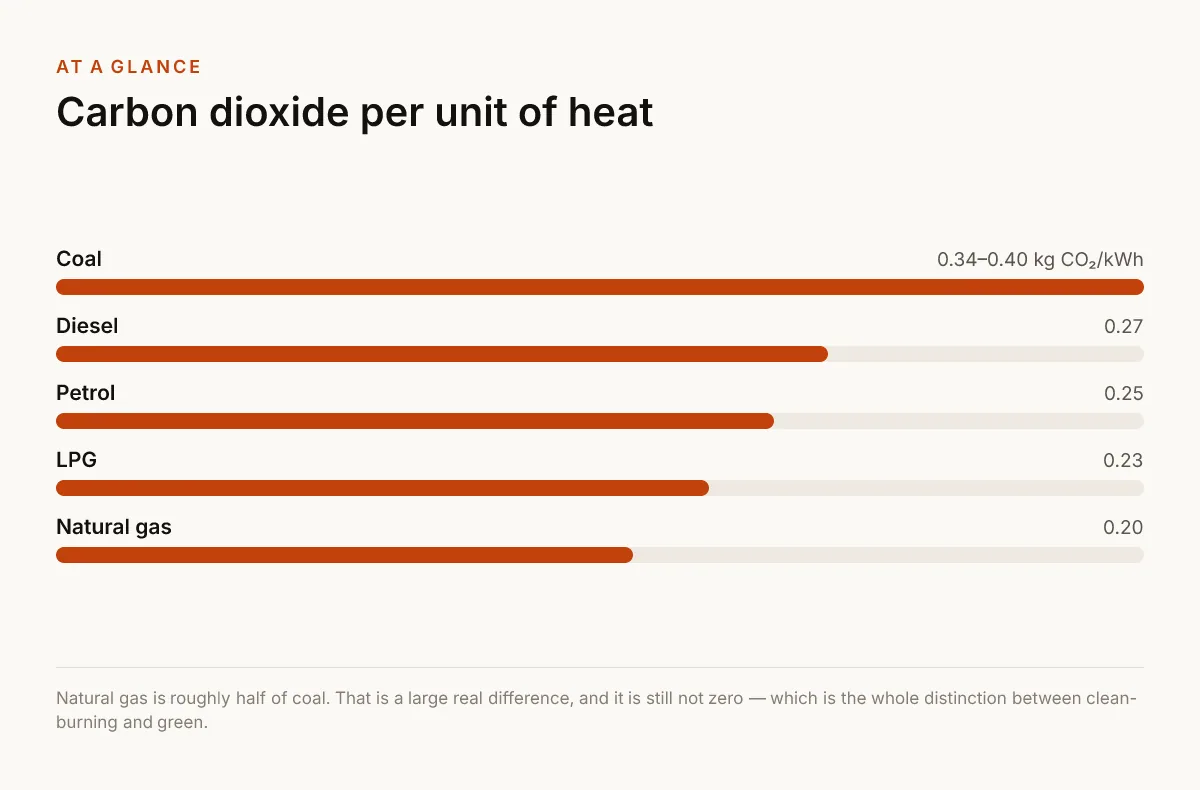
Carbon dioxide emitted per unit of energy:
| Fuel | Approx. kg CO₂ per kWh of heat |
|---|---|
| Natural gas | 0.20 |
| LPG | 0.23 |
| Petrol | 0.25 |
| Diesel | 0.27 |
| Coal | 0.34–0.40 |
Roughly half the carbon dioxide of coal for the same heat. This is why replacing coal generation with gas generation was, for a period, the single largest driver of emissions reduction in several countries.
#Reason 3: no ash, no residue, no particulates
Gas leaves nothing behind. There is no ash to remove, no clinker, no fly ash to dispose of, no soot on the burner and no black deposits on pans.
Coal-fired power stations produce large volumes of ash, sometimes containing heavy metals, requiring dedicated ponds or landfill. Solid fuel burned domestically produces particulate matter directly in the living space.
#Reason 4: virtually no sulphur
Sulphur dioxide is the acid rain gas. Coal typically contains 0.5–3% sulphur and heavy fuel oils more; processed natural gas contains almost none, because sulphur compounds are stripped out before distribution.
The odour of domestic gas comes from mercaptan added deliberately as a safety measure, since methane itself is odourless. That is a trace additive, not a combustion pollutant.
#Reason 5: lower other emissions
Natural gas combustion produces less carbon monoxide, fewer unburnt hydrocarbons and generally lower nitrogen oxides than solid or heavy liquid fuels. Modern low-NOₓ burners reduce the last of these further by controlling flame temperature.
#Where the label overreaches
Three qualifications keep this honest.
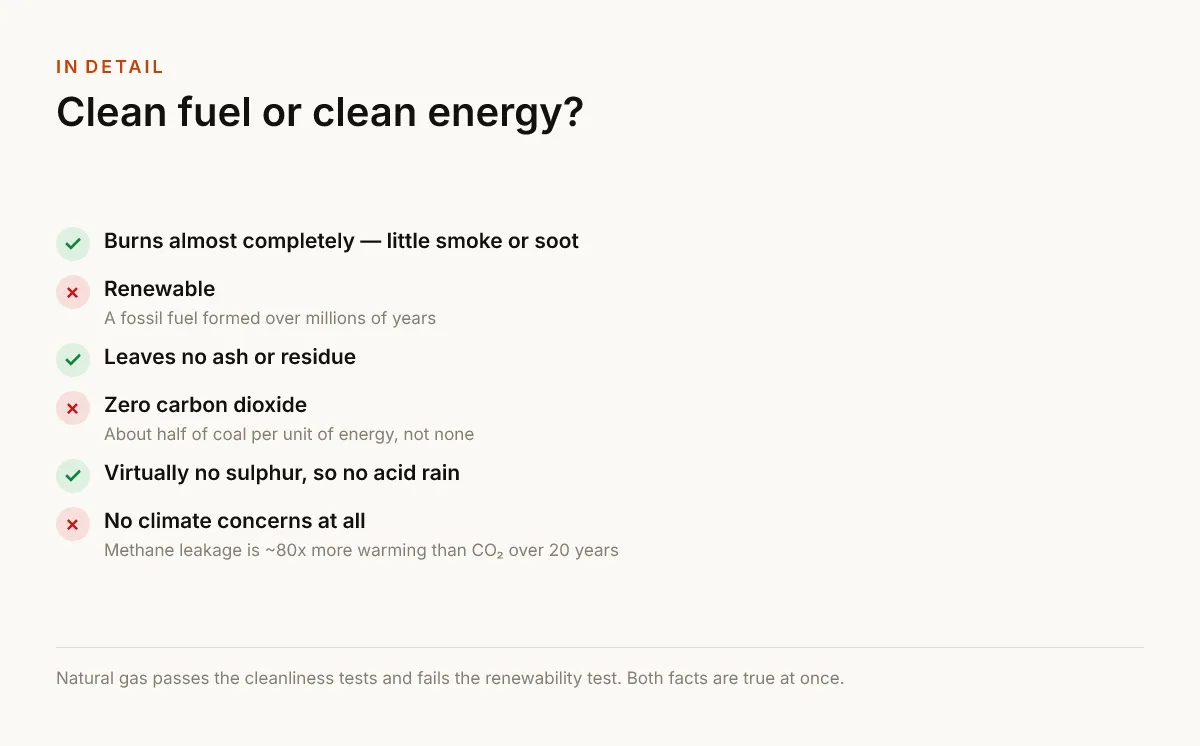
It still emits carbon dioxide. Half of coal's emissions is a large improvement and not zero. A gas-fired power station is a significant source of greenhouse gas.
It is non-renewable. Natural gas is a fossil fuel formed over millions of years. Cleaner combustion does not make it renewable, and "clean fuel" does not mean "green energy".
Methane leakage. This is the serious one. Methane is a greenhouse gas roughly 80 times more potent than carbon dioxide over a twenty-year horizon. Leaks from wells, pipelines, compressors and domestic connections release it unburnt. Studies of leakage rates vary considerably, and where leakage is high, the advantage over coal narrows substantially. Burning methane is clean; losing it is not.
#The domestic picture
For a household, the case is strong and immediate:
- No fuel storage, no deliveries, no cylinder handling
- No smoke, ash or soot indoors
- Instant, precisely controllable heat
- High efficiency in a condensing boiler, above 90% on a net basis
- Far better indoor air quality than solid fuel
The caveats are the ones that apply to any combustion appliance indoors: it consumes oxygen, produces water vapour, and produces carbon monoxide if starved of air. A flued appliance sends all of that outside; a flueless one does not, which is why flueless gas fires carry strict ventilation and room-size rules.
For where gas sits against every other fuel, see which is the cleanest fuel. For what it means indoors without a flue, see flueless gas heaters explained.
#The compact answer
Natural gas is called a clean fuel because it burns almost completely, producing mainly carbon dioxide and water with very little smoke, soot or ash. It contains almost no sulphur, so it does not cause acid rain, and it produces about half the carbon dioxide of coal for the same amount of energy. However, it is still a fossil fuel: it is non-renewable and its combustion does release carbon dioxide.
Frequently asked questions
Why is natural gas called a clean fuel?
Because it burns almost completely, producing mainly carbon dioxide and water with very little smoke, soot or ash. It contains virtually no sulphur, so it does not cause acid rain, and being mostly methane it releases about half the carbon dioxide of coal per unit of energy. It also leaves no solid residue to dispose of.
Is natural gas a clean energy source?
It is a clean-burning fossil fuel, not clean energy. Green or clean energy means renewable and essentially non-polluting — solar, wind, hydro. Natural gas is finite and its combustion still emits carbon dioxide. It is cleaner than coal and oil, which is a meaningful difference, but it is not a renewable source.
Why does natural gas produce less carbon dioxide than coal?
Because of its hydrogen content. Methane has four hydrogen atoms per carbon atom, so a large share of its energy comes from burning hydrogen to water rather than carbon to carbon dioxide. Coal is largely carbon with little hydrogen, so almost all of its energy comes with carbon dioxide attached.
What is the environmental problem with natural gas?
Methane leakage. Unburnt methane released from wells, pipelines and compressors is a greenhouse gas roughly 80 times more potent than carbon dioxide over twenty years. If leakage across the supply chain is high enough, it can erode much of the carbon advantage that natural gas has over coal.
Sources
Every figure above traces back to one of these. If you find one that does not, tell us and we will fix it.
- [1]Natural gas basics — U.S. Department of Energy, Alternative Fuels Data Center
- [2]Carbon dioxide emissions coefficients by fuel — U.S. Energy Information Administration
Written by
Marcus Hale — Contributing gas engineer
Working Gas Safe engineer. Services flued and flueless appliances all week and fact-checks everything on this site that involves a gas pipe.
- Gas Safe registered (UK)
- 15 years in the field
- CCN1, CENWAT, HTR1 assessed