What Are Fossil Fuels? Definition, Types and Examples
A plain definition of fossil fuels with the three main types, everyday examples, how each is used, and where the world's supplies come from.
Key takeaways
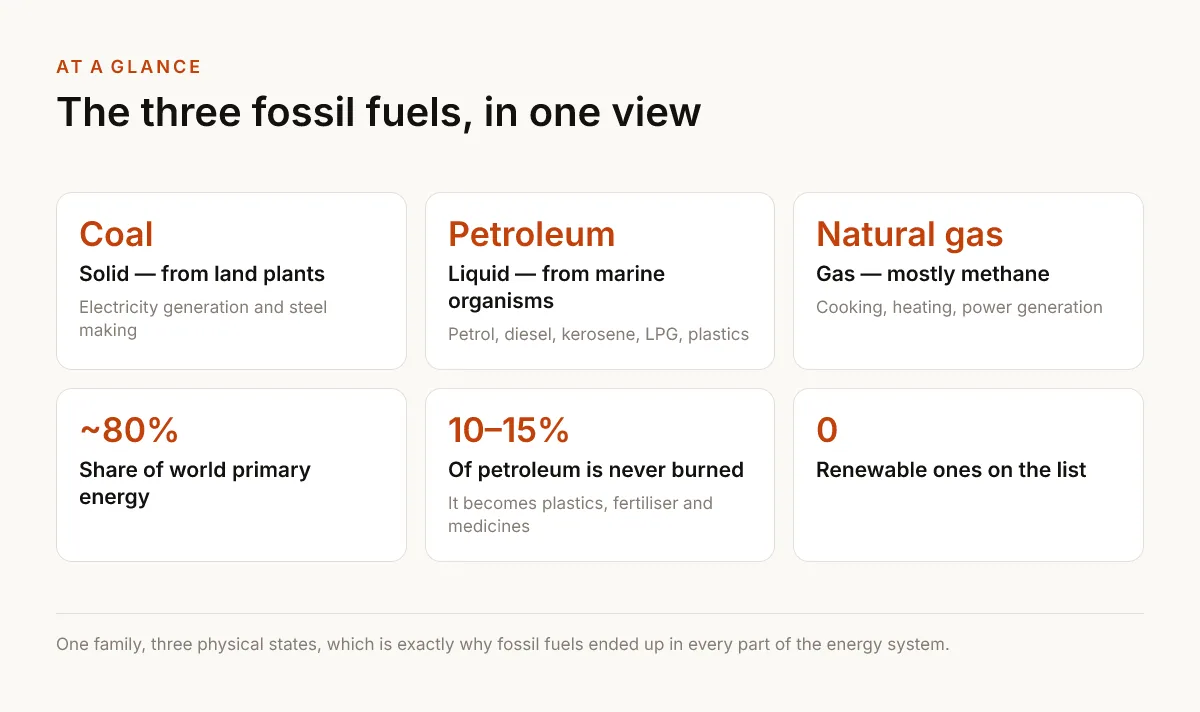
- Definition: non-renewable fuels formed from the buried remains of ancient organisms.
- Three types: coal (solid), petroleum (liquid), natural gas (gaseous).
- Everyday examples include petrol, diesel, kerosene, LPG, CNG and coal.
- They supply roughly 80% of world primary energy.
- All are exhaustible and all release carbon dioxide when burned.
Ask ten people to define a fossil fuel and most will say something about it being old, or dirty, or running out. All true, and none of it is the definition.
The actual definition is short, and it does something useful: it tells you immediately which things on any list qualify and which do not. Here it is, with the three types and the examples people actually recognise.
#Definition
Fossil fuels are carbon-based fuels formed from the fossilised remains of plants and animals that lived millions of years ago, buried under sediment and transformed by heat and pressure into concentrated hydrocarbons.
Three properties follow from that definition and appear in every textbook treatment:
- They are non-renewable — the stock is fixed and forms far too slowly to replace.
- They are carbon-rich — burning them releases carbon dioxide.
- They store ancient solar energy captured by photosynthesis.
#The three types
#Coal — the solid fossil fuel
Formed from land plants in ancient swamps. Grades run from lignite through bituminous coal to anthracite, with carbon content and calorific value rising along the sequence.
Used mainly for electricity generation and for steel making, where coal is converted to coke. India, China, the United States, Australia and Russia hold the largest reserves.
#Petroleum — the liquid fossil fuel
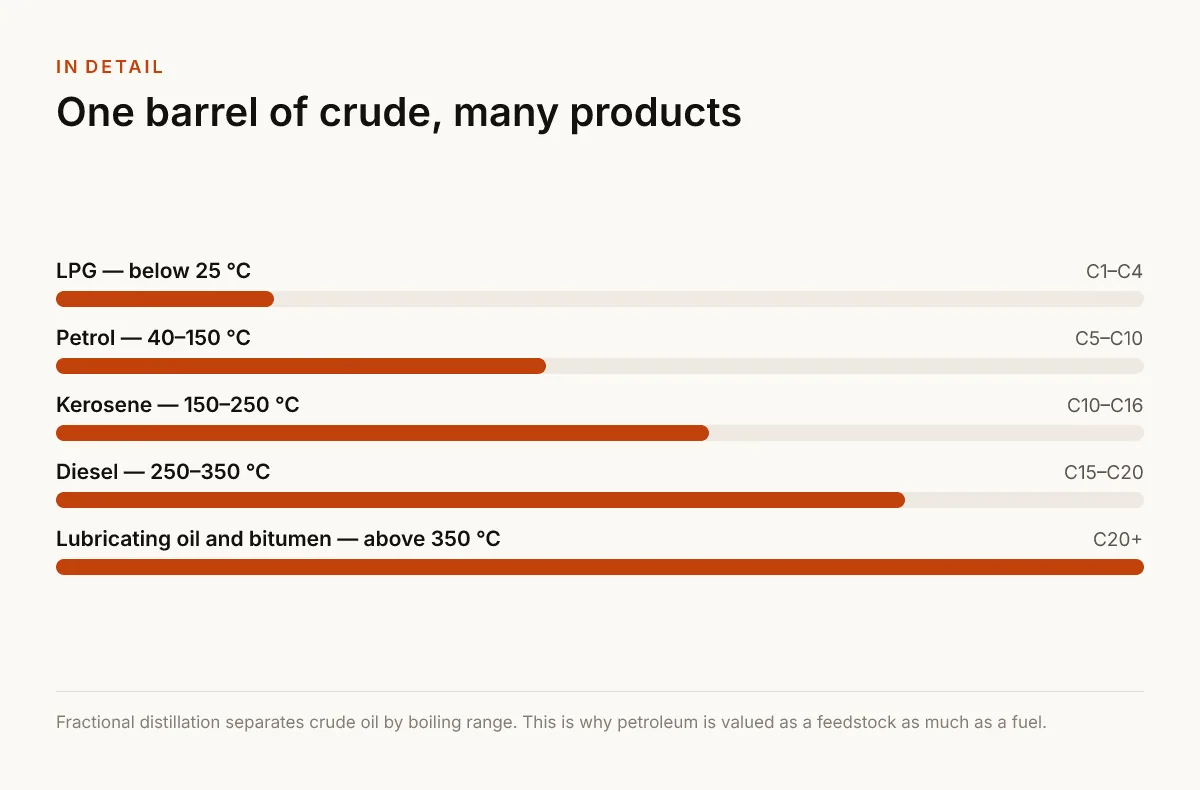
Crude oil, formed from marine microorganisms. On its own it is not directly usable; it is separated by fractional distillation into fractions of different boiling ranges:
| Fraction | Typical use |
|---|---|
| Petroleum gas (LPG) | Cooking fuel |
| Petrol | Motor fuel for spark-ignition engines |
| Kerosene | Lamps, stoves, jet fuel base |
| Diesel | Trucks, buses, generators, railways |
| Lubricating oil | Machinery lubrication |
| Paraffin wax | Candles, ointments, waterproofing |
| Bitumen | Road surfacing |
Because so many products come from one barrel — including the kerosene in lamps and jet engines — petroleum is often called "black gold" — its value lies as much in the chemical feedstock it supplies as in the fuel.
#Natural gas — the gaseous fossil fuel
Mostly methane (CH₄), typically 70–90%, with smaller amounts of ethane, propane and butane. Found in reservoirs above petroleum deposits and also in standalone gas fields.
Supplied by pipeline to homes, compressed as CNG for vehicles, or cooled to −162 °C as LNG for shipping across oceans. It burns more cleanly than coal or oil: no ash, negligible sulphur, and roughly half the carbon dioxide of coal per unit of energy.
#Everyday examples
If you want examples that are recognisable rather than categorical:
- Coal in a thermal power station generating electricity
- Petrol in a motorbike or car
- Diesel in a bus, truck or generator
- Kerosene in a wick stove or lamp, and as the base of aviation turbine fuel
- LPG in a domestic cooking cylinder
- CNG in an auto-rickshaw or city bus
- Natural gas piped to a household stove or boiler
Every one of these traces back to coal, crude oil or natural gas.
#How much of world energy they supply
Fossil fuels provide roughly 80% of global primary energy. The share has fallen slowly as renewables have grown, but the absolute quantity consumed has not fallen, because total demand keeps rising.
The reasons for that dominance are practical rather than political:
- High energy density. Petrol carries roughly 12 kWh per kilogram — far more per unit mass than any battery in production.
- Storability. A tank of diesel holds its energy indefinitely with no losses.
- Existing infrastructure. Refineries, pipelines, filling stations, boilers and engines were all built around these fuels over a century.
- Dispatchability. A gas turbine produces power on demand, regardless of weather or time of day.
#The costs
The same combustion that makes them useful causes the problems:
- Carbon dioxide, the principal greenhouse gas driving climate change
- Sulphur dioxide from sulphur-bearing coal and oil, causing acid rain
- Oxides of nitrogen, contributing to smog and acid rain
- Particulates and soot, linked to respiratory and cardiovascular disease
- Carbon monoxide wherever combustion is incomplete
- Ash and slag requiring disposal, and land damage from mining and spills
And underlying all of it, the fact that reserves are finite.
#Fossil fuels versus the alternatives
| Fossil fuels | Renewables | |
|---|---|---|
| Source | Ancient buried organisms | Sun, wind, water, heat, biomass |
| Renewable | No | Yes |
| CO₂ at point of use | High | None or near-zero |
| Energy density | Very high | Low to moderate |
| Availability | Depletes | Continuous but variable |
#The compact answer
Fossil fuels are fuels formed from the remains of dead plants and animals buried under the earth for millions of years and converted by heat and pressure into carbon-rich substances. The three fossil fuels are coal, petroleum and natural gas. Examples: coal used in power stations, and petroleum, from which petrol, diesel and kerosene are obtained.
Frequently asked questions
What are fossil fuels? Give two examples.
Fossil fuels are fuels formed from the remains of plants and animals that were buried underground millions of years ago and converted by heat and pressure into carbon-rich substances. Two examples are coal and petroleum. Natural gas is the third.
What are the three types of fossil fuels?
Coal, which is solid and formed from land plants; petroleum or crude oil, which is liquid and formed from marine organisms; and natural gas, which is gaseous, mostly methane, and usually found alongside petroleum deposits.
Is petrol a fossil fuel?
Yes. Petrol is obtained by the fractional distillation of crude oil, so it is a petroleum product and shares its fossil origin. The same is true of diesel, kerosene, LPG, paraffin wax and bitumen.
What are fossil fuels used for?
Electricity generation (mainly coal and natural gas), transport (petrol, diesel, jet fuel), heating and cooking (natural gas, LPG, kerosene), industrial process heat, and as chemical feedstock for plastics, fertilisers, paints and synthetic fibres.
Sources
Every figure above traces back to one of these. If you find one that does not, tell us and we will fix it.
- [1]Oil and petroleum products explained — U.S. Energy Information Administration
- [2]Natural gas explained — U.S. Energy Information Administration
- [3]Fossil fuels — Our World in Data
Written by
Priya Raman — Energy science editor
Taught school science for eight years, then moved into writing about combustion and energy. Still explains things the way you would to a class.
- MSc Chemistry
- Eight years teaching physical science
- Science curriculum writer