Which Fuel Has the Highest Calorific Value? Hydrogen, and Why
Hydrogen, at about 150,000 kJ/kg — roughly three times petrol. The full ranking, and why hydrogen still is not in general use.
Key takeaways
- Hydrogen: ~150,000 kJ/kg, the highest of any fuel.
- Among common fuels: LPG and methane ~55,000 kJ/kg, then petrol and diesel ~45,000.
- By volume the ranking reverses — hydrogen is very poor per cubic metre.
- High hydrogen content raises calorific value; moisture, ash and oxygen lower it.
- Cow dung and green wood sit at the bottom of the table.
The expected answer is hydrogen, and you can stop there if you only need the mark.
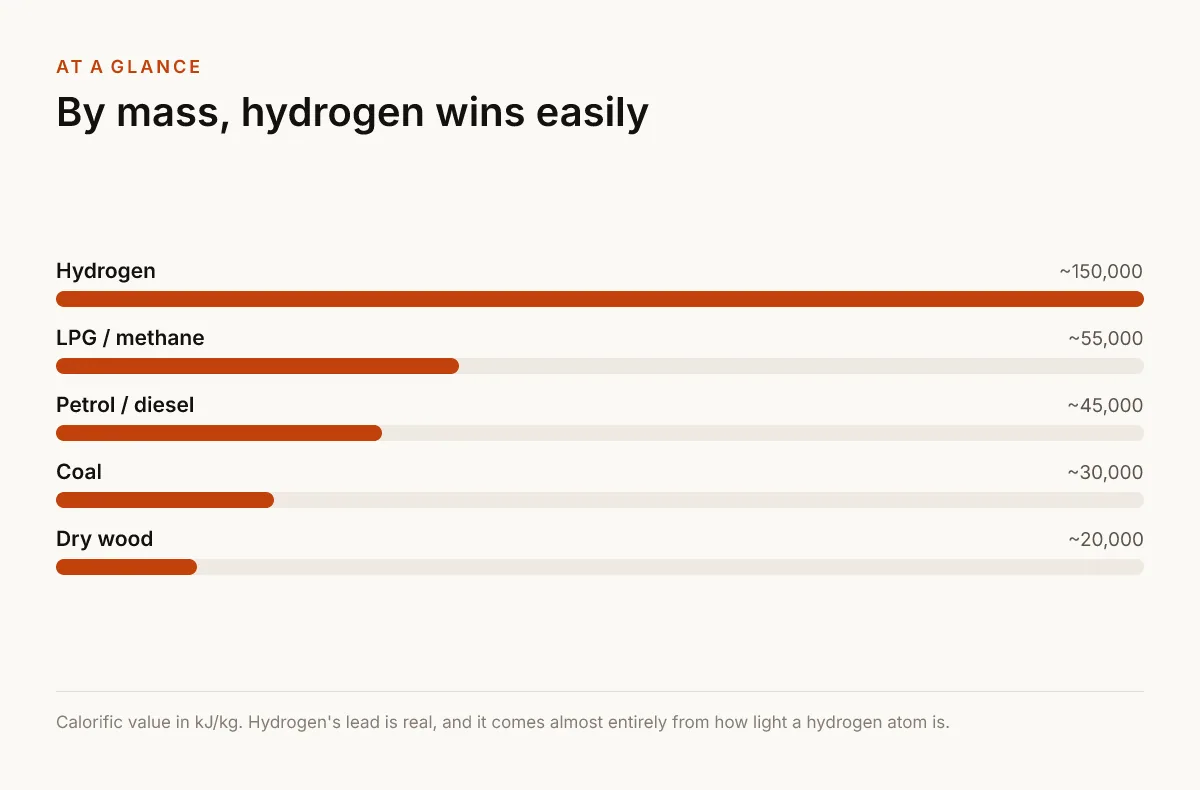
But the interesting bit is the follow-up: if hydrogen is so far ahead, why is there not one in your car? The answer is that calorific value is measured per kilogram, and a car does not have a kilogram problem. It has a space problem — and on that measure the ranking turns completely upside down.
#The ranking by mass
| Fuel | Calorific value (kJ/kg) |
|---|---|
| Hydrogen | ~150,000 |
| Methane / natural gas | ~55,000 |
| LPG (propane/butane) | ~55,000 |
| Petrol | ~45,000 |
| Diesel | ~45,000 |
| Kerosene | ~43,000 |
| Biogas | ~35,000–40,000 |
| Charcoal | ~30,000 |
| Anthracite | ~30,000–35,000 |
| Bituminous coal | ~25,000–33,000 |
| Dry wood | ~17,000–22,000 |
| Cow dung cake | ~6,000–8,000 |
Hydrogen is roughly three times petrol and more than twenty times cow dung cake.
#Why hydrogen leads
Two reasons combine.
Hydrogen atoms are extremely light. Calorific value is energy per kilogram. One kilogram of hydrogen contains vastly more atoms than one kilogram of any other fuel, because hydrogen has the smallest atomic mass of all elements.
The bonds formed release a lot of energy. Burning hydrogen forms strong O–H bonds in water:
2 H2 + O2 -> 2 H2O
There is no carbon to oxidise, and the reaction is highly exothermic.
Note the qualifier that most sources skip: per molecule, methane releases more energy than hydrogen. Hydrogen's supremacy is entirely a mass effect. Which criterion matters depends on whether you are carrying the fuel or paying for it.
#Where hydrogen loses: volume
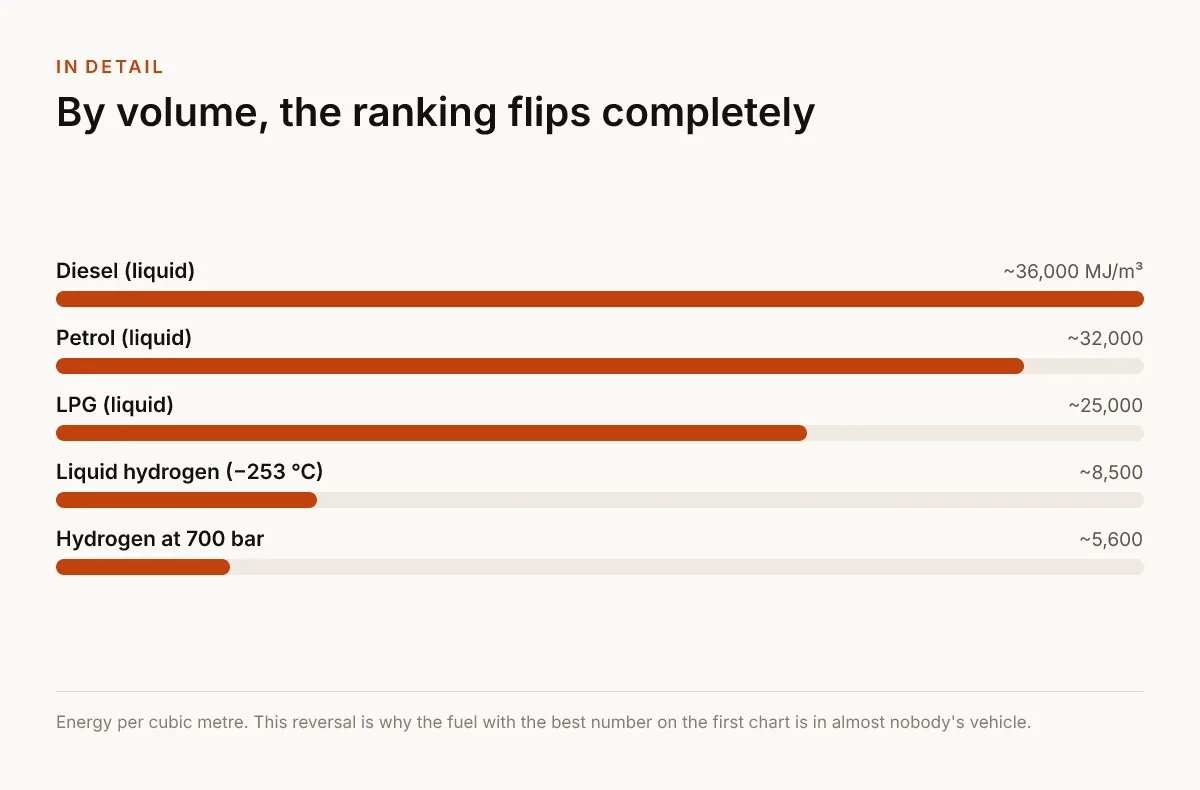
Reverse the basis and the table turns upside down.
| Fuel | Approx. energy per m³ (MJ) |
|---|---|
| Diesel (liquid) | ~36,000 |
| Petrol (liquid) | ~32,000 |
| LPG (liquid) | ~25,000 |
| Liquid hydrogen (−253 °C) | ~8,500 |
| Hydrogen at 700 bar | ~5,600 |
| Natural gas at 200 bar | ~9,000 |
| Hydrogen at atmospheric pressure | ~11 |
Hydrogen gas is so light that at ordinary pressure a cubic metre holds almost no energy. Even at 700 bar — a pressure demanding heavy, expensive composite tanks — it stores far less energy per litre than petrol.
For anything that has to carry its own fuel in a fixed space, volume matters at least as much as mass. That single trade-off explains most of the history of hydrogen vehicles.
#Why hydrogen is still not in general use
Beyond the volume problem:
- It has to be manufactured. There are no hydrogen wells. Most commercial hydrogen comes from steam reforming of natural gas, which emits carbon dioxide; electrolysis is clean but consumes more electricity than the hydrogen returns.
- Storage is difficult. 700 bar compression or cryogenic cooling to −253 °C, both energy-intensive and equipment-heavy.
- Metal embrittlement. Hydrogen diffuses into many steels and makes them brittle, so ordinary pipelines and vessels cannot simply be reused.
- Wide flammability range. Hydrogen burns in air from about 4% to 75% concentration, a far wider range than most fuels, and its flame is nearly invisible in daylight.
- No infrastructure. Almost no distribution network exists compared with petrol, diesel or natural gas.
Hydrogen is therefore best understood as an energy carrier with an excellent mass metric and difficult engineering, currently most attractive where mass matters more than volume and where nothing else works — rocketry, some heavy industry, possibly long-distance shipping.
#What raises and lowers calorific value
Reading the table top to bottom, the pattern is systematic:
Raises it
- High hydrogen content — hydrogen-rich fuels outperform carbon-rich ones
- Full reduction — fuel with no oxygen already bound in it
Lowers it
- Moisture. Water absorbs heat to vaporise and yields none. Green wood can carry 50% moisture and delivers barely half the heat of seasoned wood.
- Ash and mineral matter. Incombustible weight. High-ash coal delivers less per tonne.
- Oxygen in the fuel. Ethanol and wood are partly oxidised already, leaving less energy to release.
That explains the ordering neatly: gases with high hydrogen ratios at the top, wet high-ash solids at the bottom.
#The practical takeaway
Calorific value alone does not determine what to burn. The fuels people actually use — LPG, natural gas, petrol, diesel — sit in the upper-middle of the table because they combine good energy content with storability, transportability and controllability.
Hydrogen wins the metric and loses the engineering. Cow dung loses the metric and wins on being free and locally available. The best fuel for a job is the one that scores adequately across all criteria, not the one that tops a single column.
The obstacles are covered in full in why hydrogen is not widely used as a fuel. For what the number itself means and how it is measured, see calorific value explained.
#The compact answer
Hydrogen has the highest calorific value of any fuel, approximately 150,000 kJ/kg. Among commonly used fuels, LPG and methane are highest at about 55,000 kJ/kg, followed by petrol and diesel at about 45,000 kJ/kg.
Frequently asked questions
Which fuel has the highest calorific value?
Hydrogen, with a calorific value of about 150,000 kJ/kg. It is roughly three times that of petrol and about five times that of coal, and it produces only water on burning.
Which fuel has the highest calorific value among LPG, petrol, kerosene and coal?
LPG, at about 55,000 kJ/kg. Petrol and diesel are around 45,000 kJ/kg, kerosene about 43,000 kJ/kg, and coal between 25,000 and 35,000 kJ/kg depending on grade.
If hydrogen has the highest calorific value, why is it not used everywhere?
Because calorific value per kilogram is only one criterion. Hydrogen has very low density, so even compressed to 700 bar it needs several times the tank volume of petrol for the same energy. It also requires energy-intensive production, embrittles many metals, and has almost no distribution infrastructure.
Why does hydrogen have such a high calorific value?
Because hydrogen atoms are extremely light while the H–O bonds formed on combustion release a large amount of energy. Energy released per kilogram is high precisely because a kilogram of hydrogen contains an enormous number of atoms. Per molecule burned, methane actually releases more energy — hydrogen wins on a mass basis, not an absolute one.
Sources
Every figure above traces back to one of these. If you find one that does not, tell us and we will fix it.
- [1]Fuel properties comparison — U.S. Department of Energy, Alternative Fuels Data Center
- [2]Hydrogen basics — U.S. Department of Energy, Alternative Fuels Data Center
Written by
Priya Raman — Energy science editor
Taught school science for eight years, then moved into writing about combustion and energy. Still explains things the way you would to a class.
- MSc Chemistry
- Eight years teaching physical science
- Science curriculum writer