Pulverised Fuel: The Advantages, and the One That Isn't
Grinding coal to powder gives faster, more complete, more controllable combustion — but costs grinding power and makes far more fly ash.
Key takeaways
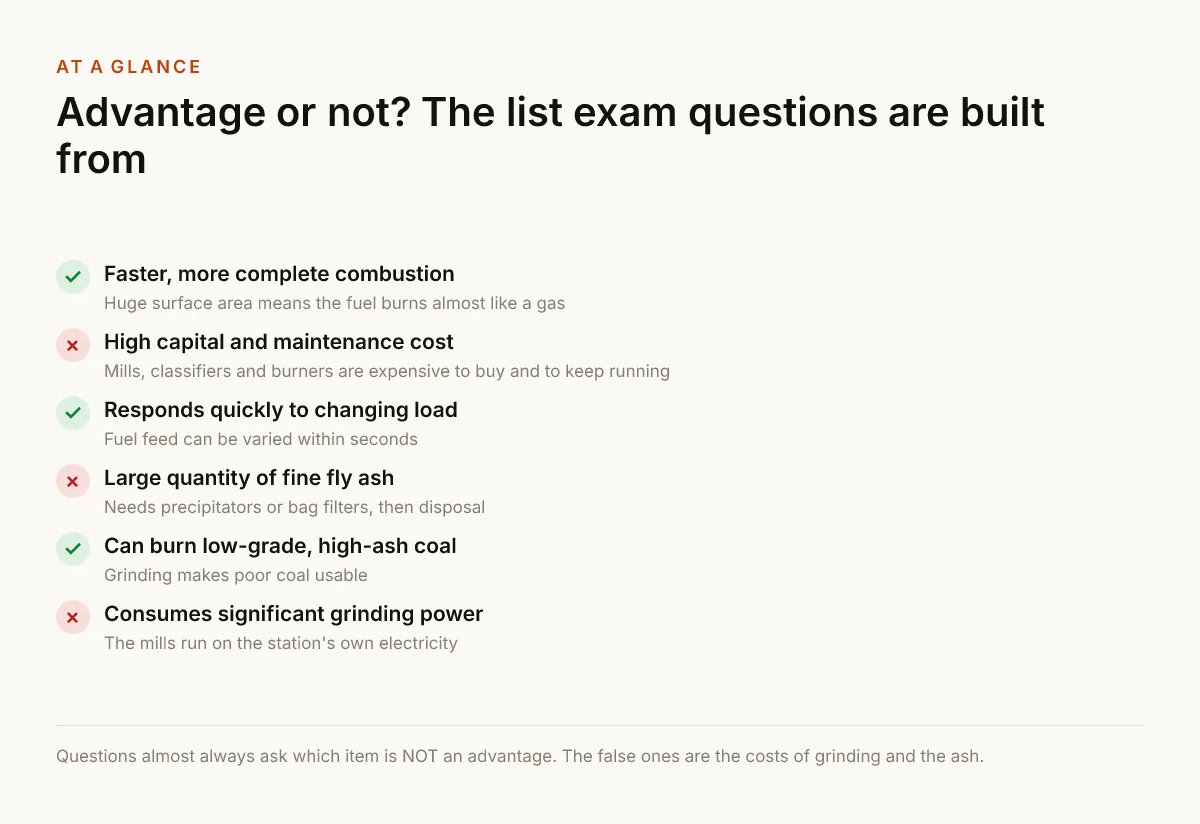
- Powdered coal burns almost like a gas because its surface area is enormous.
- Advantages: high combustion efficiency, quick response to load, less excess air, fuel flexibility.
- Not advantages: mill power consumption, high capital cost, and much more fly ash.
- Fly ash needs electrostatic precipitators or bag filters to capture.
- Pulverised fuel needs a support fuel to light the furnace from cold.
There is a question in this area that catches almost everyone, because it is asked backwards. Not "what are the advantages of pulverised fuel" but "which is not an advantage". The list looks plausible all the way down, and the trap is usually sitting in the middle.
So it is worth understanding the principle, because then you do not have to remember the list at all.
#The principle: surface area
Combustion happens where fuel meets oxygen — at a surface. A lump of coal has very little surface for its mass, so oxygen can only attack the outside, and the interior burns slowly and often incompletely.
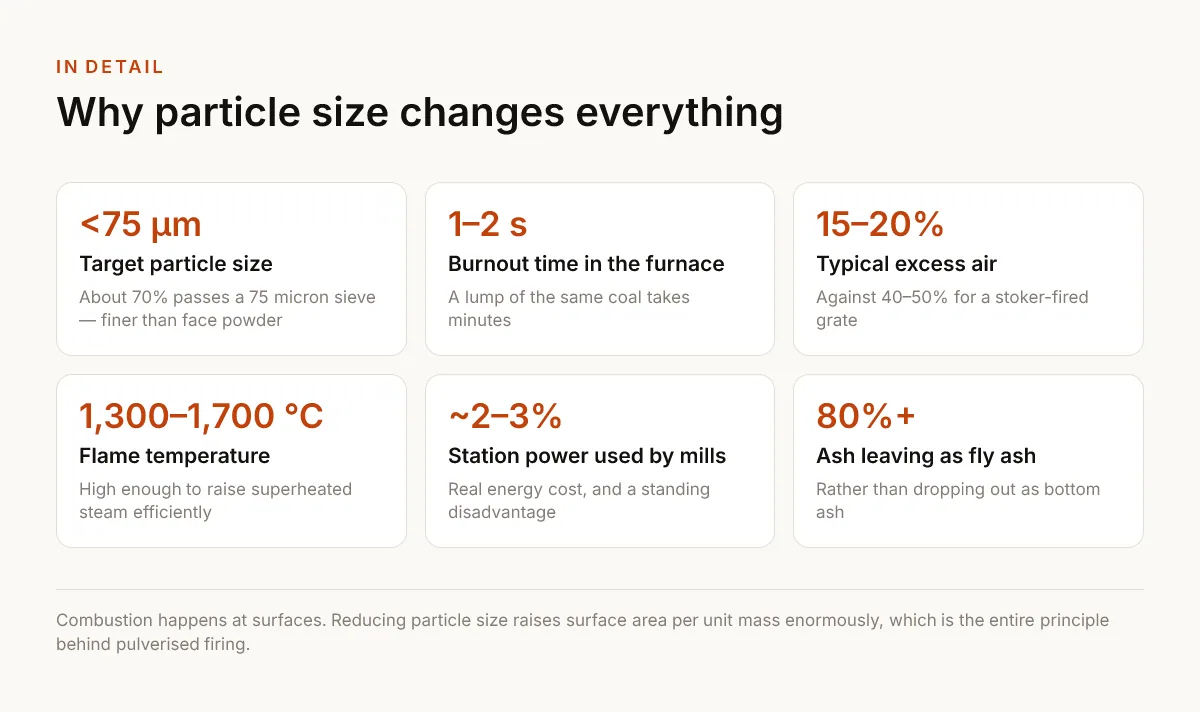
Grind that same coal until roughly 70% of it passes a 75 micron sieve, and the surface area per kilogram increases enormously. Blown into the furnace suspended in hot air, the powder behaves almost like a gas: it ignites nearly instantly and burns out in one to two seconds.
Everything on the advantages list is a consequence of that single change, and every disadvantage is a cost of achieving it.
#The genuine advantages
Fast, near-complete combustion. Very little unburnt carbon leaves in the ash, so more of the fuel you paid for becomes heat. This is the same mechanism, in reverse, that makes incomplete combustion such a waste in a poorly aired domestic appliance.
Less excess air. Lump-fired grates need 40–50% more air than theory requires, to be sure oxygen reaches everything. Pulverised firing manages on 15–20%. That matters because every cubic metre of surplus air is heated by your fuel and then sent up the stack.
Rapid response to load. Fuel feed can be varied within seconds, so the boiler can follow grid demand. A grate full of burning lumps cannot be turned down quickly, which is a serious operational limitation.
Fuel flexibility. Grinding makes low-grade, high-ash coal usable — which matters enormously in India, where much domestic coal runs 30–45% ash.
Higher furnace temperature. Around 1,300–1,700 °C, hot enough to raise the superheated steam that makes the steam cycle in a power station efficient.
No moving grate in the furnace. Fewer mechanical parts sitting in the fire.
#The things that are not advantages
Grinding power. The mills consume a real share of the station's own electricity — commonly a couple of percent of output, running continuously. That is fuel burned to prepare fuel.
Capital and maintenance cost. Pulverising mills, classifiers, primary air fans and burner assemblies are expensive to install, and grinding rock is punishing on machinery.
Fly ash — the big one. Because the fuel is airborne when it burns, most of the ash leaves with the flue gas as very fine particles rather than falling out of the bottom. Capturing it needs electrostatic precipitators or bag filters, and then you have to do something with it. Some goes into cement and concrete; the rest goes into ash ponds and landfill.
Explosion risk. Suspended coal dust in the right concentration is genuinely explosive. Mills and ducts need inerting, temperature monitoring and careful design.
Support fuel for start-up. Cold pulverised coal will not ignite on its own — a consequence of coal's high ignition temperature. Oil or gas burners light the furnace and warm it until coal firing is self-sustaining.
Drying requirement. Wet coal will not grind or flow properly, so mills use hot air to dry it as it grinds, which costs more heat.
#How to answer the question without memorising anything
Ask yourself which side of the trade each item sits on:
- Does it describe how the fuel burns? Fast, complete, controllable, hot, flexible → advantage.
- Does it describe what it costs to prepare the fuel, or what it leaves behind? Mill power, capital cost, maintenance, fly ash, dust explosion risk, start-up fuel → not an advantage.
That single split resolves every version of the question I have seen.
#The compact answer
Pulverised fuel firing has genuine advantages: rapid and nearly complete combustion, high combustion efficiency, low excess air, quick response to load changes, high furnace temperature and the ability to burn low-grade coal. What is not an advantage is the high capital and maintenance cost, the electricity consumed by the pulverising mills, and the large quantity of fine fly ash produced, which must be captured and disposed of.
Frequently asked questions
Which is not an advantage of using pulverised fuel?
The high capital and operating cost — including the electricity consumed by the pulverising mills — and the large quantity of fine fly ash produced, which must be captured and disposed of. These are the standard distractors, because everything else on a typical list (faster combustion, better efficiency, quicker load response, ability to burn low-grade coal) genuinely is an advantage.
Why is pulverised coal more efficient than lump coal?
Because combustion happens at surfaces. Grinding coal to under 75 microns multiplies the surface area available to oxygen enormously, so the fuel burns quickly and almost completely in one to two seconds, with much less excess air and much less unburnt carbon left over.
What are the disadvantages of pulverised fuel firing?
High capital cost for mills, classifiers and burners; significant electricity consumed by grinding; more fly ash requiring electrostatic precipitators or bag filters; explosion risk from coal dust; and the need for a support fuel such as oil or gas to light the furnace from cold.
Why is fly ash a problem?
Because pulverised firing sends most of the ash up with the flue gas as very fine particles rather than dropping it out at the bottom of the furnace. That fine ash must be captured before the stack, and then handled, stored or sold. It can be used in cement and concrete, which is the best outcome, but the volumes are large and disposal ponds are a persistent environmental liability.
Sources
Every figure above traces back to one of these. If you find one that does not, tell us and we will fix it.
- [1]Coal explained: How coal is used — U.S. Energy Information Administration
- [2]Carbon dioxide emissions coefficients by fuel — U.S. Energy Information Administration
Written by
Priya Raman — Energy science editor
Taught school science for eight years, then moved into writing about combustion and energy. Still explains things the way you would to a class.
- MSc Chemistry
- Eight years teaching physical science
- Science curriculum writer