What You Must Never Burn Indoors (And Why People Still Do)
Charcoal, generators, camping stoves and patio heaters kill people indoors every winter. The mechanism behind each, and what to use instead.
Key takeaways
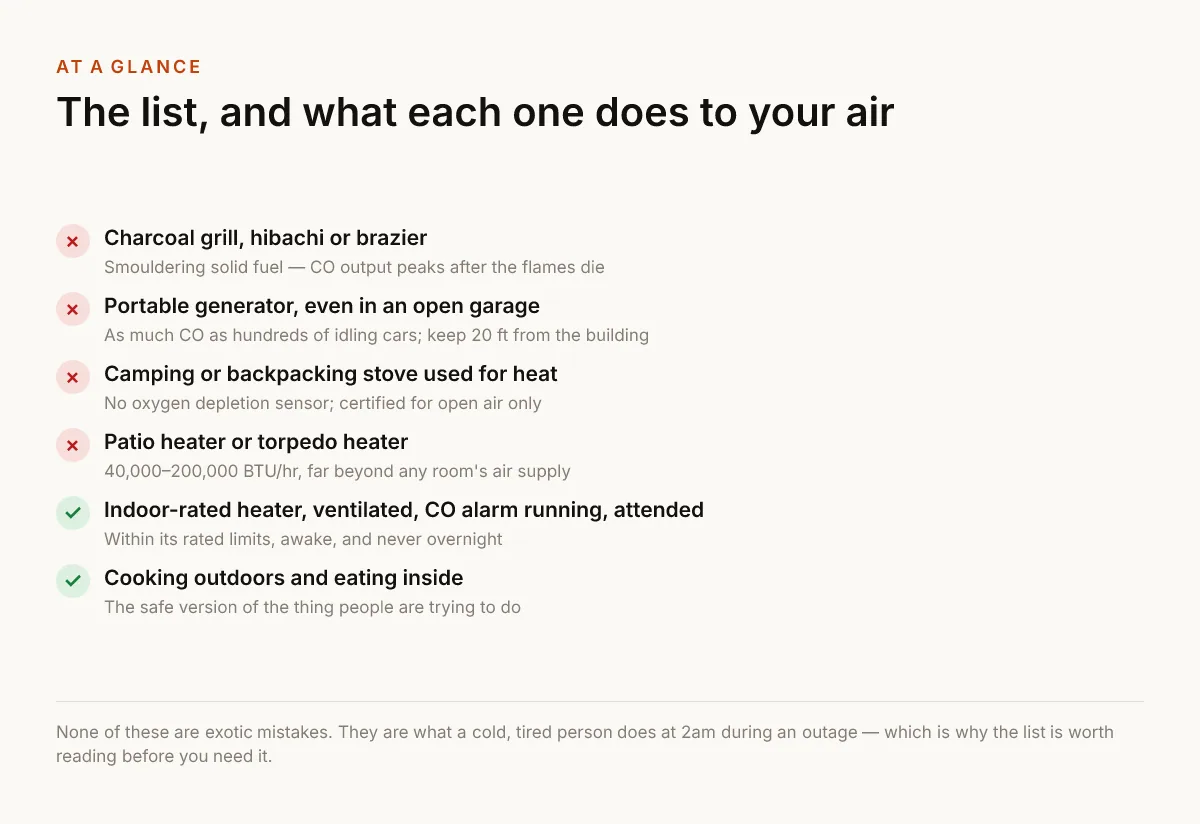
- Charcoal produces extremely high CO even after flames die down; a single grill indoors can be lethal.
- A portable generator can produce as much CO as hundreds of running cars — garages, porches and basements all count as indoors.
- Camping stoves are cooking appliances with no ODS, tested for open-air use.
- During an outage, layer clothing, close down to one room and use certified indoor-rated heating only.
- If anyone shows headache, nausea, confusion or drowsiness during fuel use, get outside and call emergency services.
The thing I want you to take from this guide is not a list of forbidden objects. It is a feel for why people reach for them, because that is the part that makes the list stick.
After every big storm, hospitals see the same cluster of cases, and the story barely changes. The power went out. The house got cold. It was late, everyone was tired, and there was a barbecue on the patio or a generator in the garage, and bringing it a little closer seemed like a small, sensible step. Nobody in these accounts is being reckless. They are cold and improvising at 2am.
So read this before you need it — because the moment you need it is exactly when your judgement will be worst, and with carbon monoxide, impaired judgement is one of the symptoms.
#Charcoal and briquettes: never, in any form
A charcoal grill, hibachi, kamado or brazier indoors is among the most reliably lethal things in this list. The mechanism:
- Charcoal burns as a smouldering solid. Oxygen reaches the surface of each briquette but not the interior, which is exactly the condition that yields carbon monoxide instead of carbon dioxide.
- Output peaks after the flames die. A grill that looks safely "spent", with grey ash and no visible fire, is often producing more CO than it was at ignition.
- There is no smell. Smoke odour comes from particulates, and a well-established charcoal fire produces little of it — while producing CO at concentrations that can incapacitate in under an hour in a closed room.
This applies to garages, porches, tents, camper vans, conservatories, cabins, and any space with a roof and walls. "I'll leave the door open" is the sentence that appears in the case reports.
#Portable generators
A generator is an internal combustion engine with no catalytic converter, running continuously. CDC guidance is blunt: a single portable generator can produce as much carbon monoxide as hundreds of idling cars.
The rules:
- Outdoors only, at least 20 feet (6 m) from any building.
- Exhaust pointed away from doors, windows and vents.
- Never in a garage, carport, porch, basement, crawlspace or shed — open door or not.
- Fit CO alarms inside the home before you ever need to run one.
Every year people die from a generator in an attached garage with the door up. Attached structures share air with the house through ceilings, walls, and every service penetration between them.
#Camping and backpacking stoves
Butane, propane and multi-fuel camping stoves are certified for outdoor use, without oxygen depletion sensors, and designed for short cooking bursts in unlimited air.
Used for heating in a room or tent, they run for hours in a volume measured in cubic metres. The result is oxygen depletion and rising CO with no automatic shutdown and no alarm built into the appliance. Tent deaths from stoves — and from bringing a "still-warm" stove or grill into a tent overnight — are a recurring category in mountain rescue statistics.
#Patio heaters and torpedo heaters
Two products that look like room heaters and are not:
- Patio heaters are rated on the assumption of unlimited outdoor air. Typical outputs of 40,000 BTU/hr are far beyond what any room can supply combustion air for.
- Forced-air kerosene or propane "torpedo" heaters are construction equipment, rated 50,000–200,000 BTU/hr — a different class of appliance entirely from an indoor-rated wick heater — with manuals restricting them to well-ventilated worksites. They are the single most common cause of serious CO incidents in enclosed garages and workshops.
Both are sold in general retail alongside indoor-rated heaters, which is precisely why people mix them up.
#Barbecues, fire pits and ovens
- A gas barbecue indoors carries the same combustion-air problem as a patio heater plus an LPG cylinder in your living space.
- A fire pit or chiminea on an enclosed porch or in a garage is an open unvented fire.
- Using a gas oven with the door open as a heater is explicitly warned against by every appliance maker. Ovens are designed for intermittent, sealed-cavity operation, not continuous open-door running, and doing so produces CO alongside a serious burn and fire risk.
#What to do instead during an outage
Heat:
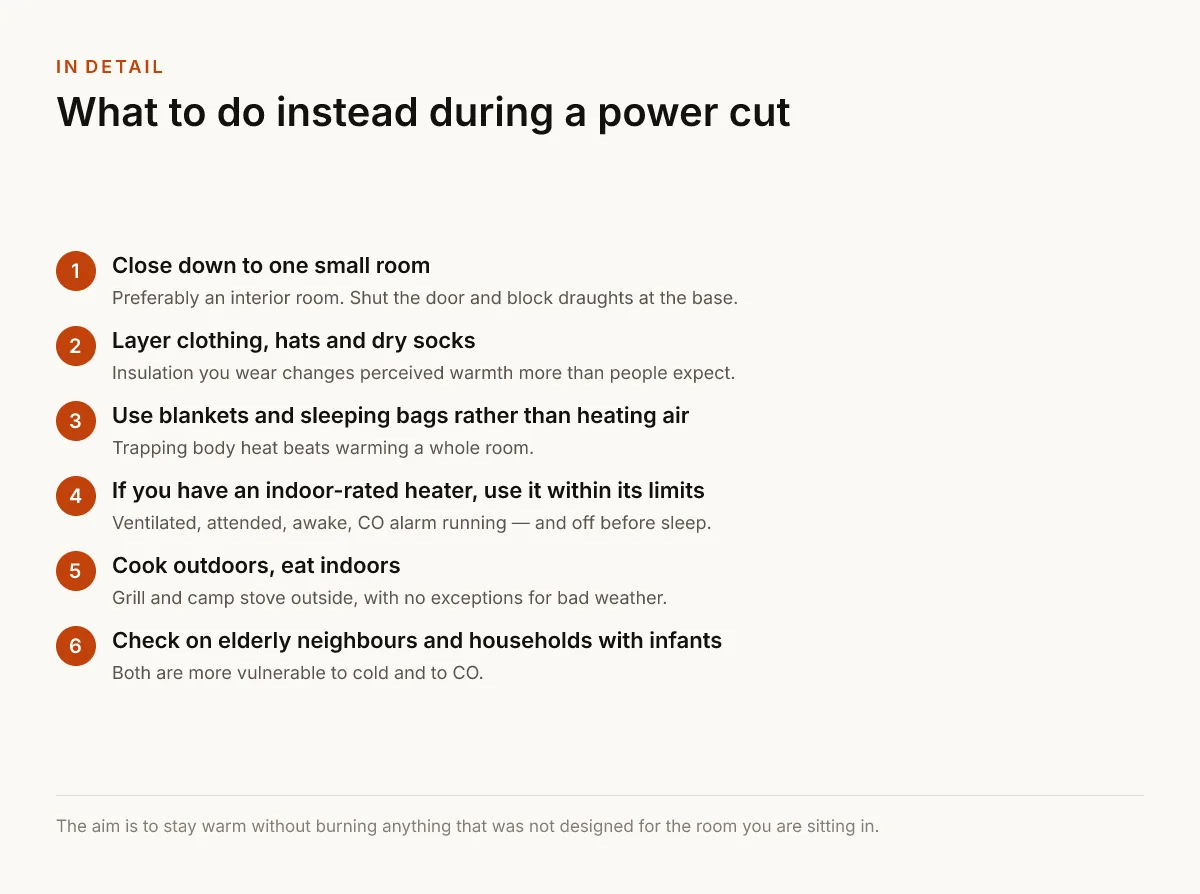
- Close down to a single small room, preferably interior, with the door shut and draught-blocked.
- Layer clothing; hats and dry socks change perceived warmth more than people expect.
- Use blankets and sleeping bags — insulation you carry beats heating a room.
- If you have an indoor-rated propane or kerosene heater with an ODS or with proper ventilation and a CO alarm, use it within its rated limits, awake and attended.
- Battery-powered CO alarms should be running the whole time.
Cooking:
- Cook outdoors, on the grill or camp stove, and eat inside.
- Eat food that needs no cooking, or heat it in short bursts outdoors.
People:
- Check on elderly neighbours, and on households with infants — both are more vulnerable to both cold and CO.
- Move to a designated warming centre if one is open. Local authorities open them during outages precisely so people do not resort to the list above.
#Recognising the failure while you still can
Carbon monoxide poisoning does not announce itself. The symptoms — headache, nausea, dizziness, drowsiness, confusion, shortness of breath — read as flu, and the confusion arrives before the alarm does.
The two patterns that distinguish it:
- Everyone feels ill at once, including pets.
- Symptoms improve outside and return indoors.
If either is true, or a CO alarm sounds: get everyone outside first, call emergency services from outside, and do not re-enter until responders clear the building. Tell the clinician you suspect carbon monoxide — the tests and treatment are specific and time-sensitive.
The rule underneath all of this is simple: if it was designed for outdoors, it does not come inside, no matter how cold it gets.
Frequently asked questions
Why is burning charcoal indoors so dangerous?
Charcoal burns as a smouldering solid with limited oxygen access to the interior of each briquette, which is the classic condition for producing carbon monoxide rather than carbon dioxide. It also emits most heavily once visible flames have gone, so the appearance of a 'dying' grill is exactly when output peaks. Enclosed-space charcoal deaths are documented worldwide every year.
Can I run a generator in my garage with the door open?
No. Manufacturer and CDC guidance is that generators run outdoors only, at least 20 feet from the building, with the exhaust directed away from doors, windows and vents. An open garage door does not provide anything close to the air exchange needed, and CO migrates readily into the house through shared walls and ceilings.
Is a camping stove safe to use indoors in an emergency?
Camping stoves are certified for outdoor use, have no oxygen depletion sensor, and are designed for short cooking bursts in open air. Using one for heat indoors runs it far longer than intended in a far smaller volume. If there is genuinely no alternative for brief cooking, do it beside a wide-open window with a CO alarm running, and never for heating.
What are the first signs of carbon monoxide poisoning?
Headache, nausea, dizziness, fatigue and shortness of breath — commonly mistaken for flu or food poisoning. Distinguishing signs are that symptoms improve when you leave the building and return when you come back, and that several people or pets in the same space feel unwell at once.
Sources
Every figure above traces back to one of these. If you find one that does not, tell us and we will fix it.
- [1]Carbon Monoxide's Impact on Indoor Air Quality — U.S. Environmental Protection Agency
- [2]Household air pollution and health — World Health OrganizationEvidence on the health burden of burning solid fuel in enclosed spaces.
- [3]Portable Generator Hazards — U.S. Consumer Product Safety CommissionSource of the 20-foot separation guidance and the generator CO comparison.
Written by
Dana Kerr — Editor — heating, stoves and indoor air
Twelve winters spent testing heaters in cold, draughty buildings, and a slightly obsessive interest in what a flame is actually doing.
- EPA 608 certified
- Former HVAC service writer
- 12 years covering domestic heating