What Fuel Do Trains Run On in India?
Indian Railways runs mostly on electricity now, with diesel for unelectrified lines. How the split works and why the switch happened fast.
Key takeaways
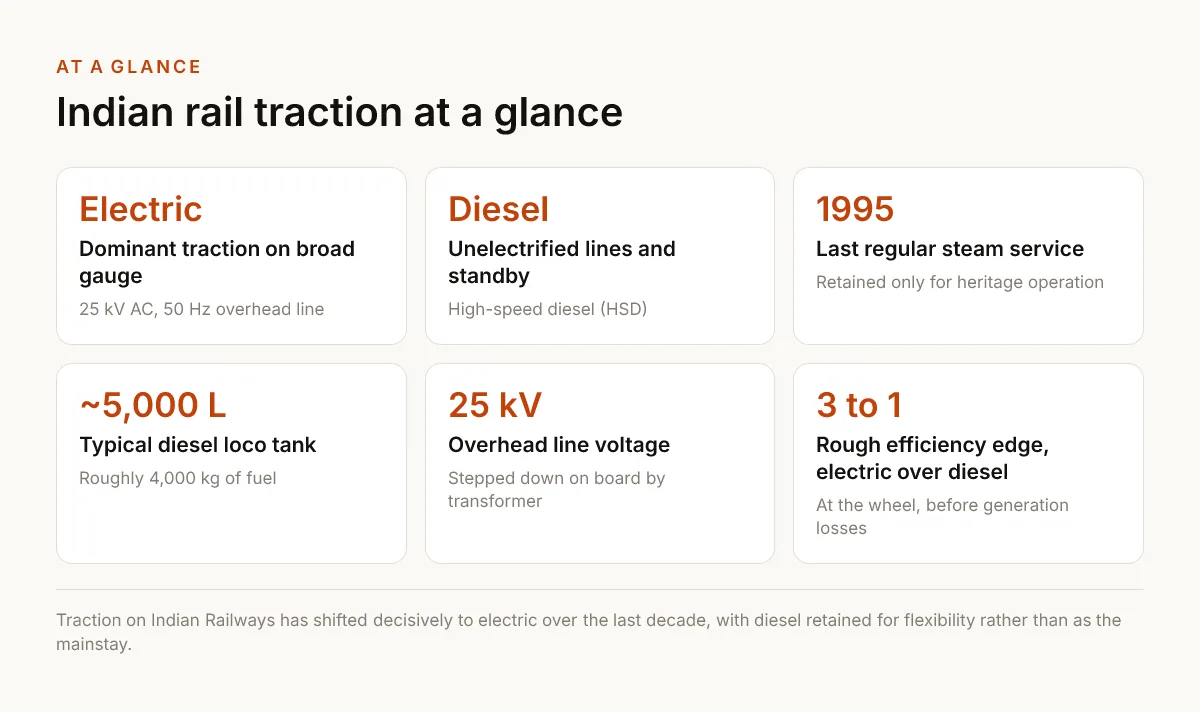
- Electric traction is now the default on Indian Railways broad gauge routes.
- Diesel locomotives burn high-speed diesel, and a big one holds around 5,000–6,000 litres.
- Steam ended in regular Indian service in 1995, though heritage runs continue.
- Electric traction is cheaper per tonne-kilometre and shifts emissions to the power station.
- Diesel units are kept for flexibility: no overhead line needed, and useful when power fails.
There is a moment on a long Indian train journey when the locomotive changes at a junction, and if you are on the platform you can see the switch: an electric loco with its pantograph folded down, and a diesel waiting to take over for the stretch where the wires stop. That handover is the whole story of Indian rail traction in one scene, and it happens a lot less often than it used to.
#The short version
Electricity, for most trains on most routes. Diesel, for everything else. Steam left regular service in 1995.
#How electric traction actually works
Overhead lines carry 25,000 volts AC at 50 Hz. The locomotive's pantograph — the sprung frame on the roof — presses against that wire and collects current. On board, a transformer steps the voltage down and converters feed the traction motors on the axles.
Two consequences follow, and both matter:
The locomotive carries no fuel. No tank, no fuel weight, no refuelling stop. Its energy arrives continuously through a wire.
It can push energy back. Under braking, the traction motors act as generators and return power to the overhead line — regenerative braking. A train slowing into a station can help power one accelerating out of the next. Diesel locomotives have no equivalent; they dump braking energy as heat through resistor banks on the roof.
#What diesel locomotives burn
High-speed diesel (HSD), the same fuel family as road diesel — a petroleum fraction distilled between roughly 250 °C and 350 °C, a fossil fuel like everything else out of a barrel of crude.
A mainline diesel loco holds around 5,000–6,000 litres, roughly four to five tonnes of fuel. Almost all are diesel-electric: the engine does not drive the wheels mechanically at all. It drives a generator, and the electricity produced runs traction motors. It is an electric locomotive that happens to carry its own power station.
That design exists because of torque. A diesel engine makes useful torque only across a narrow speed band; electric traction motors make maximum torque from a standstill, which is exactly what you need to move two thousand tonnes of freight from rest.
#Why the efficiency gap is so wide
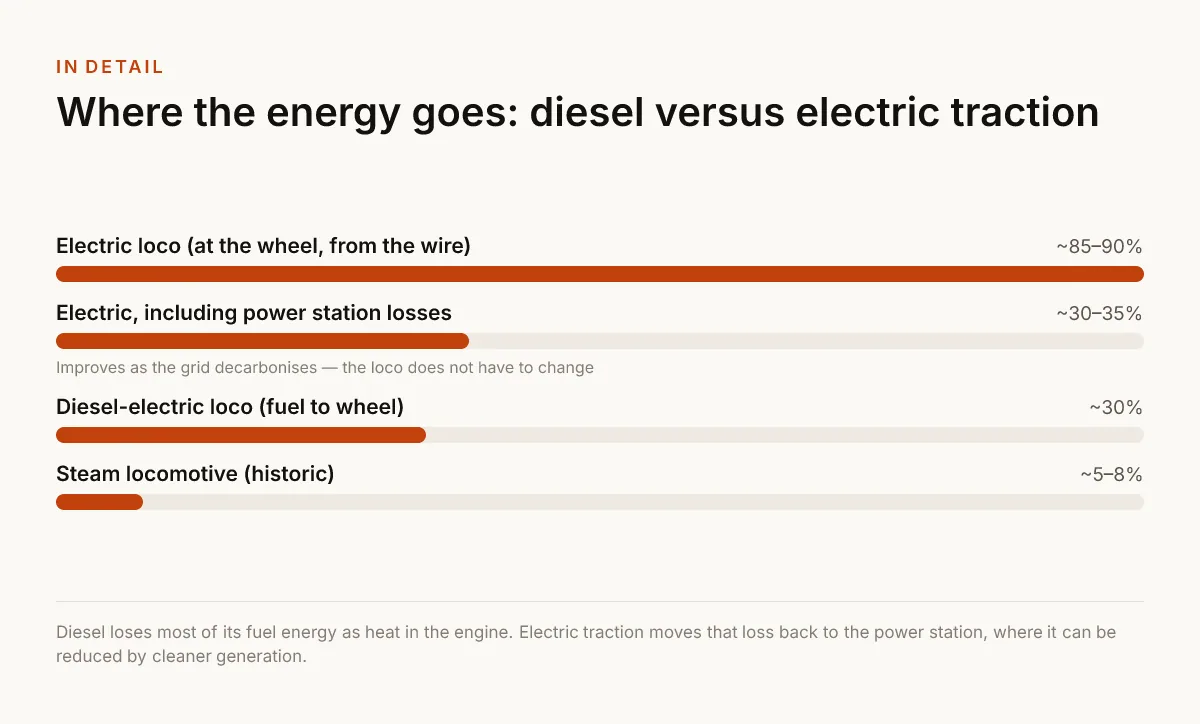
The figure above is worth sitting with, because it explains most railway economics.
A diesel-electric converts about 30% of its fuel energy into movement at the wheel. The rest goes out as heat, for the same thermodynamic reason a thermal power station loses two-thirds of its fuel energy — any engine that makes work from heat is bound by that limit.
An electric locomotive is not a heat engine. It converts electricity to motion at roughly 85–90%. The losses have not vanished; they have moved back up the wire to the generating station. But that relocation has three real benefits:
- A large power station burns fuel more efficiently than thousands of small engines.
- Emissions leave a tall stack outside a city rather than at platform level.
- When the grid gets cleaner, every train on the network gets cleaner with it — no locomotive modification required.
#What this looks like from the platform
If you want to tell what you are looking at:
- Pantograph up, wires overhead — electric traction, and the loco will be notably quieter at rest.
- Deep idling rumble, exhaust haze, roof grilles — diesel.
- A loco change at a junction — you are at the edge of the electrified network, though this is now much rarer than it was a decade ago.
#The one thing diesel still does better
It goes anywhere.
An electric locomotive is useless without a wire above it. When a section loses power, when a cyclone brings the catenary down, when an engineering train needs to work a possession with the power isolated, or when a branch line carries too little traffic to justify electrification — the diesel fleet does that work.
This is the same argument that keeps standby generators in hospitals and diesel in ships. It is not about efficiency. It is about not being dependent on infrastructure that can fail.
#The compact answer
Trains in India run mainly on electricity, drawn from 25 kV AC overhead lines, since most of the broad gauge network is electrified. Diesel locomotives, burning high-speed diesel, operate on unelectrified routes and as standby. Steam locomotives were withdrawn from regular service in 1995 and now run only on heritage sections.
Frequently asked questions
Trains run on which fuel in India?
Most run on electricity drawn from 25 kV AC overhead lines, since the great majority of the broad gauge network is now electrified. Diesel locomotives burning high-speed diesel still work unelectrified sections, some freight duties and standby roles. Steam ended in regular service in 1995.
Is electric traction cheaper than diesel?
Yes, substantially, on operating cost per tonne-kilometre. An electric locomotive converts around 85–90% of the energy at the pantograph into motion, while a diesel-electric converts about 30% of its fuel energy. Electric locos also have fewer moving parts and lower maintenance costs, offsetting the heavy capital cost of electrifying a route.
Why keep diesel locomotives at all?
Flexibility. A diesel loco can work any track, electrified or not, which matters for branch lines, sidings, engineering trains, rescue duties and sections where the overhead line has failed. Retaining a diesel fleet is cheap insurance against a network that would otherwise stop dead in a power outage.
Is an electric train actually cleaner?
It depends on the grid. The train itself emits nothing locally, which is a real gain in stations and cities. The emissions move to the power station, so on a coal-heavy grid the total carbon per passenger-kilometre is still significant. The advantage is that the train gets cleaner automatically as generation does, without touching the locomotive.
Sources
Every figure above traces back to one of these. If you find one that does not, tell us and we will fix it.
- [1]Oil and petroleum products explained: Use of oil — U.S. Energy Information AdministrationBackground on diesel as a transport fuel.
- [2]Fuel properties comparison — U.S. Department of Energy, Alternative Fuels Data CenterEnergy content figures used for the diesel comparison.
Written by
Priya Raman — Energy science editor
Taught school science for eight years, then moved into writing about combustion and energy. Still explains things the way you would to a class.
- MSc Chemistry
- Eight years teaching physical science
- Science curriculum writer