Practical Ways to Save Fuel at Home and on the Road
Fuel saving that actually works, ranked by payback — driving habits, tyre pressure, servicing, cooking and heating, and the useless gadgets.
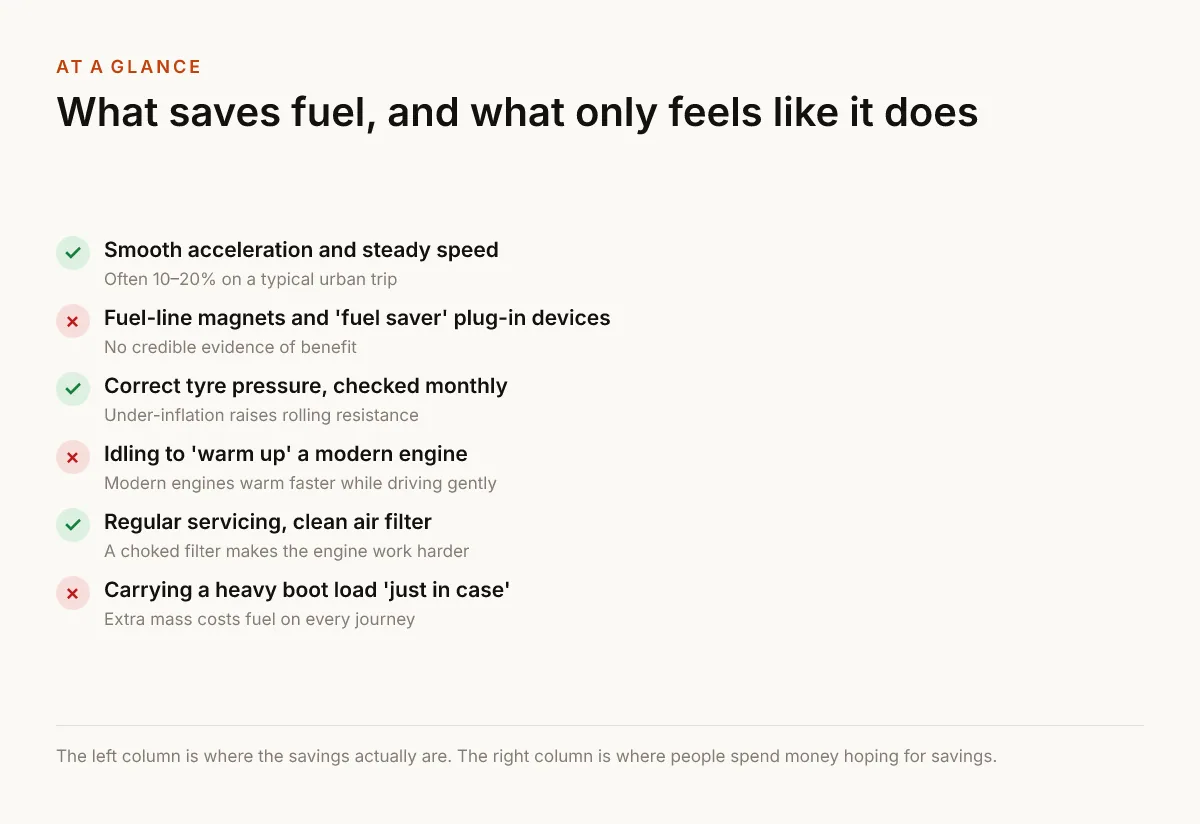
Key takeaways
- Steady driving at 50–80 km/h is far more efficient than fast acceleration and hard braking.
- Under-inflated tyres raise rolling resistance and quietly waste fuel every kilometre.
- A pressure cooker and a lid cut cooking fuel substantially, for free.
- Heating one occupied room beats heating a whole empty house.
- Switching to public transport, cycling or shared journeys removes the fuel use entirely.
I once spent a month logging every tank of fuel in a fifteen-year-old car, trying to work out where it was going. I had assumed the answer would be something mechanical. It was not. The single biggest change I made that month was learning to lift off the accelerator about a hundred metres earlier when approaching a red light. Same car, same route, roughly 12% less fuel.
That is the frustrating and useful truth about fuel conservation: the savings are mostly in habits, not in equipment.
#Start with why it matters
Two reasons, and they are independent of each other.
Fossil fuels run out. Coal, petroleum and natural gas formed over tens to hundreds of millions of years, and we are burning them in centuries. That is the whole meaning of exhaustible natural resources — the stock is fixed and the replacement rate is effectively zero.
Burning them causes damage now. Carbon dioxide driving climate change, sulphur dioxide and nitrogen oxides causing acid rain, particulates and carbon monoxide harming health — the standard list of disadvantages, all of which scale directly with how much you burn.
Conservation addresses both without waiting for anything to be invented.
#On the road: where most household fuel goes
#Drive smoothly
Every hard acceleration converts fuel into kinetic energy, and every hard braking throws that energy away as heat in the brake discs. Anticipating traffic — lifting off early, rolling towards a red light rather than rushing at it and stopping — recovers most of that waste. In city driving this alone is commonly worth 10–20%.
#Pick your speed
Aerodynamic drag rises with the square of speed, and the power needed to overcome it with the cube. Most cars sit in their efficient band somewhere around 50–80 km/h. Pushing from 90 to 110 km/h typically costs 15–20% more fuel for a small time saving.
#Check tyre pressures monthly
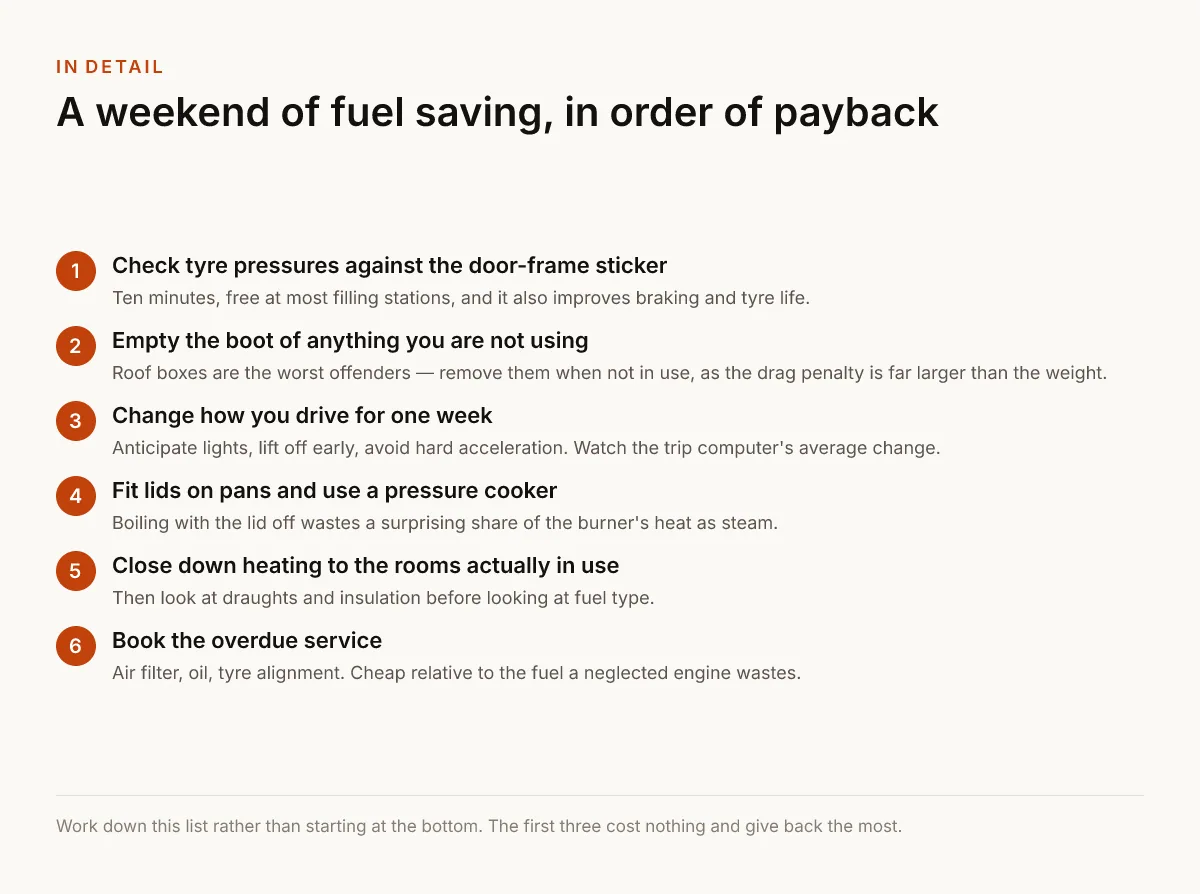
Under-inflated tyres deform more as they roll, and that deformation is energy leaving your fuel tank. It takes ten minutes, costs nothing, and improves braking and tyre life at the same time. Use the figure on the door frame, not the one moulded on the tyre wall — that is a maximum, not a recommendation.
#Stop idling
A stationary engine achieves zero kilometres per litre. Modern engines do not need to idle to warm up; they warm faster and more evenly when driven gently. If you are stopped for more than a minute and it is safe, switch off.
#Carry less, and take the roof box off
Mass costs fuel every time you accelerate. Roof boxes and racks are worse than their weight suggests, because they wreck the airflow — the drag penalty on a motorway can be 10–20%, and it applies whether the box is full or empty.
#Service it
An air filter choked with dust makes the engine work harder for the same air. Worn plugs, old oil, misaligned wheels and dragging brakes all quietly cost fuel. A service is cheap next to a year of a neglected engine.
#Combine trips, and consider not driving
A cold engine is markedly less efficient for the first few kilometres, so three separate short trips burn far more than one combined trip of the same total distance. And for short journeys, walking, cycling, sharing a car or taking a bus removes the fuel use rather than reducing it.
#At home: cooking and heating
Use a lid. Boiling with the lid off pours heat into the room as steam. It is the cheapest efficiency measure in any kitchen.
Use a pressure cooker for anything that takes a long time — pulses, rice, meat. Higher pressure means a higher boiling point, which means shorter cooking, which means less fuel.
Match the pan to the burner. A flame licking up the sides of a small pan is heating the kitchen, not the food.
Soak pulses beforehand, and take food out of the fridge before cooking. Both cut the time on the flame.
Heat rooms, not houses. If one room is occupied, heating that room is dramatically cheaper than heating everything. This is the strongest argument for portable heaters — not their fuel cost, which is mid-table at best, but their ability to heat only where you are.
Fix the draughts first. Heat leaving through gaps around doors, unlagged pipes and an uninsulated loft costs more than any fuel choice will save. Insulation is the one intervention that keeps paying every winter without you thinking about it.
Switch cleaner where you can. Moving from wood or dung to LPG or biogas cuts fuel quantity dramatically because the calorific value is so much higher — and it takes the smoke out of the kitchen, which is the larger benefit.
#The alternatives worth building towards
- Solar water heating — often the fastest payback of any home energy measure in a sunny climate
- Rooftop solar PV — displaces grid electricity, much of which is still generated by burning fuel
- Biogas — turns waste into cooking gas and fertiliser where there is a steady feedstock
- Electric vehicles — no tailpipe emissions, and they get cleaner as the grid does
- Public transport and cycling infrastructure — the largest fuel savings are usually structural rather than individual
#One honest caution
Be sceptical of anything sold as a fuel-saving device. Magnets on fuel lines, vortex inserts, plug-in modules and most economy additives have been tested repeatedly and independently, and they do not deliver. If a device worked as claimed, manufacturers competing hard on published fuel economy figures would already have fitted it.
The things that work are dull, mostly free, and entirely within your control. That is genuinely good news — it means you do not have to buy anything to start.
#The compact answer
Ways to save fuel: drive at a steady moderate speed and avoid sudden acceleration and braking; keep tyres correctly inflated and the vehicle regularly serviced; switch off the engine instead of idling; share journeys and use public transport, cycling or walking for short trips; use pressure cookers, lids and efficient stoves; heat only the rooms in use and insulate against draughts; and shift towards renewable alternatives such as solar, biogas and electric transport.
Frequently asked questions
Suggest some alternative ways to save fuel resources.
Drive at a steady moderate speed and avoid sharp acceleration and braking; keep tyres correctly inflated and the vehicle serviced; share journeys, use public transport, cycle or walk for short trips; switch off engines rather than idling; use pressure cookers, lids and efficient stoves when cooking; heat only occupied rooms and insulate against draughts; and shift where possible to renewable alternatives such as solar water heating, biogas and electric vehicles charged from clean power.
Why should people look for alternative sources of fossil fuel?
Because fossil fuels are exhaustible: they formed over millions of years and are being consumed far faster than they can ever re-form, so supplies will eventually be depleted. Burning them also releases carbon dioxide, sulphur dioxide, nitrogen oxides and particulates, causing climate change, acid rain and health damage. Alternatives such as solar, wind, hydro and biogas are renewable and far less polluting.
Does driving slower always save fuel?
Up to a point. Most cars are most efficient somewhere around 50–80 km/h. Below that, the engine runs inefficiently for the distance covered; above it, aerodynamic drag rises with the square of speed, so fuel use climbs steeply. Driving at 110 km/h instead of 90 km/h can raise consumption by roughly 15–20%.
Do fuel-saving devices work?
Almost never. Magnets, vortex generators, plug-in 'chips' and fuel additives sold as economy boosters have repeatedly failed independent testing. The things that genuinely work are unglamorous and mostly free: tyre pressure, smooth driving, reduced load, and regular servicing.
Sources
Every figure above traces back to one of these. If you find one that does not, tell us and we will fix it.
- [1]Fuel economy and driving behaviour — U.S. Department of Energy, Alternative Fuels Data CenterFuel property and energy content data underlying the efficiency comparisons.
- [2]Household air pollution and health — World Health OrganizationEvidence on the health benefits of moving away from solid fuel cooking.
- [3]Fossil fuels — International Energy AgencyContext on global fossil fuel demand and why conservation matters at scale.
Written by
Dana Kerr — Editor — heating, stoves and indoor air
Twelve winters spent testing heaters in cold, draughty buildings, and a slightly obsessive interest in what a flame is actually doing.
- EPA 608 certified
- Former HVAC service writer
- 12 years covering domestic heating