Which Fuel Is Used in Aeroplanes? Aviation Turbine Fuel Explained
Jets burn aviation turbine fuel, a kerosene grade sold as Jet A-1. Small piston aircraft use avgas. Here is why kerosene beats petrol.
Key takeaways
- Jet aircraft: aviation turbine fuel (ATF/Jet A-1), a kerosene grade.
- Piston aircraft: avgas 100LL, a high-octane petrol.
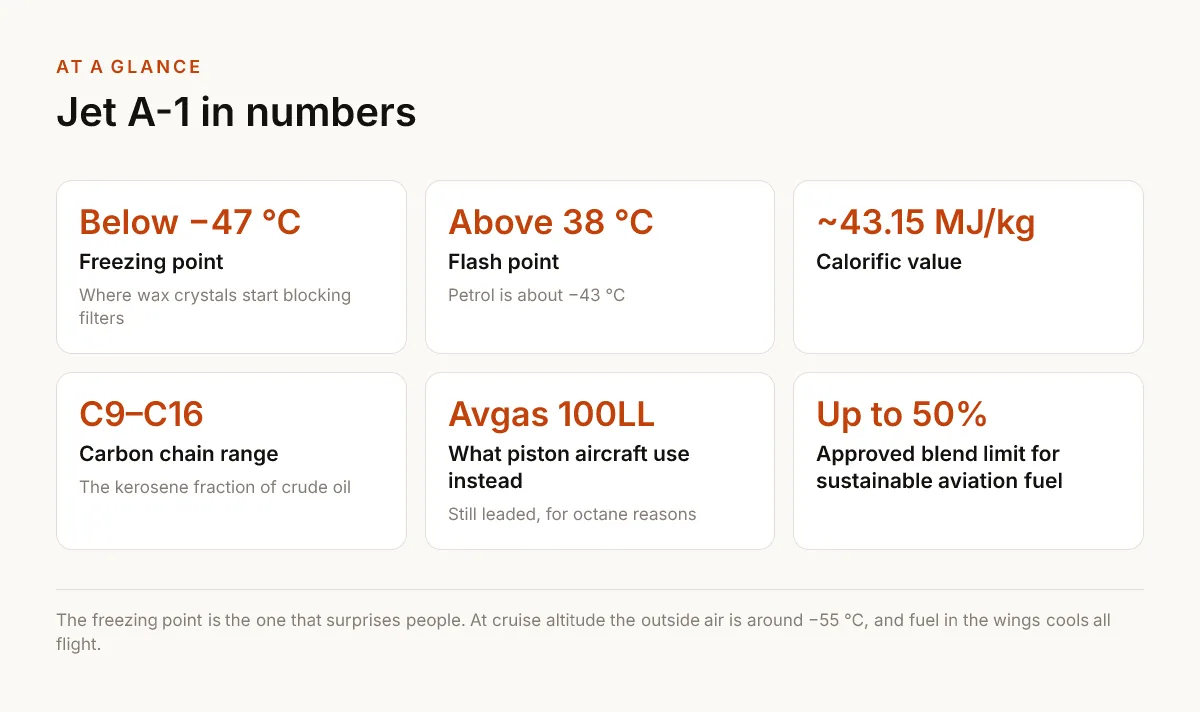
- Jet A-1 freezes below about −47 °C, essential at cruise altitude.
- Kerosene is safer than petrol because its flash point is far higher.
- Additives handle icing, static discharge, corrosion and microbial growth.
Commercial aviation runs on kerosene — chemically the same fraction of crude oil that goes into a hurricane lamp, just specified to within an inch of its life and loaded with additives.
People are often surprised by this, because the intuition is that something as demanding as a jet engine must burn something more exotic than lamp oil. The opposite is true, and the reasons are worth knowing, because they are mostly about safety rather than performance.
#The two fuels of aviation
| Aircraft type | Fuel | Description |
|---|---|---|
| Jets and turboprops | Jet A-1 / ATF | Kerosene, C₉–C₁₆ |
| Piston-engined light aircraft | Avgas 100LL | High-octane petrol |
The dividing line is engine type, not aircraft size. A turboprop trainer burns jet fuel; a piston twin burns avgas.
Avgas 100LL is the last widely used fuel still containing tetraethyl lead, retained because high-compression aircraft piston engines need the octane and a certified drop-in replacement has been slow to arrive.
#What aviation turbine fuel is
ATF is a kerosene fraction, distilled between roughly 150 °C and 250 °C, then refined and additised to a specification far stricter than domestic kerosene.
| Property | Typical Jet A-1 value |
|---|---|
| Freezing point | Below −47 °C |
| Flash point | Above 38 °C |
| Density at 15 °C | 0.775–0.840 kg/L |
| Calorific value | ~43.15 MJ/kg |
| Sulphur | Below 0.3%, usually far less |
Regional variants:
- Jet A-1 — the international standard, freezing below −47 °C
- Jet A — mainly US domestic, freezing below −40 °C
- Jet B — a wide-cut blend for extreme cold, rarely used because of its volatility
- JP-8 / JP-5 — military equivalents, JP-5 with a higher flash point for aircraft carriers
#Why kerosene rather than petrol
#Safety
Flash point is the deciding property:
| Fuel | Flash point |
|---|---|
| Avgas / petrol | ~−43 °C |
| Jet A-1 | ~38 °C |
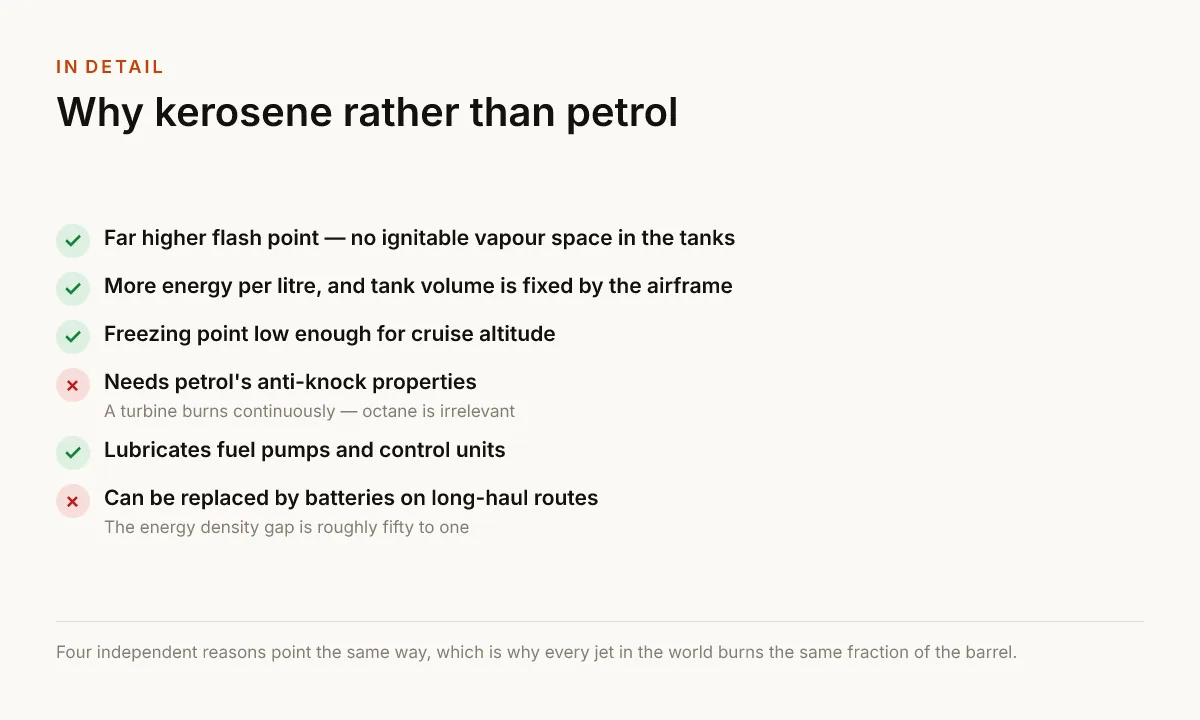
Petrol produces ignitable vapour at any ordinary temperature, so a tank of it always has a flammable vapour space above the liquid. Kerosene does not at normal conditions. In an aircraft carrying tonnes of fuel in wing tanks, that difference is decisive — it is why a survivable accident often stays survivable.
#Energy per litre
Aircraft tank volume is fixed by the airframe, so energy per litre matters more than energy per kilogram in tank sizing. Kerosene is denser than petrol and delivers roughly 5% more energy per litre.
#Low-temperature behaviour
At cruising altitude the outside air is around −55 °C, and fuel in the wings cools steadily on long flights. Jet A-1's freezing point below −47 °C keeps it flowing. Freezing point in this context means the temperature at which wax crystals begin to form and block filters, not the temperature at which the whole tank solidifies.
#Lubricity
Jet fuel lubricates the fuel pumps and control units it passes through. Petrol is a poorer lubricant, and severe hydrotreating that removes sulphur also removes lubricity — which is why lubricity improvers are added.
#Turbine tolerance
A gas turbine burns fuel continuously in a combustor rather than in timed cylinder explosions, so it does not need petrol's anti-knock properties. It needs clean, steady, high-energy combustion, which kerosene provides.
#The additives
Jet fuel is not simply distilled kerosene:
- Anti-icing (FSII) — prevents dissolved water freezing into ice crystals that block filters
- Static dissipator — prevents dangerous static charge build-up during high-rate fuelling
- Antioxidants — prevent gum formation during storage
- Metal deactivators — suppress catalytic degradation by trace metals
- Corrosion inhibitors / lubricity improvers
- Biocides — control microbial growth at the fuel–water interface in tank bottoms
That last one is a real operational issue: microbes living in water settled at the bottom of a tank produce sludge that blocks filters and corrodes tank structure.
#In India specifically
ATF at Indian airports is supplied mainly by Indian Oil, Bharat Petroleum and Hindustan Petroleum, refined domestically to Jet A-1 specification. ATF is a significant cost item for Indian carriers, partly because of the tax treatment applied to it, and fuel typically represents around a third of an airline's operating cost.
#Sustainable aviation fuel
SAF is chemically similar to conventional jet fuel but made from used cooking oil, animal fats, agricultural residues, or synthesised from hydrogen and captured carbon dioxide. It is certified for blending, currently up to 50% in most approved pathways, and burns in existing engines with no modification.
It is the main decarbonisation route available to aviation, because batteries are far too heavy for long-haul flight — the energy density gap is roughly fifty to one — and hydrogen would require entirely new airframes.
For what kerosene actually is and where it sits in the barrel, see is kerosene a fossil fuel. The propellant question for spaceflight is a different problem entirely — see rocket fuel explained.
#The compact answer
Aeroplanes with jet engines use aviation turbine fuel (ATF), a highly refined kerosene sold to the Jet A-1 specification. It is preferred over petrol because it is far less volatile and therefore safer, has a higher energy content per litre, and has a very low freezing point suited to high altitudes. Small piston-engined aircraft use aviation gasoline (avgas) instead.
Frequently asked questions
Which fuel is used in aeroplanes in India?
Aviation turbine fuel, commonly called ATF, which is a highly refined kerosene meeting the Jet A-1 specification. It is supplied at Indian airports by Indian Oil, Bharat Petroleum and Hindustan Petroleum. Small piston-engined aircraft and trainers use aviation gasoline, avgas 100LL, instead.
Why do jet aeroplanes use kerosene and not petrol?
Because kerosene is much less volatile. Its flash point is around 38 °C against about −43 °C for petrol, so it is far safer to handle and store, and it does not vapourise dangerously in tanks at altitude. It also carries more energy per litre, has a low freezing point, and lubricates the fuel system better.
What is the difference between Jet A-1 and Jet A?
Mainly the freezing point. Jet A-1 freezes below about −47 °C and is the international standard used almost everywhere. Jet A freezes below about −40 °C and is used chiefly in the United States. Jet A-1 also normally contains a static dissipator additive as standard.
What fuel did Chandrayaan and rockets use — is it the same?
No. Rockets need to carry their own oxidiser, since there is no air in space. Some launch vehicles do use a refined kerosene called RP-1 with liquid oxygen, but Indian launchers such as LVM3 use solid propellant boosters, hypergolic liquid stages, and a cryogenic upper stage burning liquid hydrogen with liquid oxygen.
Sources
Every figure above traces back to one of these. If you find one that does not, tell us and we will fix it.
- [1]Aviation — International Energy AgencyContext on aviation fuel demand and sustainable aviation fuel.
- [2]Fuel properties comparison — U.S. Department of Energy, Alternative Fuels Data Center
Written by
Marcus Hale — Contributing gas engineer
Working Gas Safe engineer. Services flued and flueless appliances all week and fact-checks everything on this site that involves a gas pipe.
- Gas Safe registered (UK)
- 15 years in the field
- CCN1, CENWAT, HTR1 assessed