A Liquid Fuel Used in Homes Is Kerosene
Kerosene is the liquid fuel used in homes, in wick stoves, lamps and heaters. Here is why it suits domestic use where petrol never could.
Key takeaways
- Kerosene is the standard answer: a liquid fuel used in homes for lamps, stoves and heaters.
- LPG is a common domestic fuel but is a gas liquefied under pressure, not a liquid fuel at ordinary conditions.
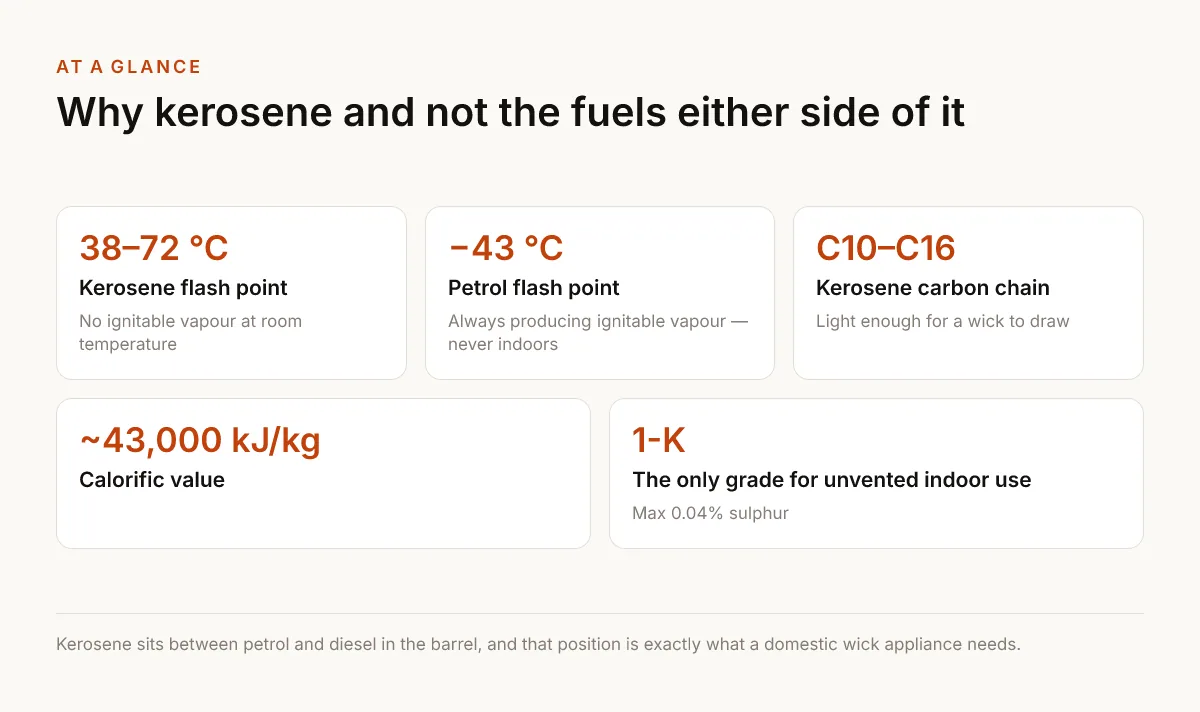
- Kerosene's flash point of roughly 38–72 °C makes room-temperature storage practical.
- Petrol's flash point of about −43 °C makes it unsuitable and dangerous indoors.
- Kerosene has a calorific value of about 43,000 kJ/kg.
The expected answer is kerosene, and it is worth knowing why rather than just remembering it — because the reason is the same reason you must never put petrol in a kerosene heater.
It comes down to one property that most people have never heard of, and it is not calorific value.
#Why kerosene and not something else
Domestic use imposes conditions that eliminate most liquid fuels immediately:
- The fuel must be safe to store in a home at room temperature.
- It must burn steadily and controllably, not explosively.
- It must work in simple appliances without pumps, pressurisation or electronics.
- It must be affordable and widely available.
Kerosene satisfies all four. The decisive property is its flash point.
#Flash point: the property that decides it
Flash point is the lowest temperature at which a liquid gives off enough vapour to form an ignitable mixture with air. What burns is always the vapour, never the liquid itself.
| Fuel | Flash point | Safe to store at room temperature? |
|---|---|---|
| Petrol | ~−43 °C | No — always producing ignitable vapour |
| Kerosene | ~38–72 °C | Yes |
| Diesel | ~52–96 °C | Yes, but too viscous for wicks |
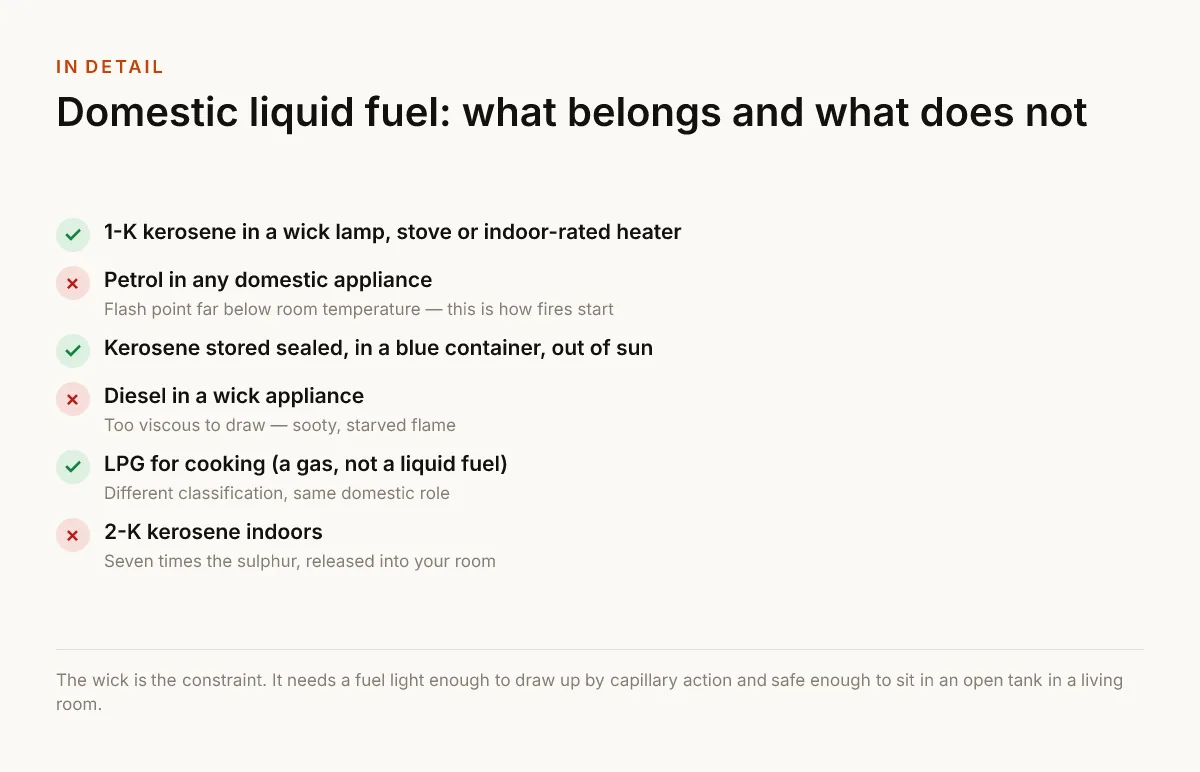
Petrol in an open container at 20 °C has an ignitable vapour layer above it continuously. Any spark reaches a ready fuel–air mixture. That is why petrol is stored outdoors in sealed containers and never used in domestic appliances.
Kerosene at 20 °C does not produce enough vapour to ignite from a spark. It must be heated first — which is precisely what a wick does, heating a tiny quantity at the flame while the bulk in the tank stays cool and inert.
This is also why putting petrol into a kerosene heater is a fire rather than a fuelling error. The appliance is engineered around a fuel that stays inert at room temperature.
#Why not diesel
Diesel has an even higher flash point, so on safety alone it would seem better. It fails on physics instead: diesel is heavier and more viscous, so a wick cannot draw it up by capillary action at a useful rate. The result is a starved, sooty, weak flame and rapid carbon build-up on the wick.
Wick appliances are matched to a specific viscosity range, and kerosene sits inside it.
#Where kerosene comes from
Kerosene is a petroleum fraction, separated by fractional distillation:
| Fraction | Boiling range | Carbon chain |
|---|---|---|
| LPG | Below 25 °C | C1–C4 |
| Petrol | 40–150 °C | C5–C10 |
| Kerosene | 150–250 °C | C10–C16 |
| Diesel | 250–350 °C | C15–C20 |
Sitting between petrol and diesel gives kerosene exactly the balance domestic appliances need: light enough to wick, heavy enough to store safely.
#Domestic uses
Lighting. Hurricane and pressure lamps — for a century the standard household light source in unelectrified areas, and still a common backup.
Cooking. Wick stoves and pressure stoves, widely used where LPG supply is unreliable or unaffordable.
Space heating. Portable radiant and convection heaters. Only heaters explicitly rated for indoor use belong inside, with ventilation and a carbon monoxide alarm — forced-air "torpedo" heaters that burn the same fuel are outdoor equipment.
Grade matters for indoor use: 1-K kerosene limits sulphur to 0.04% by weight, whereas 2-K permits up to 0.30%. Burning 2-K in an unvented indoor appliance releases sulphur dioxide into the room.
#Kerosene against other domestic fuels
| Fuel | State | Calorific value (kJ/kg) | Notes |
|---|---|---|---|
| LPG | Gas (liquefied under pressure) | ~55,000 | Cleanest, needs cylinder |
| Kerosene | Liquid | ~43,000 | Wick appliances, stores easily |
| Natural gas | Gas | ~55,000 | Needs pipeline connection |
| Charcoal | Solid | ~30,000 | Never indoors — severe CO risk |
| Wood | Solid | ~17,000–22,000 | Smoky, low calorific value |
| Cow dung | Solid | ~6,000–8,000 | Very smoky, very low value |
#The LPG ambiguity
Some question sets treat LPG as the domestic liquid fuel because it is stored as a liquid in the cylinder. Standard classification does not: LPG is a gaseous fuel liquefied under pressure for storage, and it arrives at the burner as a gas. Kerosene is a liquid at ordinary temperature and pressure and is burned as a liquid drawn up a wick.
If a question offers both, kerosene is the liquid fuel and LPG is the gaseous one.
If you use one of these appliances, the two guides that matter are kerosene grades, 1-K vs 2-K and are kerosene heaters safe indoors.
#The compact answer
A liquid fuel used in homes is kerosene. It is obtained from petroleum by fractional distillation and is used in lamps, wick stoves and portable heaters. Its calorific value is about 43,000 kJ/kg, and its relatively high flash point makes it safe to store and use in the home, unlike petrol.
Frequently asked questions
A liquid fuel used in homes is ___?
Kerosene. It is used in domestic wick stoves, hurricane lamps and portable space heaters. It is obtained from petroleum by fractional distillation between about 150 °C and 250 °C.
Is LPG a liquid fuel?
LPG is stored as a liquid under pressure but is a gas at ordinary temperature and atmospheric pressure, and it is delivered to the burner as a gas. In classification questions the liquid domestic fuel is kerosene, while LPG is listed as the gaseous domestic fuel.
Why is petrol not used as a household fuel?
Because its flash point is about −43 °C, meaning it releases ignitable vapour at any normal room temperature. A spark near an open container can ignite the vapour above the liquid. Kerosene's much higher flash point means it does not form an ignitable vapour cloud at room temperature, which is what makes domestic wick appliances possible.
What is kerosene used for in homes?
Lighting in wick and pressure lamps, cooking on wick and pressure stoves, and space heating in portable radiant and convection heaters. Its use has declined where LPG, piped natural gas and reliable electricity are available, but it remains important where those are not.
Sources
Every figure above traces back to one of these. If you find one that does not, tell us and we will fix it.
- [1]Oil and petroleum products explained — U.S. Energy Information Administration
- [2]Fuel properties comparison — U.S. Department of Energy, Alternative Fuels Data Center
Written by
Dana Kerr — Editor — heating, stoves and indoor air
Twelve winters spent testing heaters in cold, draughty buildings, and a slightly obsessive interest in what a flame is actually doing.
- EPA 608 certified
- Former HVAC service writer
- 12 years covering domestic heating