Fuel Cells: How They Convert Chemical Energy Directly Into Electricity
A fuel cell converts the chemical energy of a fuel directly into electrical energy without combustion, escaping the Carnot limit that caps heat engines.
Key takeaways
- Fuel cells convert chemical energy directly into electrical energy — no combustion, no moving parts.
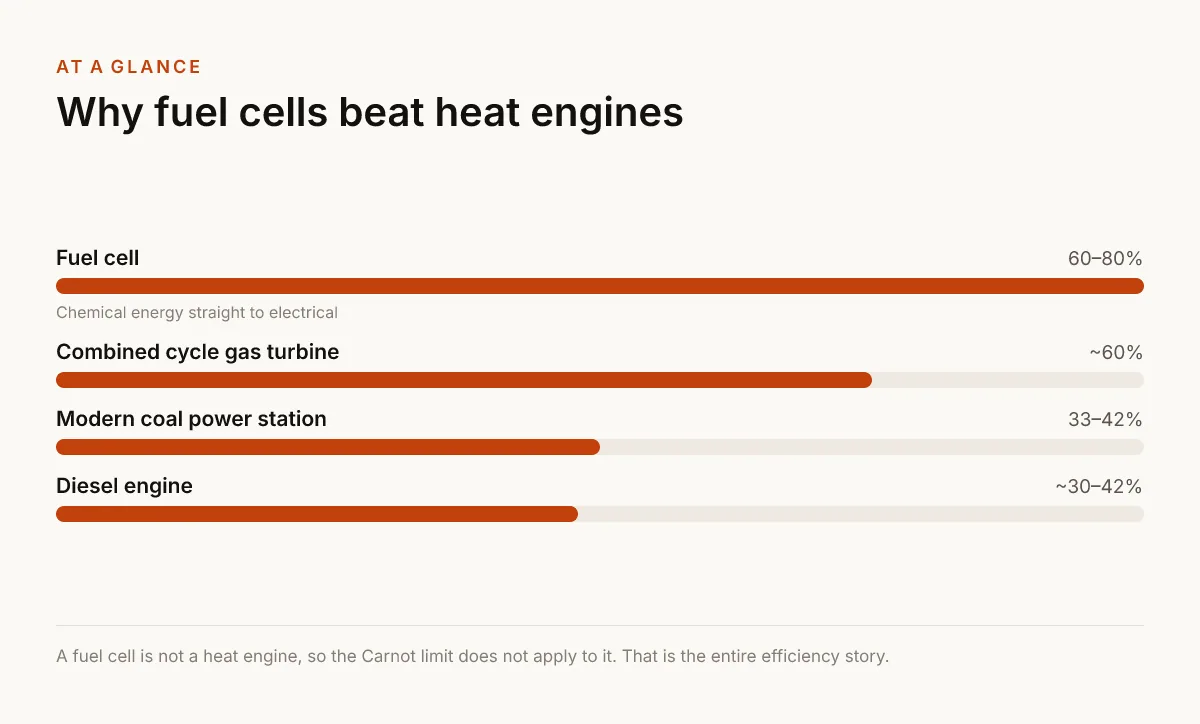
- Not being heat engines, they are not bound by the Carnot limit; 60–80% efficiency is achievable.
- The H₂–O₂ fuel cell uses aqueous potassium hydroxide (KOH) as electrolyte.
- The only product of a hydrogen fuel cell is water; hydrazine and methanol cells are also used.
- Drawbacks: high cost, catalyst poisoning, and dependence on hydrogen supply and storage.
Almost every way we make electricity is a variation on the same clumsy sequence: burn something, boil water, spin a turbine. Three conversions, each with losses, and a hard ceiling on efficiency set by thermodynamics.
A fuel cell skips all of it. Fuel goes in, electricity comes out, no flame involved. That is why it can reach efficiencies a power station cannot — and why it is worth understanding even though it is not yet in most people's lives.
#The definition
A fuel cell is an electrochemical device that converts the chemical energy of a fuel directly into electrical energy, as long as fuel and oxidant are supplied.
The distinction from a battery matters. A battery stores a fixed quantity of reactants inside itself and is exhausted when they are consumed. A fuel cell holds no fuel — it is a converter, running continuously while fuel flows in and products flow out.
#The hydrogen–oxygen fuel cell
The classic type, developed for the Apollo programme and still the standard textbook example.
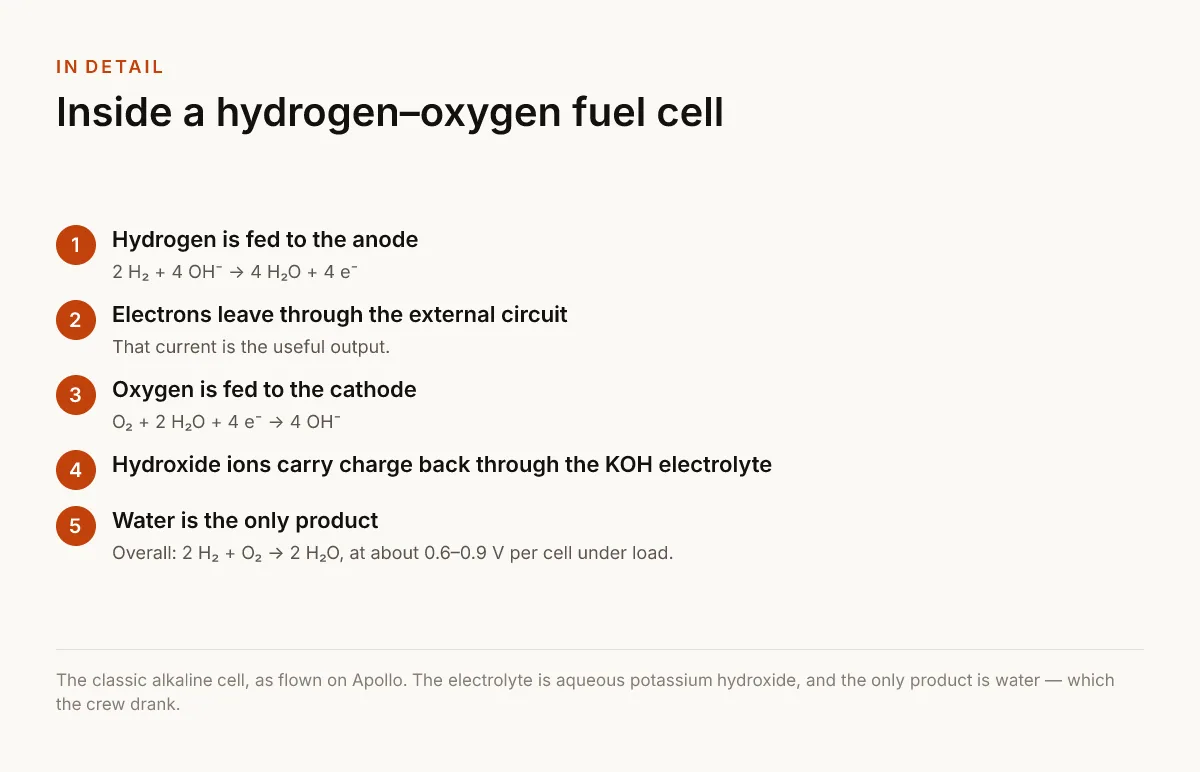
Construction. Two porous carbon or nickel electrodes impregnated with a catalyst — typically platinum or palladium — separated by an electrolyte of concentrated aqueous potassium hydroxide (KOH). Hydrogen is supplied to the anode, oxygen to the cathode.
At the anode (oxidation):
2 H2 + 4 OH- -> 4 H2O + 4 e-
At the cathode (reduction):
O2 + 2 H2O + 4 e- -> 4 OH-
Overall:
2 H2 + O2 -> 2 H2O
Electrons released at the anode travel through the external circuit — the electric current — and return at the cathode. Hydroxide ions carry charge back through the electrolyte.
The only product is water. On spacecraft, that water is drinkable and was used as such.
Theoretical cell voltage is about 1.23 V; practical cells deliver 0.6–0.9 V under load, so they are stacked in series to reach useful voltages.
#Why efficiency is so high
A conventional power station makes electricity in three lossy steps:
chemical energy -> heat -> mechanical energy -> electrical energy
The middle conversion is limited by the Carnot efficiency, which depends on the temperature difference available. Real thermal power stations achieve roughly 35–45%.
A fuel cell skips the heat and mechanical stages entirely:
chemical energy -> electrical energy
Not being a heat engine, it is not bound by the Carnot limit. Practical efficiencies of 60–80% are achievable, and higher still in combined heat and power configurations that use the waste heat.
#Types of fuel cell
| Type | Electrolyte | Temperature | Typical use |
|---|---|---|---|
| Alkaline (AFC) | KOH solution | 60–90 °C | Spacecraft |
| Proton exchange membrane (PEMFC) | Solid polymer | 50–100 °C | Vehicles, portable |
| Phosphoric acid (PAFC) | Phosphoric acid | 150–200 °C | Stationary power |
| Molten carbonate (MCFC) | Molten carbonate salts | 600–700 °C | Large stationary |
| Solid oxide (SOFC) | Ceramic oxide | 700–1,000 °C | Stationary, CHP |
| Direct methanol (DMFC) | Polymer membrane | 50–120 °C | Small portable |
Alkaline cells are the most efficient but are poisoned by carbon dioxide, which reacts with the KOH — one reason they suit spacecraft, with pure oxygen supplies, better than terrestrial use with ordinary air.
#Other fuels
Hydrazine (N₂H₄). Reacts with oxygen to give nitrogen and water. It is a liquid, avoiding hydrogen storage problems, and offers a high theoretical voltage — but it is highly toxic and unstable, so it stays in specialised and military applications.
Methanol. Fed directly as a liquid in direct methanol fuel cells. Easy to handle, but lower power density and it produces carbon dioxide.
Natural gas. Reformed internally to hydrogen in high-temperature solid oxide cells, which is how stationary fuel cell generators typically run.
#Merits
- High efficiency, 60–80%, roughly double a thermal power station
- No combustion, so no smoke, soot, particulates or nitrogen oxides
- Water as the only product for hydrogen cells
- Silent, with no moving parts in the cell itself
- Little maintenance for the same reason
- Modular — stack more cells for more power, with no efficiency penalty at small scale
- Continuous operation while fuel is supplied, unlike a battery
#Demerits
- High cost, largely from platinum-group catalysts
- Hydrogen supply, which must be manufactured, compressed or liquefied, and distributed
- Catalyst poisoning by carbon monoxide and sulphur impurities, requiring very pure fuel
- Limited operating life as membranes and catalysts degrade
- Water management — too little dries the membrane, too much floods the electrodes
- Slow start-up for high-temperature types
#Where they are used
Apollo and Space Shuttle power systems; fuel cell buses, trucks and forklifts; stationary backup power for hospitals and data centres; combined heat and power units for buildings; submarines, where air-independent operation is the point.
The pattern is consistent: fuel cells win where efficiency, silence and zero local emissions justify the cost, and lose wherever a cheap engine or a battery will do.
The fuel it works best with brings its own difficulties — see why hydrogen is not widely used — and the limit fuel cells escape is the one that caps thermal power stations.
#The compact answer
In a fuel cell, the chemical energy of the fuel is converted directly into electrical energy by an electrochemical reaction, without combustion. In the hydrogen–oxygen fuel cell, hydrogen is oxidised at the anode and oxygen reduced at the cathode in an electrolyte of aqueous potassium hydroxide, producing water as the only product. Because it is not a heat engine, its efficiency is not limited by the Carnot cycle and can reach 60–80%.
Frequently asked questions
In a fuel cell, energy is converted into which form?
The chemical energy of the fuel is converted directly into electrical energy. Unlike a conventional power station, which converts chemical energy into heat, heat into mechanical energy and mechanical energy into electricity, a fuel cell performs a single direct electrochemical conversion.
What is the electrolyte used in an H₂–O₂ fuel cell?
Aqueous potassium hydroxide (KOH), a concentrated alkaline solution, in the classic alkaline hydrogen–oxygen fuel cell. Other types use different electrolytes: proton exchange membrane cells use a solid polymer membrane, phosphoric acid cells use phosphoric acid, and solid oxide cells use a ceramic oxide.
What are the merits and demerits of fuel cells?
Merits: high efficiency of 60–80%, no combustion so no smoke or noise, no moving parts so little maintenance, and water as the only product for a hydrogen cell. Demerits: high cost from platinum catalysts, dependence on a hydrogen supply that is difficult to store and distribute, catalyst poisoning by impurities such as carbon monoxide, and limited operating life.
Can hydrazine be used in a fuel cell?
Yes. Hydrazine (N₂H₄) can be used as the fuel in a direct hydrazine fuel cell, reacting with oxygen to produce nitrogen and water. It offers a high theoretical voltage and is a liquid, avoiding hydrogen storage problems, but hydrazine is highly toxic and unstable, which restricts it to specialised applications.
Sources
Every figure above traces back to one of these. If you find one that does not, tell us and we will fix it.
- [1]Fuel cells — U.S. Department of Energy, Office of Energy Efficiency and Renewable Energy
- [2]Hydrogen basics — U.S. Department of Energy, Alternative Fuels Data Center
Written by
Priya Raman — Energy science editor
Taught school science for eight years, then moved into writing about combustion and energy. Still explains things the way you would to a class.
- MSc Chemistry
- Eight years teaching physical science
- Science curriculum writer